
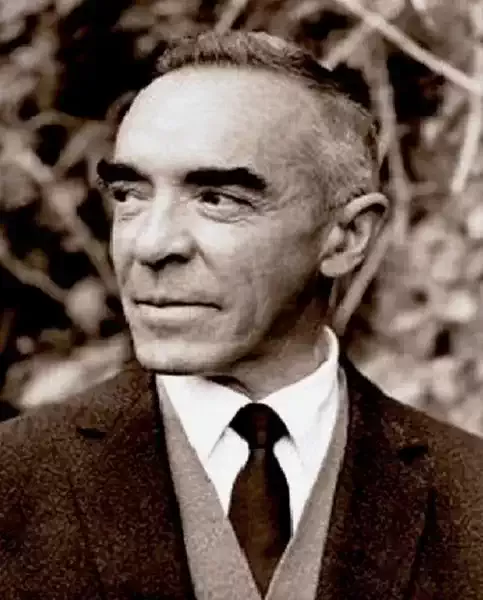
José Régio
1901–1969
· lived 68 years
 PT
PT
PT
José Régio was an influential Portuguese writer, professor, and essayist, a central figure in the Neorealist movement in Portugal. His work, which spans poetry, short stories, essays, and literary criticism, is notable for the psychological depth of its characters, social analysis, and exploration of themes such as morality, religion, the human condition, and social hypocrisy. With a rigorous style and a critical view of society, José Régio left a significant legacy in 20th-century Portuguese literature.
n. 1901-09-17, Vila do Conde · m. 1969-12-22, Vila do Conde
46
Views
Bio
Identification and Basic Context
José Maria dos Reis Pereira, better known by the literary pseudonym José Régio, was a prominent Portuguese writer, essayist, professor, and literary critic. He was born in Vila de Castelo de Paiva and died in Porto. He was one of the founders and main driving forces of the Portuguese Neorealist movement. His work reflects the social, ethical, and psychological concerns of his time, in a Portugal marked by profound transformations.Childhood and Education
José Régio was born into a traditional and conservative family. He completed his secondary studies in Coimbra and subsequently attended the University of Coimbra, where he graduated in Romance Philology in 1931. During his university education, he came into contact with various philosophical and literary currents that would influence his worldview and his written production.Literary Career
José Régio's literary career began with the publication of poetry, but it was with his work "Histórias Pessoais" (1941) that he gained notoriety as a short story writer. He founded and directed the important magazine "Presença" (1927-1940), along with Adolfo Casais Monteiro and Branquinho da Fonseca, a milestone in Portuguese literary renewal. Through this magazine, he promoted the "Neo-Realism" or "Novos Poetas" movement, later redefined as Neorealism.Work, Style, and Literary Characteristics
José Régio's work is characterized by a profound interest in the psychological analysis of his characters and in the critique of customs and social hypocrisy. His short stories, in particular, explore the complexity of the human soul, moral and existential conflicts, and the tensions between the individual and society. His style is marked by rigor, clarity, and precise language, which seeks objectivity in the description of situations and feelings. Recurring themes include religion, guilt, loneliness, sexual repression, and the contradictions of the bourgeoisie. Among his most important works are the short story collections "Histórias Pessoais," "O Caminho Recusado" (1935), "As Consequências" (1940), and "A Danação do Diabo" (1944), as well as essays and critical works.Work, Style, and Literary Characteristics
Cultural and Historical Context José Régio lived most of his adult life under the dictatorial regime of the Estado Novo in Portugal. This historical context, marked by censorship and political and cultural repression, influenced his critical view of society and the way he approached sensitive topics, often allegorically or indirectly. The magazine "Presença" was a space for resistance and affirmation of new aesthetic proposals in a period of cultural conservatism.Work, Style, and Literary Characteristics
Personal Life José Régio was a professor of Portuguese and French in high schools, dedicating much of his life to teaching. His personal journey was marked by a profound reflection on life, morality, and religion, themes that permeate his work. He maintained a strong sense of civic and intellectual duty, always seeking to transmit ethical and human values through his writing and teaching.Work, Style, and Literary Characteristics
Recognition and Reception José Régio gained recognition as one of the most important Portuguese writers of the 20th century, especially as a short story writer and theorist of Neorealism. His work has been studied and analyzed by literary critics, and his short stories are considered examples of excellence in Portuguese literature for their depth and their social and psychological relevance.Work, Style, and Literary Characteristics
Influences and Legacy José Régio was influenced by authors such as Miguel de Unamuno and by existentialist philosophical currents. His legacy lies in his ability to create narratives that explore the complexity of the human condition and in his contribution to the consolidation of Neorealism in Portugal. His work remains relevant for its attentive analysis of society and its concern with moral and existential dilemmas.Work, Style, and Literary Characteristics
Interpretation and Critical Analysis José Régio's work is often interpreted as a mirror of the tensions and contradictions of Portuguese society in his time. His deep psychological analysis and his critique of social hypocrisy make him an author of great relevance. Critics highlight his skill in constructing complex characters and in approaching difficult themes with sensitivity and rigor.Work, Style, and Literary Characteristics
Curiosities and Lesser-Known Aspects José Régio was known for his integrity and intellectual rigor. He was a dedicated teacher and an intellectual with a deep concern for human values. His connection to the magazine "Presença" was fundamental to the renewal of Portuguese literature, at a time when new aesthetic proposals faced resistance.Work, Style, and Literary Characteristics
Death and Memory José Régio died in Porto, leaving behind a vast and influential body of work. His memory is that of one of the great names of Portuguese Neorealism and an intellectual who dedicated his life to reflecting on the human condition and social criticism through literature.Poems
0No poems found
Comments (0)
Log in
to post a comment.
No comments yet. Be the first to comment.