
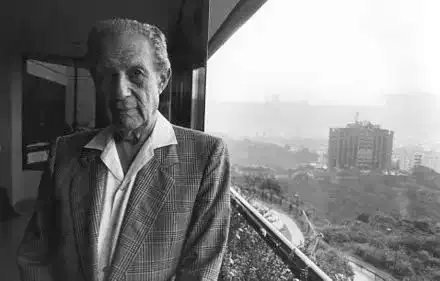
Juan Liscano
 --
--
Juan Liscano was a prominent Venezuelan poet, literary critic, and essayist. His poetic work is characterized by a profound reflection on existence, identity, and the human condition, often tinged with melancholy and a sharp perception of reality. Liscano explored diverse poetic forms, from free verse to more classical structures, always maintaining a singular voice and refined language. He was an influential figure in Venezuelan culture, not only for his literary production but also for his work as a cultural manager and critic, leaving an important legacy in 20th-century Hispanic American literature.
n. 1915-07-07, Caracas · m. 2001-02-17, Caracas
Bio
Identification and Basic Context
Juan Antonio Liscano Rivas, known as Juan Liscano, was born in La Guaira, Venezuela. He was a Venezuelan poet, literary critic, essayist, and cultural promoter. His family background and social class allowed him access to an education and an environment that fostered his literary vocation. He was a Venezuelan citizen and his writing language was Spanish. He lived through a large part of the 20th century, a period marked by significant political and social transformations in Venezuela and Latin America.Childhood and Education
Liscano's childhood and youth took place in a context that influenced his sensitivity and worldview. Although specific details of his self-taught education or initial influences are not widely disclosed, a deep connection with literary tradition and a constant search for knowledge are evident in his work. It is likely that his approach to literature and art came through formative readings and the assimilation of aesthetic and philosophical currents of his time.Literary Career
Juan Liscano's literary career developed over several decades, establishing him as an important voice in Venezuelan poetry. He began writing in his youth, evolving his style and themes over time. He actively participated in his country's cultural life, collaborating in various publications and anthologies, and also working as a literary critic and essayist, which demonstrates a comprehensive commitment to literature.Work, Style, and Literary Characteristics
Liscano's poetic work addresses universal themes such as love, death, time, memory, and identity, often from an introspective and existential perspective. His style is characterized by linguistic precision, imagistic density, and subtle musicality. He experimented with various poetic forms, demonstrating great versatility. The tone of his poetry can vary from lyrical and elegiac to reflective and philosophical. His work dialogues with literary tradition but also shows a clear connection with modernity and the aesthetic concerns of the 20th century. He was associated with currents of poetic renewal in Venezuela.Cultural and Historical Context
Juan Liscano lived in a constantly changing Venezuela, experiencing periods of dictatorship and democracy, as well as social and economic transformations. His work is situated within the Latin American cultural landscape, engaging with the concerns of his generation. As a public figure and critic, he was aware of the literary and artistic debates of his time. His position, though not always explicit in political terms, was manifested in his commitment to culture and expression.Personal Life
Details about Juan Liscano's personal life are less known than his literary work. However, his writings suggest a life dedicated to reflection and art. Affective relationships and life experiences, although not publicly detailed, undoubtedly shaped his poetic sensibility. His dedication to literature and criticism suggests a deep commitment to his vocation.Recognition and Reception
Juan Liscano is recognized as one of Venezuela's important poets. His work has been studied and appreciated by literary critics. Although specific awards and distinctions are not always the main focus of his biography, his place in contemporary Venezuelan literature is well established.Influences and Legacy
Liscano's work draws from the Hispanic American and universal poetic tradition, and in turn, has influenced later generations of Venezuelan poets. His legacy lies in the depth of his thought, the quality of his poetic language, and his contribution to the enrichment of his country's literature. His work continues to be studied and analyzed for its relevance and aesthetic quality.Interpretation and Critical Analysis
Juan Liscano's work invites diverse interpretations, focusing on his explorations of the human condition, the passage of time, and the search for meaning. His poems are a space for philosophical and existential reflection, and have been the subject of critical analysis that highlights his formal mastery and the depth of his themes.Childhood and Education
Lesser-known aspects of his personality or writing habits may not be widely documented. However, the dedication and rigor evident in his work suggest a methodical creative process and deep introspection.Death and Memory
Juan Liscano passed away in Caracas, Venezuela. His memory endures through his published work, which continues to be read and studied, securing his place in the history of Venezuelan literature.Poems
0No poems found
Comments (0)
No comments yet. Be the first to comment.