
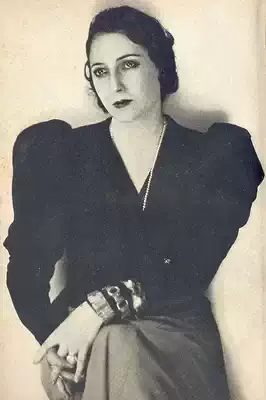
Juana de Ibarbourou
1892–1979
· lived 87 years
 UY
UY
UY
Juana de Ibarbourou, also known as Juana de América, was a Uruguayan poet of great renown, whose work is marked by a delicate lyricism and an accessible style. She explored themes such as love, nature, childhood, and the passage of time, with a language that combined sensuality and simplicity. Her poetry achieved great popularity, making her one of the most beloved voices in Latin American literature.
n. 1892-03-08, Melo · m. 1979-07-15, Montevidéu
48
Views
Bio
Identification and Basic Context
Juana de Ibarbourou (born Juana Juana Ramírez de Asnar) was a Uruguayan poet, widely known by the pseudonym Juana de América. She was born on March 8, 1892, in Melo, Cerro Largo, Uruguay, and died on July 15, 1979, at the Hospital Italiano in Montevideo, Uruguay. Originally from a middle-class family and immersed in a cultural context influenced by rural traditions and growing Uruguayan modernity, she wrote in Spanish. She lived through much of the 20th century, a period of intense social, political, and cultural transformations in Latin America.Childhood and Education
Juana de Ibarbourou was born into a family of Basque origin. Her childhood was spent in a rural environment, which would influence her sensitivity to nature. She received primary and secondary education, but was largely self-taught in her literary training. From an early age, she showed an interest in reading and writing, absorbing influences from European romantic and symbolist poetry, as well as emerging Hispano-American literature. Her youth was marked by keen sensitivity and literary precocity.Literary Career
Juana de Ibarbourou began writing in her adolescence. Her first book, "Las lenguas de diamante" (1918), was an immediate success, launching her to fame. Throughout her career, her work evolved, while maintaining a line of continuity in her lyrical expression. She subsequently published "Los cálices vacíos" (1920) and "La rosa de los vientos" (1930), among others. She actively collaborated in various literary magazines of her time, both in Uruguay and other Latin American countries, consolidating her presence in the literary circuit. She did not engage prominently in criticism or translation.Work, Style, and Literary Characteristics
Juana de Ibarbourou's main works include "Las lenguas de diamante" (1918), "Los cálices vacíos" (1920), and "La rosa de los vientos" (1930). The dominant themes in her poetry are love, nature, childhood, feminine beauty, the passage of time, and the ephemerality of life. Her style is characterized by clear, musical, and accessible language, with frequent use of metaphors and sensory imagery, often inspired by flora and fauna. The tone is predominantly lyrical, tender, and sometimes melancholic. Her poetic voice is confessional and intimate, yet capable of resonating universally. Ibarbourou did not focus on radical formal experimentation, preferring more traditional forms but with great mastery of rhythm and verse sonority. She is often associated with Hispano-American Modernism, although her poetry transcends rigid classifications, maintaining uniqueness and lasting popular appeal. Lesser-known works include "Ejemplares de mi obra" (1920) and "Canto a Uruguay" (1931).Work, Style, and Literary Characteristics
Cultural and Historical Context Juana de Ibarbourou flourished in the early 20th century, a period of great cultural effervescence in Latin America, known as the Hispano-American "Belle Époque." Her success coincided with a time when Latin American literature sought to assert its own identity, distancing itself from European models. Her poetry engaged with Modernism but maintained an originality that allowed her to reach a vast audience, transcending intellectual circles. Her public image, often idealized, reflected the search for a strong national and cultural identity in Uruguay.Work, Style, and Literary Characteristics
Personal Life In 1913, she married Captain Ricardo Ibarguren, with whom she had a son, Julio César. Her personal life was largely dedicated to poetry and her public projection. She maintained a careful image and a dignified demeanor, which earned her the epithet "Juana de América." Her personal relationships and life experiences, although not explicitly explored in detail in her works, seem to have informed her sensitivity to the themes of love and loss.Work, Style, and Literary Characteristics
Recognition and Reception Juana de Ibarbourou achieved remarkable public and institutional recognition during her lifetime. She was acclaimed as one of the greatest poets in Latin America, with "Juana de América" being a title attributed to her by her admirers and critics. She received various honors throughout her career. Her poetry enjoyed great popularity with the public, being widely read and recited, and consolidated her place in the Hispano-American literary canon.Work, Style, and Literary Characteristics
Influences and Legacy Juana de Ibarbourou was influenced by romantic, symbolist, and modernist poetry, both European and Latin American. Her lyrical, accessible, and imagistic style, in turn, influenced later generations of poets throughout Latin America, especially those seeking a clear and emotional poetic expression. Her legacy lies in the popularization of poetry and the consolidation of a strong and representative female voice in Hispano-American literature. Her work continues to be studied and admired for its formal beauty and the depth of its themes.Work, Style, and Literary Characteristics
Interpretation and Critical Analysis Ibarbourou's work is often analyzed from the perspective of her lyricism, the representation of nature and love, and her ability to evoke universal emotions. Critics highlight her skill in translating the beauty of the natural world and the complexity of human feelings into accessible and captivating poetic language. Interpretations focus on her female voice, her relationship with tradition, and her contribution to Latin American poetic identity.Work, Style, and Literary Characteristics
Curiosities and Lesser-Known Aspects A curious aspect of her life was the controversy surrounding the true authorship of some early poems, which were later confirmed as hers. Her carefully constructed public image sometimes overshadowed the depth of her poetic reflections. Her house in Montevideo became a place of pilgrimage for admirers.Work, Style, and Literary Characteristics
Death and Memory Juana de Ibarbourou died on July 15, 1979. Her death was widely mourned, and her memory is celebrated as one of the pillars of Uruguayan and Latin American poetry. Her work continues to be published and studied, remaining alive in culture and literature.Poems
0No poems found
Comments (0)
Log in
to post a comment.
No comments yet. Be the first to comment.