
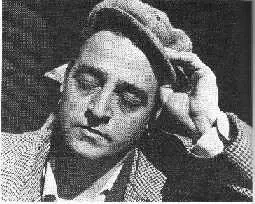
Kenneth Patchen
1911–1972
· lived 60 years
 US
US
US
Kenneth Patchen was an American poet and novelist, a prominent figure in beat poetry and one of the pioneers of spoken word poetry. Known for his experimental approach and strong social criticism, his work explores themes such as war, injustice, love, and spirituality. Patchen developed a unique style, combining visual poetry, performance, and direct, passionate language, making him an influential name for generations of artists.
n. 1911-12-13, Niles · m. 1972-01-08, Palo Alto
308
Views
Bio
Identification and basic context
Kenneth Patchen was born in Niles, Ohio, United States, on December 1, 1911. He passed away in Palo Alto, California, on November 8, 1972. He was an American poet, novelist, and artist.Childhood and education
He grew up in a working-class family and had access to public education. His youth was marked by experiences that shaped his worldview and social criticism.Literary career
Patchen began writing poetry in his adolescence. His work gained prominence in the 1940s and 1950s, associated with the beatnik movement, although he himself maintained an independent position. He was one of the first to explore poetic performance and visual poetry.Work, style, and literary characteristics
Patchen's works are characterized by intense and emotional language, with a strong social and political charge. Themes such as war, social injustice, love, freedom, and spirituality are recurrent. He experimented with form, including visual poetry, collages, and spoken word recordings. His style is direct, passionate, and at times disruptive. Notable works include "The Journal of Albion Moonlight", "The Famous Bozo", "Cloth of the Tempest", and "Love Poems".Cultural and historical context
Patchen lived in a period of great transformations in the United States, including the Great Depression, World War II, and the beginning of the Cold War. His work reflects a deep aversion to violence and oppression, positioning him as a dissident.Personal life
He suffered from chronic health problems, including a back injury that left him with intense pain throughout his life. His marriage to Miriam Patchen was a central relationship in his life and work. His experience with pain and personal resilience were important themes.Recognition and reception
Although he did not achieve mainstream fame during his lifetime, Patchen is widely recognized as an influential figure in 20th-century poetry, especially among beat poets and the subsequent generation. His work continues to be studied and celebrated for its originality and strength.Influences and legacy
He influenced many poets and artists with his experimental approach and his commitment to social justice. His exploration of spoken word and visual poetry opened new paths for poetic expression.Interpretation and critical analysis
Patchen's work is often interpreted as a cry against dehumanization and a passionate defense of individual freedom and compassion.Curiosities and lesser-known aspects
Patchen was also a visual artist, creating illustrations and collages for his books. His resistance to being classified within a specific movement demonstrates his individuality.Death and memory
He died in 1972, but his work continued to be published and to influence literature and art.Poems
0No poems found
Quotes
8No poems found
Comments (0)
Log in
to post a comment.
No comments yet. Be the first to comment.