
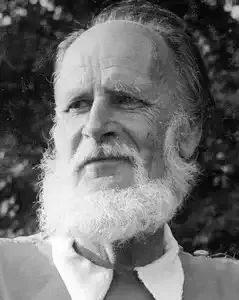
Lanza del Vasto
1901–1981
· lived 79 years
 IT
IT
IT
Lanza del Vasto, secular name of Jean-René, was an Italian poet, philosopher and activist, known for his philosophy of non-violence and his engagement in social and political causes. With a vast literary and essayistic work, Del Vasto explored themes such as spirituality, social justice and critique of industrial society, becoming an influential figure in the pacifist movement.
n. 1901-09-29, San Vito dei Normanni · m. 1981-01-05, Múrcia
21
Views
Bio
Identification and basic context
Lanza del Vasto, pseudonym of Jean-René, Lord of Lanza, was an Italian poet, philosopher, essayist and activist, born in San Giovanni Rotondo, Italy. He adopted the name Lanza del Vasto (meaning "vast spear") as a war and spiritual name. He was one of the pioneers of the non-violence movement in France and Europe, inspired by the figure of Mahatma Gandhi.Childhood and education
Jean-René was born into a humble family. His youth was marked by an intense spiritual quest and an attraction to mysticism and philosophy. He studied in Paris, where he came into contact with various currents of thought and artistic and literary movements, which shaped his worldview.Literary career
Lanza del Vasto's literary career began with the publication of poetry and philosophical essays. His best-known work, "Pèlerinage de la Terre" (Pilgrimage of the Earth), describes his journey on foot from France to India, following in Gandhi's footsteps, and became a landmark in pacifist literature. He also wrote about community life, agriculture and criticism of modern society.Work, style and literary characteristics
Lanza del Vasto's work is characterized by a deep spiritual sense and a strong critique of industrial civilization. His poetry is often philosophical and contemplative, exploring themes such as the search for truth, inner peace, man's relationship with nature, and criticism of violence and injustice. His style is erudite and poetic, marked by rich language and deep existential reflection. His most relevant works include "Pèlerinage de la Terre", "Le retour du héros" and "La ஏனெனில் du peuple". He was a defender of organic farming and a simpler, more sustainable way of life.Cultural and historical context
Lanza del Vasto lived during a period of great social and political upheaval in the 20th century, including two World Wars and the rise of decolonization movements. His philosophy of non-violence and his activism were a direct response to these events, inspired by Gandhi's teachings. He was a contemporary of figures such as Albert Einstein and Martin Luther King Jr., with whom he shared pacifist ideals.Personal life
Lanza del Vasto's personal life was dedicated to his mission of promoting non-violence and social justice. He founded the community "La Borie Noble" in France, an example of community living based on the principles of non-violence and self-sufficiency. His personal relationships were marked by his idealism and his commitment to others.Recognition and reception
Lanza del Vasto was internationally recognized as a leader of the pacifist movement and an original thinker. He received several awards and distinctions for his activism and his literary work. His influence extended to social and environmental movements worldwide.Influences and legacy
Lanza del Vasto was deeply influenced by the thought of Mahatma Gandhi, but also by Eastern and Western spiritual traditions. His legacy lies in his promotion of non-violence as a transformative force in society and his vision of an alternative to industrial civilization, based on simplicity, community, and respect for nature. He inspired generations of activists and thinkers.Critical interpretation and analysis
Lanza del Vasto's work has been interpreted as a profound reflection on the dilemmas of modernity and a proposal for a path to peace and harmony. His critique of technological society and his defense of a return to more human and spiritual values continue to be the subject of debate and study.Curiosities and lesser-known aspects
A curiosity about Lanza del Vasto is his connection with India, where he traveled on foot and where he developed much of his philosophy inspired by Gandhi. He was also an artist and musician, who used art as a form of expression and social intervention.Death and memory
Lanza del Vasto passed away in 1981. His memory is kept alive through his works, the communities he founded, and the continuing impact of his pacifist and philosophical legacy.Poems
0No poems found
Comments (0)
Log in
to post a comment.
No comments yet. Be the first to comment.