
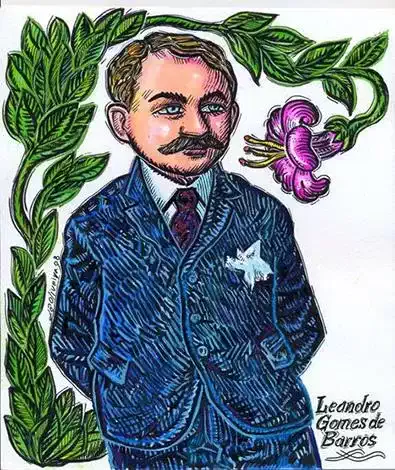
Leandro Gomes de Barros
 BR
BR
Leandro Gomes de Barros was a popular poet and Brazilian playwright, considered one of the greatest representatives of cordel literature. Born in the Paraíba sertão, his work is a vivid portrait of the life, customs, beliefs, and conflicts of the Northeastern people. With accessible language and an engaging narrative style, Barros addressed themes such as cangacismo, religiosity, social injustices, love, and bravery, using rhyming verse and popular meter to create stories that captivated and educated. His literary production is vast and diverse, encompassing novels, pamphlets, and plays, many of which have been adapted for other art forms. Leandro Gomes de Barros is an indispensable figure in Brazilian popular culture, whose legacy continues to influence and enchant generations.
n. 1865-11-19, Pombal · m. 1918-03-04, Recife
Bio
Identification and Basic Context
Leandro Gomes de Barros was one of the most influential popular poets and Brazilian playwrights, born in the sertão of Paraíba, in the Northeast of Brazil. He is widely recognized as one of the fathers of cordel literature in the country. His work reflects the social, cultural, and historical context of the Brazilian Northeast at the end of the 19th and beginning of the 20th centuries, a period marked by great transformations, social conflicts, and strong popular religiosity.Childhood and Education
Leandro Gomes de Barros was born in Ingá, Paraíba. His childhood and youth were marked by the simple and harsh life of the Northeastern sertão. His education was largely self-taught, acquiring knowledge through reading and careful observation of the world around him. Popular culture, orally transmitted stories, and religiosity were primary influences on his formation.Literary Career
Leandro Gomes de Barros's literary career began with writing verses for cordel pamphlets, which quickly gained popularity. His literary production was incredibly prolific, encompassing hundreds of works. He did not limit himself to cordel poetry, also writing novels, plays, and even a newspaper, 'O Araruna'. His activity as a writer was marked by intense production and distribution of his texts, which became accessible to a wide audience.Work, Style, and Literary Characteristics
Leandro Gomes de Barros's main works include "O Cachorro dos Mortos" (The Dog of the Dead), "O Pajeú", "O Filho do Pescador" (The Fisherman's Son), "A Chegada de Lampião no Inferno" (Lampião's Arrival in Hell), and "História de Severino de Aracaju" (The Story of Severino de Aracaju). The dominant themes in his work are cangacismo, life in the sertão, religiosity (with a strong element of critique and humor), social injustices, love, bravery, and cunning. His style is characterized by clear, direct, popular language, precise meter and rhyme, and engaging narrative, often blending the real and the fantastic. He used devices such as personification and allegory to convey his messages. His poetic voice is that of the people, representing their anxieties, dreams, and worldview.Cultural and Historical Context
Leandro Gomes de Barros lived in a time when the Brazilian Northeast was the stage for great social inequalities, migrations, and the rise of the cangacismo phenomenon. His work reflects these realities, serving as a mirror of the society of the time. He engaged with oral tradition and other cordel writers but innovated by introducing elements of social criticism and refined humor into his narratives. His work is a landmark of the popular neorealist movement in Brazil.Personal Life
Little is known about specific details of Leandro Gomes de Barros's personal life, beyond his marriage and children. He was known for his dedication to writing and his ability to connect with the public through his stories. His life was intrinsically linked to the production and dissemination of his literary work.Recognition and Reception
Leandro Gomes de Barros achieved enormous popularity during his lifetime, with his pamphlets being widely read and reprinted. His work was fundamental to the consolidation of cordel literature as a legitimate form of Brazilian cultural expression. Although he did not formally receive major awards or institutional distinctions at the time, popular recognition was immense and endures to this day.Influences and Legacy
Leandro Gomes de Barros influenced countless cordel poets who came after him, establishing a standard of narrative and thematic quality. His legacy lies in the preservation and valorization of Northeastern popular culture, the democratization of access to reading, and the keeping alive of stories and values that shaped Brazilian identity. His work has been and continues to be adapted for various other media, such as theater, music, and cinema.Interpretation and Critical Analysis
Leandro Gomes de Barros's work has been extensively studied for its sociological, anthropological, and literary importance. Critical analyses highlight his ability to portray the soul of the Northeastern people, his skill in combining entertainment with social criticism, and his contribution to the formation of a collective Brazilian imagination.Curiosities and Lesser-Known Aspects
A curiosity is that Leandro Gomes de Barros was an excellent storyteller, which certainly contributed to the development of his narrative talent in verse. It is said that he wrote an average of one pamphlet per week, such was his productivity.Death and Memory
Leandro Gomes de Barros passed away in Juiz de Fora, Minas Gerais. His death, however, did not represent the end of his work, which continued to be published and widely circulated. His memory is celebrated through festivals, academic studies, and the continuous reading of his pamphlets, keeping alive the spirit of the sertão and the voice of the Northeastern people in Brazilian literature.Poems
0No poems found
Comments (0)
No comments yet. Be the first to comment.