
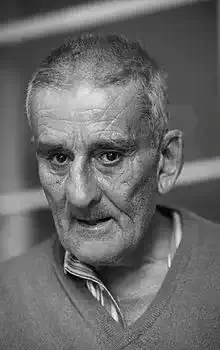
Leopoldo María Panero
1948–2014
· lived 65 years
 ES
ES
ES
Leopoldo María Panero was a Spanish poet associated with the generation of "Novísimos", known for their reinterpretation of the poetic tradition with influences from other arts. His work is marked by a confessional tone, the exploration of marginality, violence, madness, and existential themes, often reflecting his own life experiences.
n. 1948-06-16, Leão · m. 2014-03-05, Las Palmas de Gran Canaria
45
Views
Bio
Identification and basic context
Leopoldo María Panero Tortosa was a Spanish poet, born in Madrid. He is one of the most prominent representatives of the poetic generation known as "Novísimos" or "Poetry of Experience". His work is marked by a strong autobiographical charge and the exploration of dark themes.Childhood and education
Born into an upper-middle-class family, he was the son of Leopoldo Panero and Francisca Tortosa. He grew up in a literary environment, with a poet father and an uncle, Juan Panero, also a writer. This proximity to the literary world influenced his education, although his personal life was marked by difficulties and marginal experiences.Literary career
His literary career began to gain notoriety with the publication of "Así se cuenta el secreto" (1970), a work that foreshadowed his characteristic style. His inclusion in the anthology "Nueve novísimos poetas españoles" (1970), organized by Josep Maria Castellet, was a milestone in his career and that of his generation, projecting him onto the Spanish literary scene. Throughout his life, he published several poetry books, consolidating his unique voice.Work, style, and literary characteristics
Panero's work is characterized by its rawness, confession, and exploration of themes such as madness, marginality, violence, sexuality, death, and the disintegration of the self. His poetry is often described as visceral and dark, but also imbued with a disturbing beauty. He uses a vocabulary that transitions between the colloquial and the erudite, and does not hesitate to address the darker aspects of the human experience. The lyrical "I" is often fragmented and suffering, reflecting a deep existential crisis. The influence of cinema, pop music, and mass culture is evident, in line with the characteristics of the "Novísimos" generation.Cultural and historical context
Panero emerged during a period of transition in Spain, with the end of the Franco dictatorship. The "Novísimos" generation reacted against the social and political poetry of the previous period, paving the way for a more intimate, culturalist, and internationally influenced poetry. His work dialogues with other poets of his generation, such as Pere Gimferrer and Félix de Azúa.Personal life
Leopoldo María Panero's life was marked by profound personal difficulties, including mental health problems, drug addiction, and long periods in psychiatric institutions. These painful experiences intensely permeated his work, giving it a raw authenticity and a unique voice in Spanish literature.Recognition and reception
Although his work has been recognized for its originality and strength, Panero was a poet who often lived on the margins of mainstream recognition. However, his figure and poetry have gained a cult following and a prominent place in contemporary Spanish poetry, especially among those interested in a more radical and confessional approach.Influences and legacy
Panero was influenced by poets such as Baudelaire, Rimbaud, and the Beat poets. His legacy lies in his ability to give voice to suffering, marginality, and the complexity of the human psyche, paving the way for more transgressive and introspective poetry in Spain. His work continues to be studied and admired for its brutal honesty and dark beauty.Interpretation and critical analysis
Panero's work is often analyzed through the lens of the relationship between his personal life and his poetic output. Critics highlight his ability to transform pain into art, his exploration of identity and subjectivity in a context of crisis, and his audacity in addressing taboo subjects. The deconstruction of the "self" and the search for meaning in a chaotic world are central to these analyses.Curiosities and lesser-known aspects
Leopoldo María Panero had a complex relationship with his family and his own condition as a poet. His life in psychiatric hospitals, far from being just a burden, also became a source of inspiration and material for his poetry.Death and memory
Leopoldo María Panero passed away in Madrid. His death left a void in Spanish poetry, but his work endures, continuing to impact readers and writers with its intensity and originality.Poems
0No poems found
Comments (0)
Log in
to post a comment.
No comments yet. Be the first to comment.