
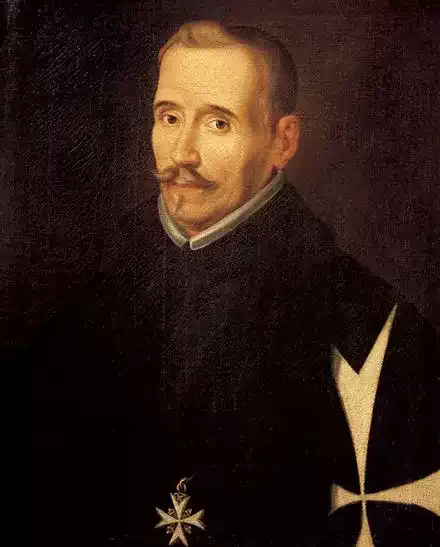
Lope de Vega
1562–1635
· lived 72 years
 ES
ES
ES
Félix Lope de Vega y Carpio was a Spanish playwright and poet, a prominent figure of the Golden Age of Spanish literature. Known for his prolificacy and versatility, Lope de Vega revolutionized Spanish theater with his dramatic formula, known as "comedia nueva", which became extremely popular. His poetic work covers a wide range of themes, from courtly love to religion, demonstrating a remarkable mastery of form and language.
n. 1562-11-25, Madrid · m. 1635-08-27, Madrid
76
Views
Bio
Identification and Basic Context
Lope de Vega, full name Félix Lope de Vega y Carpio, was born in Madrid, Spain. He is considered one of the greatest names of the Spanish Golden Age. He wrote in Castilian.Childhood and Education
Lope de Vega had a childhood marked by the premature death of his mother and the absence of his father. He was raised by an aunt and showed prodigious talent for poetry and learning from an early age. He studied at the Real Colegio de la Compañía de Jesús in Madrid and later at the University of Alcalá de Henares, where he studied Law and Theology, although his literary and worldly vocation kept him away from sacred orders.Literary Career
Lope de Vega began writing at a very young age, showing exceptional talent early on. His literary career was long and extremely productive, covering almost all forms of writing of the era, with emphasis on theater and lyric poetry. He published numerous works and actively collaborated in literary journals and anthologies. He was also a critic and translator.Work, Style, and Literary Characteristics
Lope de Vega's work is vast, with hundreds of plays and thousands of poems. Among his most important poetic works are "Rimas" (1604) and "Rimas sacras" (1617). His poetic themes are varied, including love, nature, religion, and daily life. He is characterized by great formal mastery, often using the sonnet, but also exploring other forms. His style is marked by naturalness, vivacity, and richness of language, combining the popular with the learned. He introduced innovations in theater with the "comedia nueva", which broke Aristotelian rules in favor of greater freedom and dynamism.Cultural and Historical Context
Lope de Vega lived at the height of the Spanish Empire, a period of great cultural effervescence, known as the Golden Age. He mingled with and rivaled other great writers of the time, such as Cervantes and Góngora. His work reflects the spirit of his time, with its conflicts, its religiosity, and its national pride.Personal Life
Lope de Vega's life was as intense as his work. He had numerous love affairs, marriages, and children, which often led him to social conflicts and even exiles. His personal experiences, passions, and disappointments were a source of inspiration for many of his poems and plays.Recognition and Reception
Lope de Vega was an extremely popular author during his lifetime, known as the "Phoenix of Geniuses" (Fénix de los Ingenios). His theatrical work was staged with enormous success, and his poems were widely read and admired. He received recognition during his life, and his legacy endures to this day as one of the pillars of the Spanish-language literature.Influences and Legacy
Lope de Vega was influenced by classical and Italian poets, but his genius lies in how he adapted and innovated tradition. He influenced generations of playwrights and poets, both in Spain and Latin America. His "comedia nueva" established a model for Spanish theater that endured for centuries. He is a central figure in the Hispanic literary canon.Interpretation and Critical Analysis
Lope de Vega's work has been the subject of numerous analyses, highlighting his ability to capture the human soul and the customs of his time. His lyric poetry, in particular, is admired for its expressiveness and emotional depth.Curiosities and Lesser-Known Aspects
Lope de Vega was a man of action, having participated in the Spanish Armada expedition. His life was marked by tumultuous passions and scandals that often took him away from his duties and led him into trouble with the law. He had a habit of writing anywhere and at any time, given his enormous output.Death and Memory
Lope de Vega died in Madrid. His death was felt as a great loss to Spanish literature. Posthumous publications continued to disseminate his work, consolidating his immense literary importance.Poems
0No poems found
Quotes
2No poems found
Comments (0)
Log in
to post a comment.
No comments yet. Be the first to comment.