
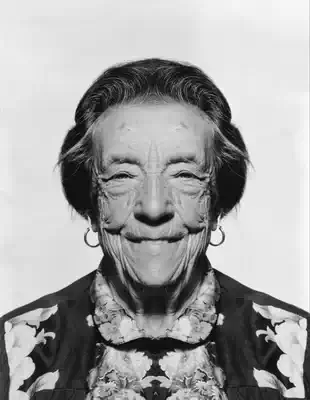
Louise Bourgeois
 FR
FR
Louise Bourgeois was an internationally renowned visual artist, whose sculptures and installations explored profound themes of the human psyche, such as trauma, memory, family, and sexuality. Her work, often autobiographical, is marked by raw emotional intensity and the exploration of diverse materials, such as metal, fabric, and latex. Bourgeois used organic and symbolic forms to express her childhood experiences, complex relationships with her parents, and her existential anxieties. Her long career was a testament to her persistence and her ability to transform pain into powerful and universal art.
n. 1911-12-25, 6.º arrondissement de Paris · m. 2010-05-31, Nova Iorque
Bio
Identification and basic context
Louise Bourgeois (1911-2010) was an influential Franco-American visual artist, known for her sculptures, installations, and performance art. Born in Paris, France, she moved to the United States in 1938 and developed most of her career in New York. Her work, spanning over seven decades, deeply explored human psychology, memory, trauma, family, sexuality, and the female condition. Bourgeois used a wide range of materials, including metal, fabric, latex, and wood, to create works that often evoke feelings of anxiety, fear, desire, and liberation.Childhood and education
Louise Bourgeois was born into a family of tapestry restorers, which exposed her to manual labor and art from an early age. However, her childhood was marked by her father's infidelity, who was having an affair with Bourgeois's English governess, and by her mother's controlling nature. These traumatic experiences had a profound impact on her psyche and became recurring themes in her work. Bourgeois studied mathematics and geometry at the Sorbonne before dedicating herself to art, attending several art schools in Paris, where she came into contact with artists such as Fernand Léger and André Lhote.Literary career
Although best known as a visual artist, Louise Bourgeois also explored writing, particularly through autobiographical texts and reflections on her work and life experiences. Her writings, often fragmented and intensely personal, function as a complement to her visual work, revealing the complexities of her mind and the origins of her creative impulses.Work, style, and literary characteristics
Bourgeois's work is characterized by the exploration of universal themes through a highly personal and symbolic visual language. Her sculptures, often monumental and disturbing, address issues of identity, memory, sexuality, and family relationships. Her style is difficult to categorize, as she moved through various artistic currents throughout her life, but she always maintained an authentic and unmistakable voice. Recurring elements in her work include spiders (symbolizing her mother, a weaver), fragmented bodies, cells, and domestic objects transformed into symbols of imprisonment or liberation.Work, style, and literary characteristics
Cultural and historical context Bourgeois lived and worked during a period of intense cultural and artistic transformation, witnessing and influencing movements such as Surrealism, Abstract Expressionism, and Conceptual Art. Her work engages with the social and political issues of her time, but her approach is fundamentally introspective and focused on individual experience. Her long career allowed her continuous interaction with the art world, from the avant-garde circles of Paris to the New York art scene, where she became a prominent figure.Work, style, and literary characteristics
Personal life Louise Bourgeois's personal life was intrinsically linked to her artistic production. Her relationships, especially with her parents and her husband, art historian Robert Goldwater, were sources of inspiration and conflict that shaped her work. Her experience as a woman, an immigrant, and a survivor of childhood trauma informed her unique perspective and her resilience. Bourgeois was known for her intensity, sharp intelligence, and determination to continue creating until the last days of her life.Work, style, and literary characteristics
Recognition and reception Although she was an active figure in the art scene for decades, Louise Bourgeois's widespread recognition as one of the most important artists of the 20th century only solidified in the last decades of her life. She received numerous awards and distinctions, and her works are part of the collections of major museums worldwide. Her critical reception evolved from a certain initial skepticism to a deep admiration for the originality and emotional power of her art.Work, style, and literary characteristics
Influences and legacy Bourgeois's influences were diverse, including Surrealist art, Freudian psychoanalysis, and her own childhood memories. Her legacy is immense, having paved the way for the exploration of psychological and emotional themes in contemporary art, especially for women artists. Her work continues to inspire generations of artists to confront their own vulnerabilities and transform them into powerful expressions.Work, style, and literary characteristics
Interpretation and critical analysis Bourgeois's work is rich in symbolism and open to multiple interpretations. Critical analysis often focuses on her exploration of the unconscious, dysfunctional family dynamics, and the representation of the female body and its frailties and strengths. Themes of control, desire, fear, and reparation are central to her work.Work, style, and literary characteristics
Curiosities and lesser-known aspects A curiosity about Bourgeois is her artistic longevity and her prolific output even in old age. She worked tirelessly until her final years, demonstrating impressive vitality. Another aspect is her constant writing practice, filling numerous notebooks with reflections, poems, and drawings, many of which were only published posthumously.Work, style, and literary characteristics
Death and memory Louise Bourgeois passed away in 2010, at the age of 98, in New York. Her memory is celebrated through her vast body of work, which continues to be exhibited, studied, and admired worldwide. The Louise Bourgeois Foundation, established to preserve and promote her legacy, ensures that her work remains accessible and influential for future generations.Poems
0No poems found
Quotes
1No poems found
Comments (0)
No comments yet. Be the first to comment.