
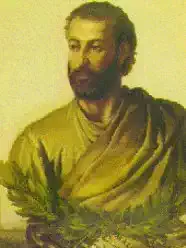
Lucano
39–65
· lived 25 years
 IT
IT
IT
Marcus Annaeus Lucanus (39-65 AD), known in Portuguese as Lucano, was a Roman poet of the Golden Age of Latin literature. He is most famous for his unfinished epic, "Pharsalia", which narrates the civil war between Julius Caesar and Pompey. Lucano was the nephew of the Stoic philosopher Seneca the Younger. His work is marked by a rhetorical and dramatic style, and by a frequently dark and critical tone towards war and imperial power. He died young, supposedly forced to commit suicide by order of Emperor Nero.
n. 0039-11-03, Corduba · m. 0065-04-30, Roma
47
Views
Bio
Marcus Annaeus Lucanus, known as Lucano, was a Roman poet born in Corduba, Hispania Baetica (modern Spain). He moved to Rome with his family when he was young and received an excellent education. Under the patronage of Emperor Nero, Lucano achieved fame with his poetry, but soon fell into disgrace due to the emperor's envy. He became involved in a conspiracy against Nero, which led to his condemnation and the order to commit suicide in 65 AD. His main work, "Pharsalia" (or "The Civil War"), is an epic poem in ten books describing the struggle between Caesar and Pompey. The poem is notable for its vivid and often dark portrayal of the horrors of war and for its analysis of the collapse of Roman republican institutions. "Pharsalia" is considered one of the most important works of late Latin poetry and has influenced many later writers.
Poems
0No poems found
Quotes
13Comments (0)
Log in
to post a comment.
No comments yet. Be the first to comment.