
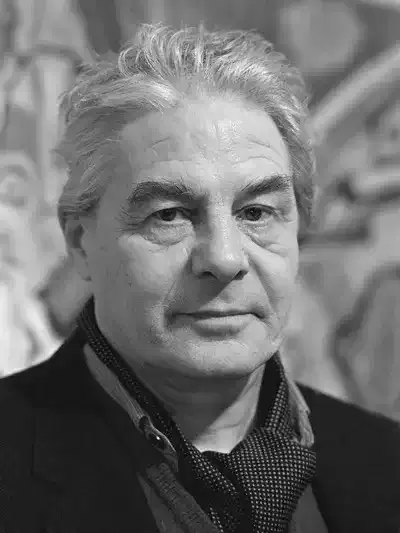
Lucebert
 NL
NL
Lucebert (real name: Lubertus Jacobus Swaanswijk) was a Dutch poet and painter, a central figure in the experimental CoBrA movement. His poetry, like his art, is characterized by a playful, transgressive, and often provocative approach that challenges linguistic and artistic conventions. With a body of work marked by experimentation and the pursuit of authentic and visceral expression, Lucebert explored themes such as the human condition, freedom, nature, and social criticism. His ability to merge the visual and the verbal, creating poetic images charged with meaning and emotion, established him as one of the most unique and influential post-war artists in the Netherlands and Europe.
n. 1924-09-15, Amesterdão · m. 1994-05-10, Alkmaar
Bio
Identification and Basic Context
Lucebert, pseudonym of Lubertus Jacobus Swaanswijk, was a prominent Dutch poet and painter, born in Amsterdam. He was a seminal figure in the CoBrA art movement, an international group of European avant-gardists active in the post-war era. His work, in both poetry and painting, is recognized for its experimental, transgressive, and profoundly original nature. His nationality and the post-World War II European context were crucial in shaping his artistic and literary vision.Childhood and Formation
Lucebert's childhood was marked by the difficulties and turbulence of World War II, experiences that undoubtedly influenced his worldview and his art. His formal artistic training may have been interrupted or shaped by the circumstances of the war, but his self-taught talent and his absorption of emerging artistic currents were fundamental. His exposure to various cultural manifestations, including folk art and oral traditions, contributed to the development of his unique style.Literary Career
Lucebert's literary career developed in parallel with his artistic career. He was one of the founding poets of the CoBrA movement, where poetry was seen as a natural extension of visual expression. His beginnings in poetic writing were driven by a desire to innovate and break away from traditional literary forms. Over time, his poetic work evolved, always maintaining an experimental spirit and an innovative language. He was also active in collaborating with other publications and participating in artistic events.Work, Style, and Literary Characteristics
Lucebert's poetry is known for its spontaneity, its use of playful and often surrealist language, and its exploration of themes such as freedom, nature, the human condition, and social criticism. His major works include poetic collections that challenge conventional structure, using wordplay, neologisms, and non-linear syntax. The tone of his poetic voice can range from jocular to profoundly reflective. His language is dense with imagery and rarely adheres to a fixed meter, favoring free verse and formal experimentation. His work is intrinsically linked to the CoBrA movement, sharing with it a spirit of creative freedom and a rejection of established norms.Cultural and Historical Context
Lucebert was a product and an influencer of the European post-war cultural and historical context. The CoBrA movement emerged as a response to the devastation of the war, seeking a renewed and humanistic artistic expression. He dialogued with other artists and writers of his generation, contributing to a period of artistic effervescence in Europe. His philosophical stance, often linked to individual freedom and criticism of power structures, was reflected in his work.Personal Life
Details of Lucebert's personal life, while not as widely publicized as his work, undoubtedly shaped his perspective. His dedication to art and poetry, his active participation in the CoBrA movement, and his reflections on the world indicate a life deeply immersed in creation. His approach to life, as to art, seemed to be one of constant exploration and questioning.Recognition and Reception
Lucebert was widely recognized as one of the most important artists in the Netherlands and Europe. He received several awards and distinctions for his artistic and literary work. Critical reception of his poetry has generally been positive, highlighting its originality and his contribution to the literary avant-garde. His popularity lies not only in academic recognition but also in the fascination his work holds for an audience that appreciates experimentation and creative freedom.Influences and Legacy
Lucebert's influences include the historical avant-gardes, folk art, and surrealist poetry. He, in turn, influenced numerous subsequent artists and poets, especially those seeking to break with conventions and explore new forms of expression. His legacy is firmly established in the canon of modern art and European experimental poetry. Translations of his work have allowed his influence to extend beyond Dutch borders.Interpretation and Critical Analysis
Lucebert's work offers a vast field for interpretation and critical analysis. His explorations of freedom, identity, and nature invite profound philosophical reflections. Critics analyze his innovative language and the way he merged visual and literary arts to create a unique aesthetic experience. The social critiques embedded in his work are also a point of interest.Curiosities and Lesser-Known Aspects
A curious aspect of Lucebert's work is his ability to infuse humor and lightness into complex themes, often through unexpected wordplay. His writing habits, likely intuitive and exploratory, and his relationship with his own manuscripts and paintings, could reveal more about his creative process.Death and Memory
Lucebert passed away in 1994. His death marked the end of an era for Dutch art and literature. His memory is perpetuated through the continued preservation and exhibition of his work, as well as through academic studies and publications that explore his lasting impact on art and poetry.Poems
0No poems found
Comments (0)
No comments yet. Be the first to comment.