
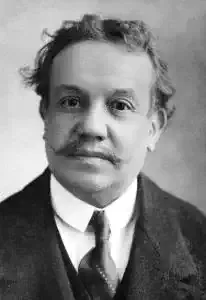
Luis Gonzaga Urbina
 --
--
Luis Gonzaga Urbina was a prominent Mexican poet, essayist, and literary critic, a key figure of Modernism in Mexico. His work is characterized by formal elegance, the musicality of verse, and a deep sensitivity towards beauty, love, and melancholy. Urbina is remembered for his contribution to the development of Mexican Modernism, providing a refined lyrical voice and an exceptional command of poetic language. His influence extended through his writings and his teaching, leaving an indelible mark on his country's literature.
n. 1864-02-08, Cidade do México · m. 1934-11-18, Madrid
Bio
Identification and basic context
Luis Gonzaga Urbina Kanan was a Mexican poet, essayist, literary critic, and academic. He is a fundamental figure of Modernism in Mexico, known for his learned lyricism, his mastery of language, and his profound aesthetic sensibility. He was born in Mexico City and was a member of the Mexican Academy of Language.Childhood and education
Urbina's childhood and education took place in Mexico City. He studied at the Conciliar Seminary of Mexico and later at the National School of Jurisprudence, where he graduated as a lawyer. However, his true passion leaned towards literature, where he developed a solid intellectual and self-taught education, influenced by the literary currents of his time, especially French Parnassianism and Symbolism.Literary career
Luis Gonzaga Urbina's literary career began in the 1880s, collaborating in various literary magazines of the time. He was one of the introducers of Modernism in Mexico, along with other poets such as Salvador Díaz Mirón and Manuel Gutiérrez Nájera. His poetic work was consolidated in collections published throughout his life. In addition to his poetic work, he played an important role as a literary critic and essayist, analyzing the work of his contemporaries and contributing to the dissemination of literature.Work, style, and literary characteristics
Urbina's poetry is characterized by its exquisite musicality, formal perfection, and careful, elegant language. His recurring themes include love, beauty, melancholy, nature, and spirituality. His style is framed within Modernism, with a clear influence of Parnassianism in his pursuit of metric perfection and verse refinement, as well as Symbolism in his use of suggestions and evocations. Among his most important poetic works are "Disfraces" (1889) and "Versos" (1901). His essayistic and critical prose is also of great value, notable for its sharpness and erudition.Cultural and historical context
Urbina lived during the Porfiriato, a period of economic and cultural boom in Mexico, which fostered the flourishing of Modernism. He belonged to a generation of writers who sought to renew Mexican literature, adopting European aesthetic trends and adapting them to the Hispano-American reality. He was an active member of the intellectual life of his time, participating in gatherings and literary circles.Personal life
Luis Gonzaga Urbina was a lawyer by profession and also dedicated himself to teaching, holding professorships at the National Preparatory School and the National Autonomous University of Mexico. His life was marked by his dedication to literature and his commitment to culture. He was a member of the Mexican Academy of Language since its founding.Recognition and reception
Urbina enjoyed great recognition in his time as one of the main exponents of Mexican Modernism. His work was praised by critics and had significant dissemination. He was a founding member of the Mexican Academy of Language, which attests to his prestige in the literary field.Influences and legacy
Urbina was influenced by poets such as Théophile Gautier, Leconte de Lisle, and Paul Verlaine. In turn, his work influenced later Modernist and avant-garde poets in Mexico and Latin America, laying the groundwork for more refined and aesthetically polished poetry. His legacy lies in his formal mastery and the high lyrical quality of his verses.Interpretation and critical analysis
Urbina's work has been analyzed from various perspectives, highlighting his exploration of subjectivity, his search for ideal beauty, and his ability to evoke moods through language. His poetry is a paradigmatic example of Modernism in its most lyrical and formal aspect.Childhood and education
In addition to his literary work, Urbina was a scholar of history and philology. His academic rigor and profound culture are reflected in the solidity of his essays and critiques.Death and memory
Luis Gonzaga Urbina died in Mexico City, leaving a valuable poetic and critical legacy that continues to be studied and appreciated in the field of Mexican and Hispano-American literature.Poems
0No poems found
Comments (0)
No comments yet. Be the first to comment.