
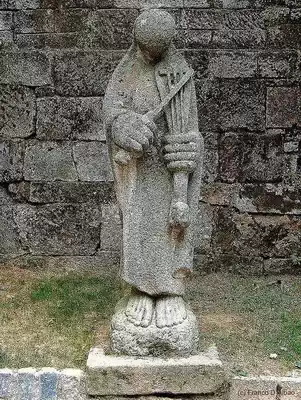
Martim Codax
 ES
ES
Martim Codax is a prominent figure in medieval Galician-Portuguese poetry. Recognized for his cantigas de amigo (songs of a friend), his work is distinguished by the vividness of its imagery, its deep connection to nature, and its authentic expression of feminine sentiments. His poetic compositions portray the world of women, their hopes, longings, and their relationship with the sea and their loved ones. His poetry is a valuable testament to medieval lyricism, characterized by its musicality and its ability to evoke landscapes and emotions vividly. His work, preserved in medieval songbooks, continues to be studied and admired for its intrinsic beauty and its historical-literary value. Martim Codax represents one of the pillars of troubadour poetry in the Iberian Peninsula, offering a unique insight into the sensibility and customs of the era.
n. 1300-01-01, Vigo · m. 1300
Bio
Identification and Basic Context
Martim Codax was a troubadour of the Middle Ages, whose work is part of the Galician-Portuguese lyric tradition. He is primarily known for authoring cantigas de amigo. His dating is uncertain but falls between the 13th and 14th centuries. His family and social origins are inferred from his status as a troubadour, possibly indicating noble origins or at least access to courtly circles. His nationality would be Galician-Portuguese, writing in the language that would become Galician-Portuguese. He lived during a period of consolidation of the Iberian kingdoms and the flourishing of troubadour poetry.Childhood and Education
Information about Martim Codax's childhood and education is scarce, as is common for most medieval troubadours. It is presumed that he received an education suitable for his social status, which would include learning music and poetry, central elements in troubadour activity. Initial influences would have been linked to oral tradition and poetic forms circulating in the Iberian Peninsula and southern France (Provençal lyricism).Literary Career
Martim Codax is known for his production as a troubadour, especially for his cantigas de amigo. These compositions are characterized by their lyrical expression, often centered on themes of love and the female perspective. His work was incorporated into medieval songbooks, which preserved and transmitted these compositions to posterity. There is no information about activity as a critic, translator, or editor.Work, Style, and Literary Characteristics
Martim Codax's most celebrated work is the collection of seven cantigas de amigo, which stand out for their originality and vivid representation of the female world. Dominant themes include love, longing (saudade), the relationship with nature (especially the sea), and communication between the maiden and her mother or friend. The predominant poetic form is the cantiga de amigo, characterized by its refrain (estribilho) and parallelisms. Codax's style is notable for its musicality, rhythm, and the strength of its poetic imagery, which frequently evokes maritime settings and daily life. The poetic voice in his cantigas is predominantly feminine, expressing the longings and sentiments of maidens. The language is apparently simple but rich in suggestion and symbolism. The tone is lyrical and melancholic, reflecting saudade and amorous waiting. His work is a paradigmatic example of the cantiga de amigo, a genre deeply rooted in Galician-Portuguese culture.Work, Style, and Literary Characteristics
Cultural and Historical Context Martim Codax was active during a period when Galician-Portuguese lyricism reached its peak, with an intense circulation of troubadours and works throughout the Iberian Peninsula. His production is part of a cultural context where music and poetry played a central role in social life and courts. He belongs to the so-called "Troubadour School," which developed in the kingdoms of León and Castile and the County of Portugal. His poetry reflects medieval society, its social structures, and its sensibilities.Work, Style, and Literary Characteristics
Personal Life Detailed information about Martim Codax's personal life is non-existent. As a troubadour, his life was likely connected to travels and courts, where he presented his compositions. His work suggests a refined sensitivity to human feelings, especially feminine ones, but does not allow for inferences about his emotional or familial relationships.Work, Style, and Literary Characteristics
Recognition and Reception Martim Codax's recognition stems from the preservation of his work in medieval songbooks (such as the Cancioneiro da Vaticana and the Cancioneiro Colocci-Brancuti). His literary importance was recognized by later studies on Galician-Portuguese lyricism, which highlight him as one of the most important authors of the genre. His work is studied and admired for its aesthetic quality and its value as a testament to medieval culture.Work, Style, and Literary Characteristics
Influences and Legacy Martim Codax is considered one of the central figures of the cantiga de amigo. Although his direct influences are difficult to pinpoint, he contributed to the consolidation of this genre, which would go on to influence later lyrical poetry. His legacy lies in the timeless beauty of his cantigas and his ability to express, so profoundly and originally, the female voice in medieval poetry.Work, Style, and Literary Characteristics
Interpretation and Critical Analysis Martim Codax's poetry has been the subject of in-depth study, with particular attention to its musicality, the symbolism of its imagery (such as the sea, waves, boats), and the representation of the female figure. His cantigas are seen as manifestations of a lyrical sensibility that transcends his time, addressing universal themes such as love, waiting, and saudade. Interpretations focus on the authenticity of the voice expressed and the technical mastery with which the author constructs his poems.Work, Style, and Literary Characteristics
Curiosities and Lesser-Known Aspects A curiosity about Martim Codax is the relative scarcity of information about his life, contrasting with the remarkable quality and popularity of his cantigas. His figure tends to be better known through his works than through a detailed biography. The absence of autograph manuscripts and the transmission of his work through medieval copies also contribute to a certain mystery surrounding his persona.Work, Style, and Literary Characteristics
Death and Memory There are no records regarding the circumstances of Martim Codax's death. His memory endures through his cantigas, preserved in medieval songbooks, which continue to be read, studied, and appreciated as a treasure of Galician-Portuguese literature.Poems
0No poems found
Comments (0)
No comments yet. Be the first to comment.