
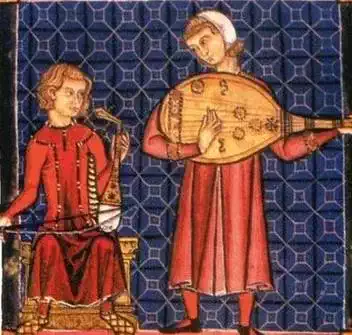
Meendinho

Meendinho, whose name is lost in the mists of time, is an enigmatic figure of medieval Galician-Portuguese poetry. Recognized for a single cantiga de amigo, "Mendiño, se miña/a mia dona veo", he embodies the saudade, the absence, and the depth of amorous feelings expressed in contexts of separation. His work, though scarce, possesses a remarkable lyrical strength, revealing a refined sensitivity for expressing the pain of distance and the hope for reunion. Meendinho is a testament to the richness and expressiveness of the troubadour poetry of the Iberian Peninsula.
51
Views
Bio
Identification and basic context
Meendinho is a Galician-Portuguese troubadour from the Middle Ages, author of a single known cantiga de amigo: "Mendiño, se miña/a mia dona veo". His real name and exact dates of life are unknown, making him an enigmatic figure. His work is part of the context of medieval Galician-Portuguese lyric poetry.Childhood and education
There is no information available about Meendinho's childhood or education. Given the era and the nature of his work, it is presumed that he had contact with oral tradition and sung poetry, fundamental elements for the production of cantigas de amigo.Literary career
Meendinho's literary career is reduced to the authorship of a single cantiga de amigo, transmitted through medieval songbooks. This scarcity of work does not diminish his impact, as the cantiga in question is one of the most representative and emotionally charged examples of the genre.Work, style, and literary characteristics
The only work attributed to Meendinho is the cantiga de amigo "Mendiño, se miña/a mia dona veo", which has become one of the most famous examples of this lyrical genre in the Iberian Peninsula. The cantiga explores the theme of saudade and absence, through a dialogue between the poetic voice (the maiden) and an interlocutor (possibly a sailor or a messenger, identified as Mendiño), to whom she asks for news of her beloved. The style is characterized by simplicity of language, repetition of structures (parallelism and refrain), and a deep emotional charge that expresses the pain of separation and the yearning for reunion. Musicality and rhythm are intrinsic to the form of the cantiga, conceived to be sung and accompanied by instruments.Cultural and historical context
Meendinho is part of the context of medieval Galician-Portuguese lyric poetry, which flourished between the 12th and 14th centuries. This period was marked by the influence of Provençal poetry and the consolidation of vernacular languages as literary vehicles. The cantiga de amigo, in particular, is a genuinely Iberian genre, with strong ties to the popular culture and oral traditions of the Galician-Portuguese region. Medieval society, with its feudal and religious structures, influenced the themes and poetic forms, although the cantiga de amigo stands out for its feminine perspective and the expression of personal feelings.Personal life
There is no information available about Meendinho's personal life, including family relationships, profession, or beliefs. His personal identity is subsumed by the poetic voice of his only work.Recognition and reception
Meendinho's recognition stems almost exclusively from the quality and expressiveness of his single known cantiga. This work has been preserved in medieval songbooks and has been the subject of study and admiration over the centuries, being considered one of the greatest exponents of the cantiga de amigo.Influences and legacy
Meendinho, as a representative of the cantiga de amigo, contributed to the tradition of Iberian lyric poetry. His work, although unique, is a testament to the sophistication and emotional depth that medieval Galician-Portuguese poetry achieved. His legacy lies in the preservation of a poignant example of the expression of saudade and absence, universal themes in the human experience.Interpretation and critical analysis
Meendinho's cantiga is often analyzed from the perspective of medieval literary theory, focusing on its formal and thematic characteristics. Its interpretation centers on the representation of the pain of amorous separation and the figure of the maiden who expresses her feelings directly and movingly. The enigmatic figure of "Mendiño" has generated various theories, from that of a messenger to a simple stylistic element to introduce the maiden's speech.Curiosities and lesser-known aspects
The main curiosity surrounding Meendinho is his very anonymity, which makes him an almost mythical figure in the history of literature. The persistence of his cantiga through the centuries, despite the absence of other works, attests to its strength and relevance.Death and memory
Meendinho's death occurred on an unknown date, as did his birth. His memory is perpetuated exclusively through his work, preserved in medieval songbooks, which have ensured his survival to this day.Poems
0No poems found
Comments (0)
Log in
to post a comment.
No comments yet. Be the first to comment.