
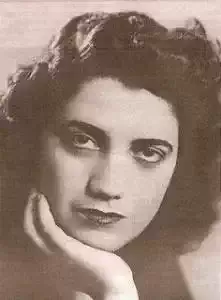
Meira Delmar
1922–2009
· lived 86 years
 --
--
--
Meira Delmar was a Cuban poet, essayist, and literary critic. Her work is characterized by deep introspection, the exploration of themes such as time, memory, and identity, and a refined and precise language. Throughout her career, she established herself as one of the most important voices in 20th-century Cuban poetry, distinguished by her formal rigor and intellectual acuity. Her influence extends to several generations of poets in Cuba and Latin America.
n. 1922-04-21, Barranquilla · m. 2009-03-18, Barranquilla
40
Views
Bio
Identification and basic context
Meira Delmar, whose full name was Emma de la Caridad Delmar y Ramírez, is a prominent figure in Cuban literature. She was born and lived in Cuba, recognized for her outstanding work as a poet, essayist, and literary critic. Her work is part of the context of 20th-century Cuban poetry.Childhood and education
Meira Delmar's childhood and education were marked by an environment conducive to intellectual development. Although specific details of her formal education and early exposure to literature are less known, it is known that she cultivated a deep love for letters from a young age. Her education was nourished by select readings and a constant interest in culture and reflection.Literary career
Meira Delmar's literary career began with a clear poetic vocation. From her earliest writings, she demonstrated her own style and a concern for thematic depth. Throughout her career, her work evolved, maintaining a common thread of introspection and formal rigor. She actively collaborated in important literary publications, consolidating her prestige as a poet and critic.Work, style, and literary characteristics
Meira Delmar's poetic work is distinguished by the exploration of universal themes such as time, memory, identity, and the human condition. Her style is characterized by refined, precise language charged with nuances, with remarkable musicality and rhythm. She uses resources like metaphor and imagery to construct evocative and reflective atmospheres. Her tone is often introspective and melancholic, but always with profound lucidity. She is associated with a more intimate and existential poetry, far from grandiloquent rhetoric. Her poems, though seemingly simple, contain complex layers of meaning and great emotional weight.Cultural and historical context
Meira Delmar lived and wrote during a period of significant social and political changes in Cuba. Her work developed parallel to the literary movements of her time, establishing a dialogue with other writers and intellectual circles. Although there is no explicit affiliation with mass movements, her poetry shares the search for depth and authenticity that characterized much of 20th-century Latin American literature.Personal life
Meira Delmar's personal life, although not extensively documented with anecdotal details, was deeply linked to her literary vocation. Affective relationships and life experiences undoubtedly shaped her poetic sensibility, lending her work a palpable human resonance. Her dedication to writing and intellectual reflection was a constant in her life.Recognition and reception
Meira Delmar enjoyed considerable recognition in Cuban and international literary circles. Her work was valued for its aesthetic quality and thematic depth, receiving critical acclaim and appreciation from her peers. She is considered one of the most important female poetic voices in Cuba.Influences and legacy
Meira Delmar's work has been influenced by poetic tradition and, in turn, has exerted a notable influence on subsequent generations of poets. Her legacy is manifested in the way she approached universal themes with a personal voice and an unmistakable style, inspiring others to explore the depths of existence through the poetic word.Interpretation and critical analysis
Meira Delmar's work has been the subject of critical analysis focused on her deep exploration of temporality, memory, and human fragility. Her poems invite reflection on existence and the search for meaning in a constantly changing world.Childhood and education
Although her public image was marked by her literary work, there are lesser-known aspects of her personal life that reveal her reflective nature and dedication to the arts. Her constant pursuit of formal perfection and thematic depth in her writing is a distinctive trait of her profile.Death and memory
Meira Delmar passed away, leaving a valuable literary legacy. Her work continues to be studied and appreciated, ensuring its permanence in the memory of Cuban literature.Poems
0No poems found
Comments (0)
Log in
to post a comment.
No comments yet. Be the first to comment.