
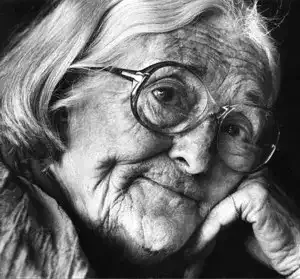
Meridel Le Sueur
1900–1996
· lived 96 years
 US
US
US
Meridel Le Sueur was an American writer whose works addressed the struggles of the working class and women, especially during the Great Depression. Through powerful and often lyrical prose, she gave voice to the marginalized, exploring themes of social injustice, resistance, and the pursuit of dignity in times of adversity. Her writing is marked by a deep sense of empathy and a commitment to social justice, making her an important figure in American progressive literature.
n. 1900-02-22, Murray · m. 1996-11-14, Hudson
26
Views
Bio
Identification and Basic Context
Meridel Le Sueur was an American writer known for her fiction, poetry, and journalistic writings that frequently addressed the struggles of the working class, women, and minorities in the United States. Pseudonyms or heteronyms are not prominent in her career. She was born in 1900 and passed away in 1996. Her family background was immersed in political and social activism, with parents involved in populist and socialist movements. This profoundly shaped her cultural background. Her nationality was American, and her writing language was English. She lived during a period of intense social and political change in the United States, including the Great Depression, World War II, and the civil rights and feminist movements.Childhood and Education
Meridel Le Sueur was born into an environment of political and social activism, with parents who were social reformers and activists. This family background and social environment instilled in her from an early age a strong sense of social justice and empathy for the oppressed. Her formal education included studies in performing arts and writing, but she was also largely self-taught in her readings and engagement with political and literary ideas. Early influences included readings of radical literature, the poetry of Walt Whitman, and the ideas of populism and socialism that permeated her family. She absorbed literary and artistic movements that promoted social criticism and the representation of the working classes. Significant events in her youth, such as the Bisbee mining strike in 1917, where her parents were arrested, solidified her commitment to advocating for workers.Literary Career
Le Sueur's writing began during her youth, driven by her activist family environment and her own observations of social injustices. Her writing evolved over time, starting with short stories and poems that reflected her experiences and observations, and gradually delving into more complex and socially engaged narratives. The chronological evolution of her work mirrors the social and political changes in the United States, from the Great Depression to the late 20th century. She actively collaborated in various left-wing and progressive publications, including newspapers and magazines that gave voice to social movements and the working class. In addition to writing, she was also involved in community organizing and activism.Work, Style, and Literary Characteristics
Meridel Le Sueur's major works include "The Girl" (1939), a powerful story about the exploitation of a young working woman, and "North Country" (1945), a collection of short stories about life in the northern Minnesota mining region. Her dominant themes include economic exploitation, working-class resistance, human dignity, motherhood, and women's struggle for autonomy. Her style is characterized by lyrical and visceral prose, often using poetic language to describe the harshness of working-class life and the beauty of human resistance. She experimented with form, frequently using fragmented narratives and stream of consciousness to capture the complexity of her characters' experiences. The tone of her poetic voice is often empathetic, supportive, and combative, reflecting her deep connection to the themes she addressed. The language is dense with imagery, often drawing on metaphors from nature and manual labor. Le Sueur introduced thematic innovations by giving voice to characters frequently marginalized in American literature, focusing on the experiences of working women and their specific struggles. She is associated with social realism and protest literature, engaging with the tradition of American literature that portrays working-class life, but with a particular focus on female experiences and class struggles.Work, Style, and Literary Characteristics
Cultural and Historical Context Meridel Le Sueur lived and wrote during a period of profound social and political transformations in the United States. She was closely associated with left-wing and progressive movements, and her work reflects the social tensions of the Great Depression, World War II, and the Cold War period. Her writings engaged with other socialist and realist authors, and she was part of literary circles that promoted art with a social purpose. She is often associated with the "Depression Generation" and the social realism movement. Her political stance was clearly left-wing, advocating for workers' rights and social justice. American society and culture, with their inequalities and class conflicts, were a fundamental influence on her work, and she sought to confront these realities in her writings. She maintained dialogues and, at times, tensions with other writers and activists of her time, reflecting the ideological and artistic debates of the period.Work, Style, and Literary Characteristics
Personal Life Le Sueur's relationships with her family, especially her activist parents, were central to her development and her work. Her own experiences with motherhood and the complexities of family life also permeated her writings. She maintained friendships with other left-wing writers and activists, sharing ideals and challenges. Le Sueur faced financial difficulties and political persecution due to her left-wing convictions, especially during the McCarthy era, which led to a period of relative public silence. In addition to writing, she engaged in community organizing and educational activities, actively seeking to promote social justice. Her beliefs were firmly socialist and humanist, focused on the equality and dignity of all human beings.Work, Style, and Literary Characteristics
Recognition and Reception Although Meridel Le Sueur was a respected figure in left-wing and progressive literary circles for much of her life, her broader recognition came later, especially with the resurgence of interest in social realism and feminist literature. She received several awards and distinctions throughout her career, although many were from smaller organizations or focused on social causes. Her critical reception during her lifetime varied, with praise from her peers and criticism from more conservative sectors. Academic recognition of her work grew significantly in the decades following its initial publication, with students and researchers rediscovering the importance of her voice and perspective.Work, Style, and Literary Characteristics
Influences and Legacy Meridel Le Sueur was influenced by writers such as Walt Whitman, Upton Sinclair, and the traditions of American protest literature. Her work, in turn, influenced later generations of feminist writers, activists, and writers interested in social justice. Her legacy lies in her ability to give voice to the marginalized and to document the struggles of the working class and women with profound humanity and lyricism. She entered the canon of American literature as an important voice of social realism and feminist literature. Her works have been translated into several languages, although her international dissemination was more limited compared to more mainstream authors. Academic studies have been dedicated to analyzing her contribution to American literature, exploring her themes, her style, and her political engagement.Work, Style, and Literary Characteristics
Interpretation and Critical Analysis Le Sueur's work allows for diverse interpretations, focusing on the exploration of themes such as resistance in the face of oppression, solidarity among workers, and the search for identity in contexts of adversity. Philosophically, her work addresses human dignity, social justice, and the resilience of the human spirit. Although not the subject of major public controversies, her association with the political left and her direct representation of class struggles were sometimes points of critical debate in more conservative contexts.Work, Style, and Literary Characteristics
Curiosities and Lesser-Known Aspects An interesting aspect of Le Sueur's personality was her persistence and resilience in the face of personal and political difficulties. There was an apparent contradiction between her public life as a defender of workers and her own experiences of vulnerability and, at times, isolation. A notable episode was her arrest along with her parents during the Bisbee strike, which marked her profoundly. She was known for her methodical writing habits, often working in detailed journals and notebooks that served as the basis for her works. Her manuscripts, diaries, and correspondence are important sources for the study of her life and work.Work, Style, and Literary Characteristics
Death and Memory Meridel Le Sueur passed away peacefully at her home in 1996, at the age of 96. Her death was widely mourned by those who recognized her importance as a writer and activist. After her death, there was a renewed interest in her work, with the republication of many of her writings and a deepening of academic analysis of her contribution to American literature.Poems
0No poems found
Quotes
1No poems found
Comments (0)
Log in
to post a comment.
No comments yet. Be the first to comment.