
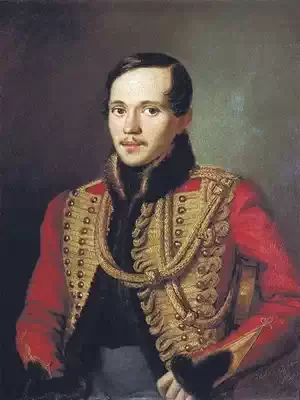
Mikhail Yurevitch Lermontov

Mikhail Lermontov was a Russian poet, playwright, and novelist, considered one of the most important figures of Russian Romanticism. His work is marked by deep melancholy, rebellion, and a strong sense of disillusionment, reflecting the anxieties of his time and his own turbulent life. Lermontov explored themes such as love, freedom, destiny, and the human condition, with a language rich in imagery and musicality. Although his life was short and marked by tragedy and exile, Lermontov's literary legacy is immense. His poems, narrative poems, and the novel "A Hero of Our Time" continue to be studied and admired, influencing generations of writers and consolidating his place as a master of Russian literature.
n. , Moscou, Império Russo · m. , Piatigorsk, Império Russo
Bio
Identification and basic context
Mikhail Yurevich Lermontov (in Russian: Михаи́л Ю́рьевич Ле́рмонтов) was born in Moscow, in the Russian Empire. He is widely regarded as one of the greatest poets and writers of Russian Romanticism, also being a talented playwright and prose writer. His work reflects a rebellious spirit, a deep melancholy, and an existential questioning that made him a central figure in Russian literature.Childhood and education
Lermontov's childhood was marked by the absence of his mother, who died when he was very young, and by a tense relationship with his paternal grandmother, who raised him and spoiled him excessively. He received an excellent education, with private tutors, and later attended Moscow University and the School of Junkers in Saint Petersburg. From an early age, he demonstrated a sharp intellect and a remarkable poetic sensibility, being influenced by readings of classic and European romantic authors, as well as by Russian folk poetry.Literary career
Lermontov began writing poetry in his adolescence, demonstrating precocious talent. His work evolved from lyrical and romantic poems to more complex and somber themes, reflecting his life experiences and his frustrations with society and the tsarist regime. He published his first poems in literary magazines, gradually gaining recognition. His poetry, often charged with emotion and rebellion, attracted the attention of the authorities, which led to one of his exiles.Work, style, and literary characteristics
Lermontov's works include collections of poems such as "The Demon" and "Mtsyri". His novel "A Hero of Our Time" is a masterpiece of Russian prose, exploring the psychology of a tormented and disillusioned hero. The dominant themes in his work are unrequited love, freedom, loneliness, death, nature, and the conflict between the individual and society. His style is characterized by vivid language, powerful imagery, striking rhythm, and profound musicality. He frequently used free verse and traditional poetic forms, but always with an innovative approach. Lermontov's poetic voice is often confessional and passionate, expressing a search for meaning in a world that seemed hostile and incomprehensible to him.Cultural and historical context
Lermontov lived in a time of great cultural and political effervescence in Russia, under the regime of Tsar Nicholas I. Russian Romanticism was flourishing, with a strong interest in national identity, folklore, and individual expression. Lermontov was a contemporary of other great writers such as Pushkin and Gogol, with whom he shared the literary avant-garde spirit, but he also faced censorship and repression from the regime. His poetry often reflected social discontent and dissatisfaction with the established order.Personal life
Lermontov's life was short and tumultuous. Marked by the premature death of his mother and family conflicts, he maintained intense and often unhappy love affairs. His friendships were deep, but also subject to rivalries. Lermontov served in the Russian army, participating in military campaigns in the Caucasus, experiences that significantly shaped his work and his worldview. His strong personality and impulsive temperament led him to multiple confrontations and, eventually, to a fatal duel.Recognition and reception
Although Lermontov achieved recognition during his lifetime, his work was widely appreciated after his death. His poetry resonated deeply with the Russian public for its emotional intensity and rebellious spirit. "A Hero of Our Time" was acclaimed as a landmark in Russian prose. His legacy was consolidated by critics and scholars who recognized his originality and his importance in the evolution of Russian literature.Influences and legacy
Lermontov was influenced by Byron, Goethe, and Shakespeare, but he developed a unique style that echoed the Russian soul. He, in turn, profoundly influenced later poets, such as the Russian Symbolists and Modernists, and left an indelible mark on world literature. His exploration of the "superfluous man" and tormented individualism in "A Hero of Our Time" became a literary archetype.Interpretation and critical analysis
Lermontov's work is often analyzed from the perspective of late Romanticism, with an emphasis on melancholy, alienation, and the search for an unattainable ideal. Critics explore his pessimistic view of the human condition, his mysticism, and his ability to capture the essence of the Russian soul in times of crisis.Curiosities and lesser-known aspects
Lermontov was known for his talent for drawing and music, in addition to his skill as a fencer. There are reports that he was fascinated by games and gambling. His short and intense life, culminating in a duel, adds a tragic and romantic element to his figure.Death and memory
Mikhail Lermontov died tragically in 1841, at the age of 26, in a duel in Pyatigorsk, in the Caucasus. His premature death cut short a promising literary career. After his death, several works were published posthumously, consolidating his position as one of the greatest figures in Russian literature. His memory is celebrated through museums, monuments, and continuous editions of his works.Poems
0No poems found
Comments (0)
No comments yet. Be the first to comment.