
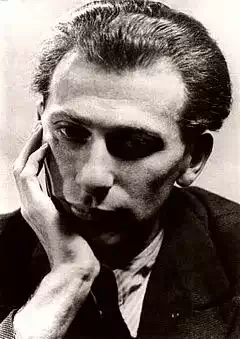
Miklós Radnóti
 HU
HU
Miklós Radnóti was a Hungarian poet of Jewish origin, whose work, profoundly marked by the atrocities of the Holocaust, became a poignant testament to the human condition in times of barbarism. His poetry, often written in extreme circumstances, is characterized by lyrical strength, the struggle for dignity, and the incessant search for beauty amidst horror. Radnóti left a legacy of verses that echo the resilience of the human spirit, the importance of memory, and the universality of suffering and hope. His work is a landmark in 20th-century literature, serving as a grim and powerful reminder of the consequences of intolerance and war.
n. 1909-05-05, Budapeste · m. 1944-11-09, Abda (Hungria)
Bio
Identification and basic context
Miklós Radnóti was born in Budapest, Hungary. He was a renowned Hungarian poet whose writings gained international prominence, especially after his death, due to their testimonial nature and profound lyricism in the face of Nazi persecution. His nationality was Hungarian, and he wrote in Hungarian.Childhood and education
Radnóti was born into a Jewish family. His childhood and youth were marked by the early loss of his mother and twin brother, an event that deeply affected him. He attended gymnasium in Budapest and later studied at the University of Szeged, where he graduated in Hungarian and French language and literature. His academic training and immersion in Hungarian culture influenced his poetic style and his identity as an artist.Literary career
Radnóti began writing poetry in his adolescence. His early work already showed a remarkable talent for form and lyrical expression. He associated with the Hungarian avant-garde movement, although his poetry developed a more personal and engaged tone over time. From 1938 onwards, with the hardening of antisemitic laws in Hungary, his life and work were increasingly dominated by the context of persecution. Even in forced labor camps, he continued to write, hiding his poems in notebooks.Work, style, and literary characteristics
Radnóti's major works include "Flying Birds" (1931), "Fifty-Year Calculations" (1933), "Judging by Life" (1936), and "Song of a Human Being" (1942). His poems address themes such as the beauty of nature, love, homeland, Jewish identity, and, primarily, the suffering, injustice, and death imposed by the Nazi regime and its collaborators. His poetic form was often classical, using meter and rhyme, but with modern language and powerful imagery. The tone of his poetry ranges from lyrical and contemplative to elegiac and denunciatory. The poetic voice is personal but transcends the individual to become a universal testimony of human tragedy. His language is both precise and evocative, marked by strong musicality.Cultural and historical context
Miklós Radnóti lived in a period of intense political and social turmoil in Europe, marked by the rise of fascism, World War II, and the Holocaust. He belonged to a generation of Hungarian writers who sought to modernize national literature. As a Jew, he was a direct target of Nazi persecution and the antisemitic laws enacted in Hungary. His work reflects the devastating impact of these events, serving as a painful record of the era.Personal life
Radnóti married Fanni Gyarmati, a union that was a source of inspiration and solace amidst adversity. He worked as a teacher and at times faced financial and professional difficulties due to discriminatory laws against Jews. His faith and his art were pillars in his life, sustaining him in the face of suffering.Recognition and reception
During his lifetime, Radnóti had some recognition in Hungary, but his work only achieved international fame after his death, when his poems were discovered and published. "Bor Notebook (Bori notesz)", written during his final days in a forced labor camp, became an iconic document. His academic and literary recognition grew exponentially, consolidating him as one of the greatest Hungarian poets of the 20th century.Influences and legacy
Radnóti was influenced by classical and modern poets but developed a unique style. His work influenced later generations of poets, especially those who address themes of war, suffering, and memory. His legacy is that of a powerful literary testimony against inhumanity, a reminder of the importance of art as a form of resistance and preservation of dignity.Interpretation and critical analysis
Radnóti's poetry is often analyzed from the perspective of Holocaust testimony, but also as a profound meditation on existence, art, and the fragility of life. Critics highlight the coexistence of lyricism and brutality in his verses, the strength of his moral resistance, and his ability to find beauty even in the darkest circumstances.Curiosities and lesser-known aspects
One of the most notable aspects of his life is his writing of poems in notebooks that he buried, hoping they would be found. He was also an amateur sculptor. The brutality of his death, forced to march to exhaustion and shot, contrasts with the delicacy and depth of his work.Death and memory
Miklós Radnóti was killed in November 1944 during a forced march from one labor camp to another, shortly before liberation. His remains were found and identified later. His complete works were published posthumously, consolidating his position in literary history.Poems
0No poems found
Comments (0)
No comments yet. Be the first to comment.