
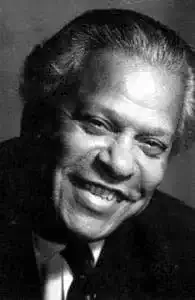
Nicolás Guillén
1902–1989
· lived 87 years
 --
--
--
Nicolás Guillén was a Cuban poet, considered one of the most important figures in 20th-century Latin American literature. His work is characterized by the fusion of Afro-Cuban and Spanish rhythms, exploring themes such as racial identity, social justice, and popular culture. He is known for his innovative use of language, incorporating colloquialisms and elements of everyday speech. Guillén was also a committed political activist, and his poetry often reflects his struggle against racism and oppression.
n. 1902-07-10, Camagüey · m. 1989-07-16, Havana
42
Views
Bio
Identification and Basic Context
Nicolás Guillén was a Cuban poet, recognized as one of the most influential voices in the literature of his country and of Latin America. Born in Camagüey, his work is deeply tied to Cuban identity, with a strong presence of Afro-Cuban elements and a penetrating social critique. His poetic language is Spanish.Childhood and Education
Born into a middle-class family, Guillén received an education that allowed him access to cultural and intellectual circles. From a young age, he showed an interest in literature and poetry, influenced by the social and political context of Cuba, marked by racial discrimination and economic dependence.Literary Career
Guillén's career began in his youth with collaborations in local newspapers and magazines. His work evolved from more lyrical poetry towards committed social and political lyricism. He became a central figure in Cuban poetry, actively participating in the island's cultural and political life, even assuming diplomatic roles.Work, Style, and Literary Characteristics
Among his most notable works are "Motivos de Son" (1930), "Sóngoro Cosongo" (1931), "West Indies Ltd." (1934), and "El son entero" (1947). His style is characterized by musicality, the incorporation of rhythms and turns of phrase from Cuban popular speech, and the themes of Blackness and racial identity. Guillén experimented with poetic forms, but his distinctive mark is the fusion of the cultured and the popular, the lyrical and the social. His poetic voice is often ironic, combative, and profoundly human.Cultural and Historical Context
Guillén lived and wrote during a crucial period in Cuban and Latin American history, marked by the Machado dictatorship, the Cuban Revolution, and the Cold War. He belonged to the Generation of '30, and his work engages with the literary currents of the time, such as surrealism and negrismo, but always maintaining his own voice and an unwavering social commitment. He was a staunch opponent of racism and social injustice.Personal Life
His life was marked by his political commitment and social activism. He maintained close relationships with other intellectuals and artists of his time, both in Cuba and abroad. His personal experiences and political militancy profoundly influenced his poetic work, imbuing it with unparalleled authenticity and strength.Recognition and Reception
Nicolás Guillén enjoyed great recognition during his life and posthumously. He received numerous awards and distinctions, and his work was translated into several languages. He is considered one of the pillars of Cuban literature and a key figure in 20th-century Spanish-language poetry. His popularity transcended academic circles.Influences and Legacy
Guillén was influenced by poets such as Rubén Darío and Walt Whitman, but his greatest contribution was the creation of a poetic language that integrated Afro-Cuban orality and musicality. His legacy lies in having elevated popular culture and Afro-descendant identity to the category of universal poetic art, inspiring generations of poets in Cuba and Latin America.Interpretation and Critical Analysis
Guillén's work has been the subject of numerous critical studies that analyze his mastery in fusing rhythms, his social commitment, and his complex representation of Cuban identity. His ability to address universal themes from a local perspective, deeply rooted in his culture, is highlighted.Childhood and Education
Although known for his poetry, Guillén also ventured into prose and journalism. His public image was always linked to his political commitment, but in his private life, he was an affable and cultured man. His manuscripts and correspondence reveal the deep reflection behind his apparent simplicity.Death and Memory
He passed away in Havana, leaving an indelible literary legacy. His memory remains alive through the reading of his work and the study of his contribution to Cuban and universal culture.Poems
0No poems found
Comments (0)
Log in
to post a comment.
No comments yet. Be the first to comment.