
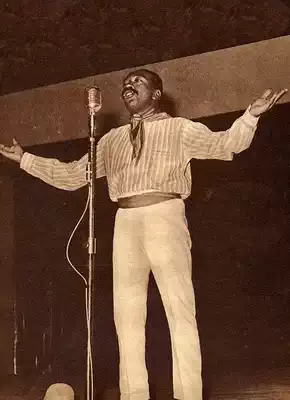
Nicomedes Santa Cruz
 --
--
Nicomedes Santa Cruz was a Peruvian poet, decimista, researcher, and literary critic, fundamental in the revaluation of Afro-Peruvian culture. His poetic work, marked by a deep social commitment and a masterful command of the décima, addressed themes such as the identity, discrimination, history, and traditions of the Afro-descendant community in Peru. He was a tireless promoter of popular culture and an intellectual reference, whose work contributed to making the Afro-Peruvian legacy visible and dignified on a national and international level.
n. 1925-06-04, Lima · m. 1992-02-05, Madrid
Bio
Identification and basic context
Nicomedes Santa Cruz Gamarra was a Peruvian poet, decimista, researcher, playwright, and literary critic. Born and died in Lima, Peru. He came from a working-class family with deep roots in Afro-Peruvian culture. He wrote in Spanish, and his work is situated in the context of the second half of the 20th century, a period of significant social and cultural movements in Peru and Latin America.Childhood and education
His childhood took place within a family that valued Afro-Peruvian oral and musical traditions. He was largely self-taught, dedicating his life to the study and dissemination of Afro-Peruvian culture. He assimilated the rich tradition of the décima and criollo music, as well as literary currents that addressed social and identity themes.Literary career
He began his literary career exploring poetry and the décima. He soon distinguished himself by his virtuosity in this metric form, using it to address social and Afro-Peruvian identity themes. He was a tireless researcher and cultural promoter, creating and directing groups and publications dedicated to Afro-Peruvian culture, such as the magazine "Fanal." His work is characterized by constant evolution in the deepening of its themes and in formal experimentation within the décima.Work, style, and literary characteristics
Among his most important works are "Décimas" (1959), "Ritmos de la negritud" (1960), "Canto a la patria" (1960), and "Gente de mi tierra" (1970). His central themes are Afro-Peruvian identity, racial discrimination, the history of slavery, blackness, social justice, and the defense of popular cultures. His style is characterized by his absolute command of the décima, the expressive force of his language, musicality, and rhythm. He used direct and emotive language, often charged with irony and denunciation. His poetic voice is combative, vindicative, and deeply rooted in his cultural heritage. He is associated with social poetry and the movement of revaluation of Afro-descendant culture.Cultural and historical context
Santa Cruz lived during the period of greatest visibility and organization of the Afro-Peruvian movement. He was a contemporary of important Peruvian intellectuals and artists who addressed social and racial issues. His work is framed within a context of seeking national identity and recognition of the diverse cultures that make up Peru. He played an important role in disseminating Afro-Peruvian culture in the face of a hegemonic cultural discourse.Personal life
He lived a life dedicated to research, writing, and the dissemination of Afro-Peruvian culture. He maintained a strong connection with his community and its traditions. His social and cultural commitment was a constant in his life, dedicating much of his time and effort to promoting his heritage.Recognition and reception
Although his recognition during his lifetime was significant within intellectual and cultural circles committed to Afro-Peruvian themes, his work has gained greater posthumous projection. He is considered an unavoidable reference in Afro-Peruvian literature and culture, and his legacy is the subject of study and admiration.Influences and legacy
He was influenced by the Afro-Peruvian oral tradition and by social and vindicatory literature. His legacy is fundamental to understanding Afro-Peruvian history and culture, and he has inspired numerous poets and artists to explore and disseminate their roots. His contribution to Peruvian décima is invaluable.Interpretation and critical analysis
His work is interpreted as an act of cultural resistance and a call for social justice. His formal virtuosity in the décima and his ability to express the complexity of the Afro-Peruvian experience are analyzed. He has been the subject of studies on identity, race, and literature.Childhood and education
In addition to his literary work, he was an active promoter of cultural events and festivals dedicated to Afro-Peruvian music and dance. His knowledge of the history and traditions of his people was encyclopedic.Death and memory
Nicomedes Santa Cruz died in 1991. His memory is kept alive through the work he bequeathed and the institutions and collectives that continue his work of disseminating and revaluing Afro-Peruvian culture.Poems
0No poems found
Comments (0)
No comments yet. Be the first to comment.