
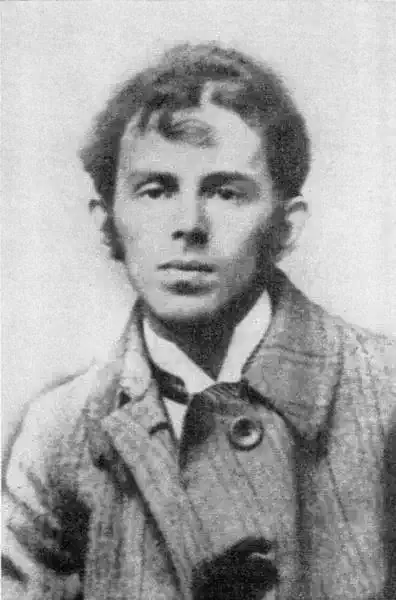
Ossip Mandelstam
1891–1938
· lived 47 years
 PL
PL
PL
Ossip Mandelstam was an influential Russian poet, considered one of the greatest exponents of 20th-century poetry. His work is marked by intellectual depth, richness of imagery, and the ability to evoke time and memory. He faced political repression in the Soviet Union, which led to his arrest and death in tragic circumstances. His poetry, although often dark and marked by pain, is a testament to the resilience of the human spirit and the power of art in the face of adversity.
n. 1891-01-03, Varsóvia · m. 1938-12-27, Gulag
70
Views
Bio
Identification and basic context
Ossip Emilievich Mandelstam was a Russian poet, born in Warsaw, then part of the Russian Empire, on January 3, 1891 (January 2, 1891, Julian calendar) and died on December 27, 1938. Although born on Polish territory, his life and work are intrinsically linked to Russia. He was the son of Jewish parents, Emil Veniaminovich Mandelstam and Flora Osipovna Verkhovskaya, who would later convert to Protestantism and Orthodox Christianity, respectively. Mandelstam wrote in Russian and his work is a cornerstone of Russian literature.Childhood and education
When Ossip was two years old, the family moved to St. Petersburg, the cultural and political center of the Russian Empire. His childhood was marked by the family's conversion to Orthodox Christianity and his education in elite institutions. He attended the prestigious Tenishev Institute in St. Petersburg, where he received a comprehensive humanist education, including literature, history, and languages. It was during these formative years that he began to develop his love for poetry and the arts. His early readings included everything from classical Russian poetry to European authors and philosophy.Literary career
Mandelstam began writing poetry in his adolescence and quickly stood out on the St. Petersburg literary scene. He became a central figure of the Russian Symbolist movement, although his work soon transcended the boundaries of this movement, developing its own unique style. He published his first book of poetry, "Stone" (Kamni), in 1913, followed by "Tristia" (1922) and "The Age of Metal" (1927). His literary career was interrupted and marked by the political persecution of the Soviet regime. Despite this, he continued to write, often in secret, and his work maintained remarkable strength and coherence over time.Work, style, and literary characteristics
Work, style, and literary characteristics Mandelstam's major works include "Stone," "Tristia," "The Second Book," "The Age of Metal," and poems written later, many of which were only published posthumously. The dominant themes in his work are time, memory, classical culture, the city (especially St. Petersburg and Rome), mortality, faith, and human resistance in the face of oppression. His style is characterized by its imagistic density, intellectual complexity, musicality, and philosophical depth. Mandelstam experimented with poetic forms, but often returned to classical structures, such as the sonnet, imbuing them with modern meaning. His language is precise, evocative, and laden with cultural allusions. He is often associated with Symbolism, but his style evolved into something more personal, marked by his historical and existential experience.Work, style, and literary characteristics
Cultural and historical context Mandelstam lived in a period of profound transformations in Russia: World War I, the Russian Revolution of 1917, the Civil War, and the beginning of the Stalinist regime. His work reflects the turbulence of these times, the loss of one world and the rise of another. He was friends with many of the great poets of his generation, such as Anna Akhmatova and Boris Pasternak, with whom he shared aesthetic and existential concerns, but also faced the political and artistic tensions of the era. Although not openly a political dissident at first, his poetry, with its emphasis on culture and individuality, became increasingly problematic for the Soviet regime. He was a member of the "Cephadiano" group of poets, linked to Symbolism.Work, style, and literary characteristics
Personal life Mandelstam's personal life was profoundly affected by the political circumstances of the Soviet Union. He married Nadezhda Khazina in 1922, who became his faithful companion and the guardian of his work, transcribing and saving many of his poems from destruction. His health was fragile and his financial situation precarious. He lived a life of relative poverty and insecurity, constantly under the threat of state surveillance and repression. His religious convictions, although Orthodox, were more cultural and existential than strictly dogmatic. His political stance, though not explicitly oppositional, was incompatible with official Soviet ideology due to his deep respect for culture and individual freedom.Work, style, and literary characteristics
Recognition and reception During his lifetime, Mandelstam had considerable recognition within Russian literary circles, but his publication became increasingly difficult under the Soviet regime. His work only began to be truly recognized internationally after his death, especially with Nadezhda Mandelstam's efforts to preserve and disseminate his writings. Today, he is considered one of the greatest Russian-language poets of the 20th century, with a vast body of critical and academic work dedicated to his study.Work, style, and literary characteristics
Influences and legacy Mandelstam was influenced by Russian Symbolist poets like Alexander Blok, by French poetry, and by classical Greek and Roman culture. His poetry, in turn, profoundly influenced later generations of Russian and international poets, being admired for his formal mastery, intellectual depth, and existential courage. He is an indispensable figure in the canon of Russian and world poetry. His work has been widely translated and studied, consolidating his legacy as a testament to art in dark times.Work, style, and literary characteristics
Interpretation and critical analysis Mandelstam's work has been the subject of numerous interpretations, focusing on his relationship with classical tradition, his reflection on time and history, and his ability to resist dehumanization through art. His poetry is seen as a constant dialogue with Western and Eastern culture, and as a meditation on the human condition. His experiences with Stalinist repression add a layer of meaning to his work, viewed as an act of defiance and preservation of human dignity.Work, style, and literary characteristics
Curiosities and lesser-known aspects Mandelstam possessed a prodigious memory and a vast encyclopedic knowledge. He had a deep love for music and architecture, elements that are often reflected in his poetry. He was known for a certain social detachment and an intellectual intensity that sometimes made him a difficult interlocutor. His travel notes, such as "Journey to Armenia," reveal a sharp eye and a sensitivity to the cultures and landscapes around him. His writing process was rigorous, with constant revisions.Work, style, and literary characteristics
Death and memory Ossip Mandelstam was arrested in 1934 because of a satirical poem about Stalin. After a period of exile in Voronezh, he was arrested again and sent to a transit camp in Vtoraya Rechka, near Vladivostok, in the Russian Far East. He died under uncertain circumstances, likely from exhaustion, starvation, or illness, in the camp in December 1938. His death marked the tragic end of one of the most important poetic voices of the 20th century. His memory has been honored with official rehabilitation and the posthumous publication of his complete works.Poems
0No poems found
Quotes
6No poems found
Comments (0)
Log in
to post a comment.
No comments yet. Be the first to comment.