
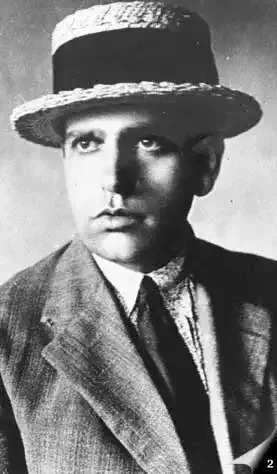
Oswald de Andrade
1890–1954
· lived 64 years
 BR
BR
BR
Oswald de Andrade was a Brazilian poet, novelist, and essayist, a central figure of modernism in Brazil. His work is marked by irreverence, linguistic experimentation, and a strong critique of traditional values and foreign influence on Brazilian culture. He was one of the initiators of the Modern Art Week of 1922, an event that introduced European avant-gardes to the country, proposing a genuinely national art, stripped of academicism and focused on Brazilian roots.
n. 1890-01-11, São Paulo · m. 1954-10-22, São Paulo
47
Views
Bio
Identification and basic context
Oswald de Andrade (full name: José Oswald de Andrade) was one of the most influential Brazilian writers of the 20th century, the best-known pseudonym of José Oswald de Andrade. Born on May 11, 1890, in São Paulo, and died on October 22, 1954, in the same city. Son of Mário de Andrade (homonym of the modernist writer) and Guiomar de Andrade, he belonged to a family of the São Paulo coffee elite, which gave him a privileged education and access to intellectual and artistic circles. He was Brazilian and wrote in Portuguese. He lived in a period of intense transformations in Brazil, marked by the urban and industrial growth of São Paulo, the first decades of the Republic, and the growing influence of European artistic avant-gardes.Childhood and education
Oswald de Andrade had a comfortable childhood in São Paulo, attending primary school at Colégio São Bento and, later, secondary school at Ginásio São Paulo. His formal education was complemented by a strong interest in literature, art, and culture, absorbing influences from classical and contemporary authors, as well as European philosophical and artistic currents, such as Futurism and Cubism. His trip to Europe in 1912 and 1913 was a milestone in his youth, where he came into direct contact with the cultural effervescence of Paris, consolidating his desire to modernize Brazilian art.Literary career
Oswald de Andrade began his literary career in journalism, publishing chronicles and poems in São Paulo newspapers from 1909 onwards. His major literary debut was the poetry book "Pau-Brasil" (1925), followed by "Primeiro Caderno do Aluno de Poesia Oswald de Andrade" (1927), both emblematic of the modernist movement. Throughout his work, Oswald showed remarkable evolution, moving from an initial lyricism to a more concise, ironic, and engaged poetry with Brazil's social and cultural issues. He actively collaborated with various avant-garde magazines and newspapers, such as "Klaxon" and "Revista de Antropofagia", where he also acted as an important cultural articulator and theorist.Work, style, and literary characteristics
Oswald de Andrade's main works include the poetry books "Pau-Brasil" (1925), "Primeiro Caderno do Aluno de Poesia Oswald de Andrade" (1927), "Serpente Dourada" (1928), and the novels "Memórias Sentimentais de João Miramar" (1924) and "Serafim Ponte Grande" (1933). His dominant themes address Brazilian identity, criticism of colonization, modernity, urban daily life, love, and Brazilianness. In terms of form, Oswald experimented with free verse, fragmentation, brevity, and colloquial language, breaking with traditional poetic structures. His style is marked by irony, irreverence, humor, conciseness, and synthesis, using resources such as metaphor and alliteration to create an agile and musical rhythm. The poetic voice is often personal and ironic, but also turns to a critical view of society and culture. Oswald introduced formal and thematic innovations by proposing an "exportable" poetry, which valued raw material and the strength of Brazilian culture, dialoguing with tradition and modernity in an original way. He is associated with the Brazilian Modernist Movement, being one of its pillars, especially with the proposal of Anthropophagy.Work, style, and literary characteristics
Cultural and historical context Oswald de Andrade lived in a period of intense transformations in Brazil and the world. His work directly dialogues with historical events, such as the Modern Art Week of 1922, the Vargas Era, and debates about national identity. He belonged to the first Brazilian modernist generation, alongside Mário de Andrade and Manuel Bandeira, forming a group that sought to break with academicism and create modern and national art. His political position, though not always explicit, was one of strong criticism of the prevailing social and cultural structures, advocating for greater cultural autonomy and the valorization of authentic Brazil. Brazilian society and culture, with their contradictions between the archaic and the modern, the European and the native, were central themes in his work. Oswald had dialogues and tensions with other writers of his time, actively participating in intellectual debates.Work, style, and literary characteristics
Personal life Oswald de Andrade had a turbulent personal life, marked by two marriages: the first to primorosa de Camargo Aranha and the second to the painter Tarsila do Amaral, a prominent figure of modernism. These relationships influenced his work, especially the anthropophagic phase, in which his partnership with Tarsila was fundamental. His friendship with Mário de Andrade was one of the intellectual pillars of modernism, although there were also creative rivalries. Oswald faced personal and financial crises throughout his life, and his health also suffered from alcoholism. Professionally, besides writing, he worked as a lawyer and a civil servant, but poetry was his passion and main activity. His philosophical and political beliefs were aligned with the desire for renewal and cultural autonomy for Brazil.Work, style, and literary characteristics
Recognition and reception Oswald de Andrade is widely recognized as one of the fathers of Brazilian modernism and an essential figure in Portuguese-language literature. Although in life he received some recognition for his boldness and innovation, the definitive consecration of his work occurred posthumously, with the deepening of modernist studies and the rediscovery of his relevance. His popularity remained among readers interested in avant-garde literature, and his academic recognition is undisputed, being the subject of numerous studies and theses.Work, style, and literary characteristics
Influences and legacy Oswald de Andrade was profoundly influenced by European avant-gardes, such as Futurism, Cubism, and Surrealism, but also by Brazilian popular culture, and indigenous and African art. His work, in turn, influenced later generations of Brazilian poets and writers, marking national literature with his irreverence, his innovative language, and his social and cultural critique. His legacy lies in the break with academicism, in the proposition of an authentic Brazilian cultural identity, and in the formal experimentation that paved the way for contemporary poetry. His work continues to be studied and admired internationally, with translations into various languages.Work, style, and literary characteristics
Interpretation and critical analysis Oswald de Andrade's work allows for multiple readings, from the perspective of criticism of tradition and colonization to the celebration of modernity and Brazilian culture. His poems explore philosophical and existential themes, such as the ephemerality of time, the search for identity, and man's relationship with the world. There have been critical debates about his political stance and his relationship with nationalism, but the genius of his aesthetic proposal is widely recognized.Work, style, and literary characteristics
Curiosities and lesser-known aspects A curious aspect of Oswald de Andrade's personality is his constant pursuit of innovation and his ability to reinvent himself. He possessed a sharp wit and an irreverence that sometimes shocked the conservative society of his time. A notable episode was his active participation in the Modern Art Week, where his works and ideas caused controversy. His writing habits, although not detailed, were characterized by speed and inspiration, often writing in notebooks and loose sheets. Oswald de Andrade's correspondence is a rich source for the study of his life and work.Work, style, and literary characteristics
Death and memory Oswald de Andrade died in São Paulo on October 22, 1954, after a long illness. His death marked a milestone for Brazilian modernism. Posthumous publications of his writings, including letters and unpublished texts, continued to enrich the literary collection and the poet's memory, consolidating his place as one of the greatest names in Brazilian literature.Poems
0No poems found
Comments (0)
Log in
to post a comment.
No comments yet. Be the first to comment.