
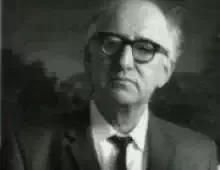
Patrick Kavanagh
1904–1967
· lived 63 years
 IE
IE
IE
Patrick Kavanagh was an Irish poet whose works are marked by a deep connection to the land, the simplicity of rural life, and a brutal honesty about the struggles and joys of existence. His poetry, often autobiographical, explores themes such as identity, faith, solitude, and the search for beauty in everyday life. Kavanagh is celebrated for his authentic voice and his ability to evoke landscapes and emotions with lyrical clarity and existential depth.
n. 1904-10-21, Inniskeen · m. 1967-11-30, Dublin
27
Views
Bio
Identification and basic context
Patrick Kavanagh was born in Ireland and is considered one of the most important Irish poets of the 20th century. He is often associated with poetry that celebrates and, at the same time, reflects on rural life and the peasant experience.Childhood and education
Kavanagh was born into a farming family in Monaghan, Ireland. His formal education was limited, but he was an avid and self-taught reader. Life in the countryside and agricultural work profoundly shaped his worldview and his poetic work.Literary career
The beginning of Kavanagh's literary career was marked by the publication of his early poems, which quickly drew attention for their authenticity and rural themes. He went through different phases, including a period of greater experimentation and, later, a return to a more direct and lyrical form. His activity as a literary critic and columnist was also relevant.Work, style, and literary characteristics
Patrick Kavanagh's works, such as "The Great Hunger" and "Tarry Flynn" (the novel that later became a play), explore themes such as poverty, religion, repressed sexuality, and the brutality of rural life in Ireland. His style is characterized by direct language, without excessive artifice, and by the ability to evoke vivid images and deep emotions. He is known for his lyrical and, at times, ironic voice, which transitions between the confessional and the universal. Kavanagh played an important role in introducing more earthy and realistic themes into Irish poetry.Cultural and historical context
Kavanagh lived and wrote during a period of great transformations in Ireland, including the War of Independence and the Civil War. His work reflects the social, religious, and cultural tensions of the country, especially the dichotomy between traditional rural life and the influences of modernity. He had complex relationships with other writers and literary circles, often feeling marginalized.Personal life
Kavanagh's life was marked by financial difficulties, conflicts with critics, and health problems. His personal relationships, including his marriages, and his struggles with alcoholism, were often reflected in his poetry, giving it a confessional and sometimes tormented tone.Recognition and reception
Although he faced difficulties and criticism throughout his career, Patrick Kavanagh is today widely recognized as a central figure in Irish literature. His poems are studied and celebrated for their depth and authenticity, and he is seen as a precursor to Irish modernism.Influences and legacy
Kavanagh was influenced by poets such as Gerard Manley Hopkins and W.B. Yeats, but he developed a unique voice. He, in turn, influenced later generations of Irish poets, who found in his work a model of honesty and exploration of national and personal identity. His work continues to be translated and studied internationally.Interpretation and critical analysis
Kavanagh's work has been interpreted in various ways, with particular emphasis on analyses of his relationship with Catholicism, his social criticism, and his exploration of the human condition. His reflections on art and life, often ironic, have generated debates about the authenticity and purpose of poetry.Curiosities and lesser-known aspects
Kavanagh was known for his difficult temperament and his disputes with critics and other writers. He was also a man of deep faith, despite his struggles and his criticism of certain religious institutions.Death and memory
Patrick Kavanagh passed away in Dublin, leaving a lasting legacy in Irish poetry. His work continues to be read, admired, and studied, ensuring his memory as one of his country's great poets.Poems
0No poems found
Quotes
2Comments (0)
Log in
to post a comment.
No comments yet. Be the first to comment.