
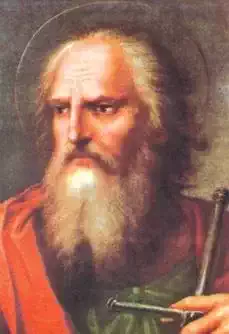
Paulo de Tarso
 TR
TR
Paul of Tarsus, a central figure in early Christianity, is known for his extraordinary journey from persecuting Christians to conversion and his subsequent role as one of the most influential apostles. His vast epistolary work, compiled in the New Testament, profoundly shaped Christian theology and practice, establishing fundamental doctrines on faith, salvation, and the nature of Christ. His expansive theology and tireless missionary activity throughout the territories of the Roman Empire were crucial for the dissemination and consolidation of Christianity as a global religion. His legacy endures as one of the intellectual and spiritual pillars of the Christian faith.
n. 1966-04-06, Tarso, na Cilícia, Império Romano · m. , Roma, Itália
Bio
Identification and basic context
Paul of Tarsus, originally Saul of Tarsus, was a prominent figure in early Christianity. Born in Tarsus, Cilicia (modern-day Turkey), he was a Jew of the Diaspora with Roman citizenship. His mother tongue was Greek, but he also spoke Hebrew and possibly Latin. He lived in the context of the Roman Empire, during a period of religious and cultural effervescence, and growing tension between Judaism and new currents of thought.Childhood and education
Saul grew up in Tarsus, a city known for its intellectual center. He received a rigorous Jewish education, becoming a devout Pharisee zealous for the Mosaic Law. He was educated in Jerusalem, where he studied at the feet of Gamaliel, a renowned master of the Law. This training gave him a deep knowledge of Jewish scriptures and rabbinic traditions, which he would later use to argue and defend his theological positions.Literary career
Paul is the author of a large part of the New Testament epistles, which constitute a substantial part of his work. These letters were written to various Christian communities and individuals, addressing theological, doctrinal, and practical issues. His epistles are milestones in the formation of Christian theology and offer a glimpse into the concerns of the early communities.Work, style, and literary characteristics
Paul's work is fundamentally theological and pastoral. Through his epistles (such as Romans, Corinthians, Galatians, Ephesians, Philippians, Colossians, Thessalonians, Timothy, Titus, Philemon, Hebrews - although the authorship of the latter is debated), he developed central Christian doctrines, such as justification by faith, the redemptive work of Christ, life in the Holy Spirit, and the nature of the Church as the body of Christ. His style is argumentative, passionate, and often dialectical, with a rich vocabulary and complex reasoning. He uses rhetoric, examples from the Old Testament, and his own life experience to persuade and instruct.Cultural and historical context
Paul lived in a period of great upheaval in the eastern Mediterranean. The Roman Empire provided relative peace and infrastructure that facilitated his missionary journeys. Judaism was divided among different sects (Pharisees, Sadducees, Essenes), and Hellenism with its philosophies and mystery religions influenced culture. The rise of Christianity, initially seen as a Jewish sect, challenged both traditional Judaism and the pagan religions of the empire.Personal life
Paul, as Saul, was a fervent persecutor of early Christians. His conversion, which occurred on the road to Damascus, was a transformative event. He dedicated the rest of his life to preaching the Gospel, traveling extensively throughout the Greco-Roman world. He suffered persecutions, imprisonments, shipwrecks, and lashings, but persevered in his mission. His personal life was marked by total dedication to the Christian cause, prayer, and study of the scriptures.Recognition and reception
Paul is widely recognized as the "Apostle to the Gentiles" and one of the most important figures in the history of Christianity. His epistles have become an integral part of the biblical canon and form the basis of much of Christian theology. During his lifetime, he faced opposition from both Jews and Christians who questioned his authority, but his legacy was consolidated after his death.Influences and legacy
Paul was deeply influenced by Pharisaic Judaism and the teachings of Jesus (obtained, according to him, by divine revelation and the testimony of the apostles). He, in turn, decisively influenced the development of Christian theological thought, the expansion of the Church, and its adaptation to the Greco-Roman world. His work is still studied today by theologians, historians, and faithful people worldwide.Interpretation and critical analysis
Paul's theology has been the subject of continuous interpretations and debates over the centuries. Questions such as the relationship between law and grace, the role of Israel in the divine plan, the interpretation of specific passages from his epistles, and his relationship with Christian ethics are subjects of constant critical analysis.Curiosities and lesser-known aspects
Paul was a craftsman, possibly a tentmaker, which allowed him to support himself during his missionary journeys. His figure is complex, combining intellectual rigor with evangelizing passion.Death and memory
Christian traditions point to his martyrdom in Rome during Nero's persecution. His memory is celebrated liturgically, and his legacy as the foremost missionary and theologian of early Christianity is undeniable.Poems
0No poems found
Videos
50
Comments (0)
No comments yet. Be the first to comment.