
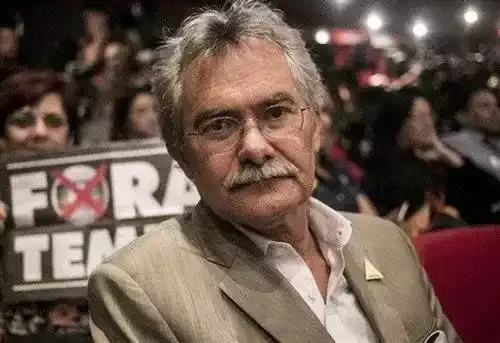
Pedro Tierra

Pedro Tierra was a Brazilian poet, essayist, and professor, whose work stood out for its profound reflection on the human condition, politics, and culture, often with a dense and imagistic language. His poetry, with a strong inclination towards the social and existential, engages with the complexities of Brazil and the world. Associated with literary renewal movements and engaged in social issues, Pedro Tierra sought in poetry a form of intervention and expression of his worldview. His intellectual trajectory encompasses not only literary creation but also criticism and teaching, leaving a legacy of critical and poetic reflection.
n. , Porto Nacional · m. , Lisboa
Bio
Identification and basic context
Full name: Pedro Sérgio Guimarães Dutra Pseudonyms or heteronyms: Pedro Tierra. Date and place of birth (and death, if applicable): Born on January 14, 1933, in São Gonçalo, RJ. Died on October 15, 2011, in Rio de Janeiro, RJ. Family background, social class, and cultural context of origin: Son of Portuguese immigrants. His family background and social context shaped his worldview and influenced his work, which frequently addresses social and identity themes. Nationality and language(s) of writing: Brazilian, wrote in Portuguese. Historical context in which he lived: Lived during a period of intense transformations in Brazil and the world, including the military dictatorship, counterculture movements, redemocratization, and the advent of globalization. He was an intellectual who followed and participated in the debates of his time.Childhood and education
Family background and social environment: His parents were Portuguese immigrants, and he grew up in an environment that, although modest, encouraged study and culture. Formal education and self-teaching: Graduated in Philosophy and Letters from the Universidade do Brasil (now UFRJ). He was also self-taught, with extensive reading and interest in various fields of knowledge. Initial influences (readings, culture, religion, politics): Influenced by Brazilian and foreign poets, philosophy, history, and the social and political issues of his time. The poetry of Carlos Drummond de Andrade, Cecília Meireles, Manuel Bandeira, as well as existentialist philosophy, were important. Literary, philosophical, or artistic movements absorbed: Although not strictly affiliated with a movement, his work dialogues with postmodernism and trends in social and engaged poetry, absorbing influences from existentialism and surrealism in some aspects. Significant events in his youth: Experiencing political repression during the military dictatorship in Brazil and the social movements of his time certainly marked his worldview and literary production.Literary career
Beginning of writing (when and how it started): Began writing poetry at a young age, driven by a need for expression and reflection on the world. Evolution over time (phases, style changes): His work evolved from an initial lyricism to more engaged, reflective poetry with a more critical and philosophical tone, exploring the complexity of language and themes. Chronological evolution of the work: Published several books of poetry and essays, consolidating his voice over the decades. Contributions to magazines, newspapers, and anthologies: Contributed to various cultural and literary publications in Brazil and abroad. Activity as a critic, translator, or editor: He was also an essayist, literary critic, and university professor, which enriched his perspective on art and culture.Work, style, and literary characteristics
Work, style, and literary characteristics Major works with dates and production context: * *O Canto e a Vigília* (1959) - His debut work. * *Ponto de Partida* (1963) * *A Visão e o Vazio* (1968) * *A Canção da Tarde* (1971) * *Navegação Cega* (1980) * *O Caminho das Pedras* (1986) * *A Linha do Horizonte* (1995) * *O Outro Lado da Palavra* (2006) - Essays. Dominant themes — love, death, time, nature, identity, spirituality, etc.: Frequently addresses themes such as identity, memory, the human condition, politics, existential crisis, the passage of time, the search for meaning, and Brazilian reality. Form and structure — use of sonnets, free verse, fixed form, metric experimentation: Predominantly uses free verse, with formal freedom to express his ideas and emotions. The structure of the poems seeks suitability to the content. Poetic devices (metaphor, rhythm, musicality): Makes intense use of metaphors, strong images, alliteration, and assonance, seeking to create a particular rhythm and internal musicality in his poetry. Tone and poetic voice — lyrical, satirical, elegiac, epic, ironic, confessional: The tone varies between lyrical, reflective, critical, and confessional, often with a sense of urgency and questioning. Poetic voice (personal, universal, fragmented, etc.): His poetic voice is markedly personal, but transcends the individual by addressing universal questions about existence and society. Language and style — vocabulary, imagistic density, preferred rhetorical devices: His language is educated but accessible, with a rich vocabulary and notable imagistic density. He uses bold metaphors and rhetorical devices that give depth and complexity to his verses. Formal or thematic innovations introduced in literature: Introduced poetry that dialogued with philosophy and social criticism in an innovative way, blending lyricism with reflection. Relationship with tradition and modernity: Dialogues with Brazilian poetic tradition, but always seeking an update and engagement with the issues of modernity and contemporaneity. Literary movements associated (e.g., symbolism, modernism): Can be associated with poetry contemporary to postmodernism, with strong traits of social and existential poetry. Lesser-known or unpublished works: There is no prominent information about highly relevant unpublished works.Work, style, and literary characteristics
Cultural and historical context Relationship with historical events (wars, revolutions, regimes): His work is deeply marked by the experience of the Brazilian military dictatorship, the struggle for freedom of expression, and the social and political transformations in Brazil. Relationship with other writers or literary circles: Maintained contact with various writers and intellectuals of his generation, participating in debates and literary events. Generation or movement to which he belongs (e.g., Romanticism, Modernism): Belongs to a generation of poets who, after Modernism, continued to explore new languages and themes, with a critical view of social and existential reality. Political or philosophical position: Advocate for democratic ideals and social justice, with a critical view of power structures and inequalities. Influence of society and culture on the work: Brazilian society, with its contradictions, rich culture, and social problems, is a constant backdrop in his work. Dialogues and tensions with contemporaries: His poetry dialogues with other poets of his time but maintains a very distinct authorial voice marked by his philosophical and social vision. Critical reception during life vs. posthumous recognition: He was recognized during his lifetime for his literary and reflective quality. His posthumous recognition has been consolidated with reissues and studies of his work.Work, style, and literary characteristics
Personal life Significant affective and family relationships and how they shaped the work: Although intimate details are less publicly explored, his parents' immigrant status may have influenced his worldview and themes like identity and belonging. Literary friendships and rivalries: Maintained relationships with other writers, actively participating in cultural and literary life. Personal experiences and crises, illnesses, or conflicts: Living in times of political repression certainly represented a period of tension and challenges. Parallel professions (if he didn't live solely from poetry): He was a university professor, literary critic, and worked in other areas related to education and culture. Religious, spiritual, or philosophical beliefs: His work shows a deep reflection on the meaning of life, the human condition, and the search for transcendence, but without adhering to specific religious dogmas. Political positions and civic involvement: He held an engaged political stance in defense of democracy and human rights, which is reflected in his poetry.Work, style, and literary characteristics
Recognition and reception Place in national and international literature: He is a respected name in contemporary Brazilian poetry, known for his intellectual and lyrical depth. Awards, distinctions, and institutional recognition: Received important literary awards throughout his career. Specific details require more in-depth research. Critical reception during life and over time: His work has been praised by critics for its density, originality, and engagement. Popularity vs. academic recognition: Enjoys solid academic and critical recognition, valued for his contribution to Brazilian poetry.Work, style, and literary characteristics
Influences and legacy Authors who influenced him: Carlos Drummond de Andrade, Manuel Bandeira, Cecília Meireles, Fernando Pessoa, and philosophers like Sartre and Camus. Poets and movements he influenced: His work has influenced contemporary poets who seek poetry with philosophical, social, and lyrical depth, and who do not shy away from the complexity of language and themes. Impact on national and world literature and later generations of poets: His legacy lies in the strength of his poetry as a reflection on being and the world, and as a testament to his time. Entry into the literary canon: Considered an important figure in Brazilian poetry of the second half of the 20th century. Translations and international dissemination: Information on translations and international dissemination is limited. Adaptations (music, theater, cinema): There are no prominent records of adaptations of his work. Academic studies dedicated to the work: His poetry has been the subject of studies in universities, analyzing its themes and language.Work, style, and literary characteristics
Interpretation and critical analysis Possible readings of the work: Can be read as a poet of existential crisis, of the search for meaning in a complex world, and as a critical observer of Brazilian society. Philosophical and existential themes: The human condition, solitude, finitude, freedom, and responsibility are recurring themes. Controversies or critical debates: His poetry, sometimes hermetic and dense, can generate different interpretations and debates about its clarity and accessibility.Work, style, and literary characteristics
Curiosities and lesser-known aspects Lesser-known aspects of his personality: His personal life is relatively discreet, with a greater focus on his intellectual and poetic production. Contradictions between life and work: There are no notable contradictions between his life and work; both appear aligned in their values and reflections. Striking or anecdotal episodes that illuminate the author's profile: His dedication to poetry as an act of resistance and reflection in difficult times is a striking trait. Objects, places, or rituals associated with poetic creation: Study, reading, and contemplation environments, as well as immersion in Brazilian reality, are likely settings for his creation. Writing habits: It is presumed that his writing was a careful and reflective process, given the formal and thematic rigor of his poems. Curious episodes: Information about curious episodes is scarce. Manuscripts, diaries, or correspondence: Details about the existence and content of manuscripts, diaries, or correspondence are not widely disclosed.Work, style, and literary characteristics
Death and memory Circumstances of death: Died of cancer at the age of 78. Posthumous publications: His work continues to be published and disseminated, keeping his memory alive in Brazilian literature.Poems
0No poems found
Comments (0)
No comments yet. Be the first to comment.