
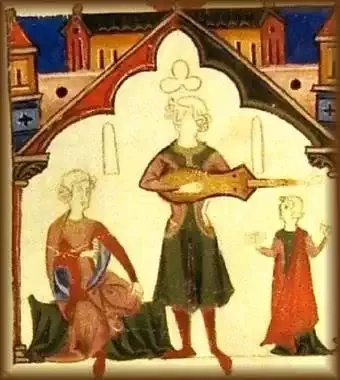
Pêro Garcia Burgalês

Pêro Garcia Burgalês was a Galician-Portuguese troubadour from the second half of the 13th century, known for his production of love and friend songs (cantigas de amor e de amigo). His work is an important testament to Iberian medieval lyric poetry, characterized by musicality, the expression of feelings, and the observation of the social and affective reality of the time. Burgalês stands out for his skill in exploring the conventions of courtly love and the themes of saudade (longing) and nature in his poetic compositions.
n. , Burgos
13
Views
Bio
Identification and basic context
Pêro Garcia Burgalês was a prominent Galician-Portuguese troubadour, active in the second half of the 13th century. His name suggests a possible origin linked to Burgos, in Spain, although his literary activity was predominantly within the context of the court of Afonso X of Castile and the kingdoms of Galicia and Portugal. He wrote in Galician-Portuguese. He lived in a period of intense literary production and cultural exchange in the Iberian Peninsula.Childhood and education
There is no detailed information about the childhood and specific education of Pêro Garcia Burgalês. It is presumed that, as a troubadour, he received an education that allowed him to master the art of poetry and music, possibly in courtly or ecclesiastical environments. His readings and absorption of literary movements would have been influenced by the Provençal lyric tradition and the emerging Peninsular poetry.Literary career
Pêro Garcia Burgalês is mainly known for his lyric work, integrating the corpus of the Cantigas de Santa Maria and other cantigas de amor e de amigo. His poetic production reflects the maturity of Galician-Portuguese lyric poetry. There are no records of extensive collaborations in specific newspapers or anthologies of the time, but his work was compiled in songbooks (cancioneiros).Work, style, and literary characteristics
The most well-known works of Pêro Garcia Burgalês include cantigas de amor and cantigas de amigo, which explore themes of courtly love, saudade (longing), nature, and the relationship between the maiden and her beloved. His style is marked by musicality, expressive delicacy, and adherence to troubadour conventions. He uses resources such as metaphor and personification to evoke feelings and landscapes. The poetic voice varies between the lament of unrequited love and the expression of the maiden's anxieties. The language is elaborate, yet accessible, with a strong rhythmic component. His work is part of the medieval Galician-Portuguese lyric movement.Cultural and historical context
Pêro Garcia Burgalês lived in a period of great cultural effervescence in the Iberian Peninsula, under the reign of Afonso X, the Wise, of Castile, a great patron of arts and sciences. The historical context included the Reconquista and the consolidation of the Christian kingdoms. His integration into courtly literary circles allowed for the exchange of ideas and the dissemination of his work through songbooks.Personal life
Little is known about the personal life of Pêro Garcia Burgalês. His exact identity and the details of his life are inferred from his poetic work and contextual references. There is no information about family or professional relationships outside his activity as a troubadour.Recognition and reception
The recognition of Pêro Garcia Burgalês lies in his contribution to the canon of Galician-Portuguese lyric poetry. His work has been preserved and studied, ensuring him a prominent place among medieval troubadours.Influences and legacy
Pêro Garcia Burgalês' influences include Provençal poetry and the Peninsular lyric tradition. His legacy lies in the consolidation of the cantiga de amor and cantiga de amigo, influencing later generations of poets in the Iberian tradition and the study of medieval literature.Interpretation and critical analysis
Burgalês' work has been the subject of critical analysis focused on the expression of amorous feeling, its relationship with the conventions of the time, and the representation of the female figure. Critical analysis explores the complexity of his songs within the context of medieval poetry.Curiosities and lesser-known aspects
The exact origin of his name and the full extent of his production are aspects that still generate debate among scholars.Death and memory
There is no precise information about the date and circumstances of Pêro Garcia Burgalês' death. His memory endures through the songbooks that preserved his poetic work.Poems
0No poems found
Comments (0)
Log in
to post a comment.
No comments yet. Be the first to comment.