

Quotes
Quotes to inspire and reflect
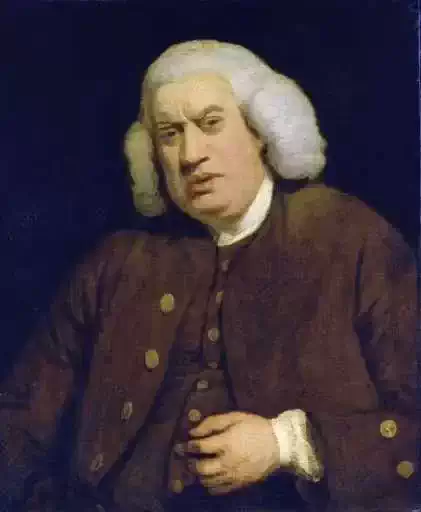
BOSEWELL: But is not the fear of death natural to man?
Sir, we know our will is free, and there’s an end on ’t.
[ Of John Hawkins :] Sir John, Sir, is a very unclubable man.
So far is it from being true that men are naturally equal, that no two people can be half an hour together, but one shall acquire an evident superiority over the other.
[ In response to Boswell’s observation that George Berkeley’s theory of the nonexistence of matter could not be refuted, Johnson kicked a large stone and said :] I refute it thus .
This was a good dinner enough, to be sure; but it was not a dinner to ask a man to.
Consider, Sir, how insignificant this will appear a twelvemonth hence.
[ To a woman who asked him why he had defined pastern in his Dictionary of the English Language as a horse’s knee :] Ignorance, Madam, pure ignorance.
[ Referring to his fits of melancholia :] The black dog I hope always to resist, and in time to drive. . . . When I rise my breakfast is solitary, the black dog waits to share it, from breakfast to dinner he continues barking. . . . Night comes at last, and some hours of restlessness and confusion bring me again to a day of solitude. What shall exclude the black dog from a habitation like this?
[ After being absent from a tutorial at Oxford because he had been “sliding in Christ Church meadow” :] JOHNSON: I had no notion that I was wrong or irreverent to my tutor. BOSWELL: That, Sir, was great fortitude of mind. JOHNSON: No, Sir; stark insensibility.
[ Of Alexander Pope’s The Rape of the Lock:] New things are made familiar, and familiar things are made new.
The want of human interest is always felt. Paradise Lost is one of the books which the reader admires and lays down, and forgets to take up again. None ever wished it longer than it is.
In the character of his [Thomas Gray’s] Elegy I rejoice to concur with the common reader; for by the common sense of readers uncorrupted with literary prejudices . . . must be finally decided all claim to poetical honors.
Words being arbitrary must owe their power to association, and have the influence, and that only, which custom has given them. Language is the dress of thought.
About the beginning of the seventeenth century appeared a race of writers that may be termed the metaphysical poets .
[ On a work by Congreve :] It is praised by the biographers. . . . I would rather praise it than read it.
While, an author is yet living we estimate his powers by his worst performance, and when he is dead we rate them by his best.
Shakespeare is above all writers, at least above all modern writers, the poet of nature; the poet that holds up to his readers a faithful mirror of manners and of life.
Nature has given women so much power that the law has very wisely given them little.
[ Of Shakespeare :] He that tries to recommend him by select quotations, will succeed like the pedant in Hierocles, who, when he offered his house to sale, carried a brick in his pocket as a specimen.
No people can be great who have ceased to be virtuous.
No sooner are we supplied with every thing that nature can demand, than we sit down to contrive artificial appetites.
PENSION. . . . In England it is generally understood to mean pay given to a state hireling for treason to his country.
STAMMEL. . . . Of this word I know not the meaning.
FAVORITE. . . . One chosen as a companion by his superior; a mean wretch whose whole business is by any means to please.
GRUBSTREET. . . . Originally the name of a street in Moorfields in London, much inhabited by writers of small histories, dictionaries, and temporary poems; whence any mean production is called grubstreet .
DULL. . . . Not exhilarating; not delightful; as, to make dictionaries is dull work .
EXCISE. . . . A hateful tax levied upon commodities, and adjudged not by the common judges of property, but wretches hired by those to whom excise is paid.
The English Dictionary was written with little assistance of the learned, and without any patronage of the great; not in the soft obscurities of retirement, or under the shelter of academick bowers, but amidst inconvenience and distraction, in sickness and in sorrow.
But these were the dreams of a poet doomed at last to wake a lexicographer.
I am not yet so lost in lexicography, as to forget that words are the daughters of earth, and that things are the sons of heaven .
I have studiously endeavored to collect examples and authorities from the writers before the restoration, whose works I regard as the wells of English undefiled , as the pure sources of genuine diction.
Such is the delight of mental superiority, that none on whom nature or study have conferred it, would purchase the gifts of fortune by its loss.
Every other author may aspire to praise; the lexicographer can only hope to escape reproach.
To neglect at any time preparation for death, is to sleep on our post at a siege, but to omit it in old age, is to sleep at an attack.
More knowledge may be gained of a man’s real character, by a short conversation with one of his servants, than from a formal and studied narrative, begun with his pedigree and ended with his funeral.

The culture of life means respect for nature and protection of God’s work of creation. In a special way, it means respect for human life from the first moment of conception until its natural end.
[ Response to suggestion that it was inappropriate for him as a cardinal to ski, ca. 1968 :] It is unbecoming for a cardinal to ski badly.

It often happens that I wake at night and begin to think about a serious problem and decide I must tell the Pope about it. Then I wake up completely and remember that I am the Pope.
This right [to join a free trade union] is not given to us by the State. . . . This right is given by the Creator.

It’s really hard to design products by focus groups. A lot of times, people don’t know what they want until you show it to them.
The social progress, order, security, and peace of each country are necessarily linked with the social progress, order, security, and peace of every other country.
[ Remark to Apple employees, 1982 :] It’s more fun to be a pirate than to join the Navy.
[ Inviting John Sculley, then president of PepsiCo, to join Apple Computer :] Do you want to spend the rest of your life selling sugared water or do you want a chance to change the world?

Merdre!
[ Description of the Macintosh computer :] Insanely great.

My thesis . . . is that the bodily changes follow directly the perception of the exciting fact, and that our feeling of the same changes as they occur is the emotion .
I firmly disbelieve, myself, that our human experience is the highest form of experience extant in the universe. I believe rather that we stand in much the same relation to the whole of the universe as our canine and feline pets do to the whole of human life. They inhabit our drawing-rooms and libraries. They take part in scenes of whose significance they have no inkling. They are merely tangent to curves of history the beginnings and ends and forms of which pass wholly beyond their ken. So we are tangent to the wider life of things.