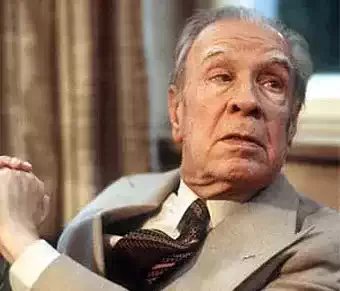
Jorge Luis Borges
Author of the day

Jorge Luis Borges

Jorge Luis Borges was an Argentine writer, poet, essayist, and translator. His work is characterized by its philosophical depth, intricate plots, and exploration of themes such as time, infinity, identity, and the nature of reality. Borges is considered one of the most significant literary figures of the 20th century, renowned for his innovative use of literary devices and his profound influence on postmodern literature.

Poem of the day

Do Not Go Gentle Into That Good Night

Dylan Thomas
Do not go gentle into that good night, 
Old age should burn and rave at close of day; 
Rage, rage against the dying of the light. 

Though wise men at their end know dark is right, 
Because their words had forked no lightning they 
Do not go gentle into that good night. 

Good men, the last wave by, crying how bright 
Their frail deeds might have danced in a green bay, 
Rage, rage against the dying of the light. 

Wild men who caught and sang the sun in flight, 
And learn, too late, they grieved it on its way, 
Do not go gentle into that good night. 

Grave men, near death, who see with blinding sight 
Blind eyes could blaze like meteors and be gay, 
Rage, rage against the dying of the light. 

And you, my father, there on that sad height, 
Curse, bless, me now with your fierce tears, I pray. 
Do not go gentle into that good night. 
Rage, rage against the dying of the light.
Read full poem

Born on this day

13
António Manuel Couto Viana

António Manuel Couto Viana was a Portuguese poet of great relevance, whose work is characterized by deep lyricism and a strong connection to the poetic tradition. His writing frequently explores themes such as nature, faith, saudade, and Portuguese identity, with an elaborate language and striking musicality. Associated with important literary movements, Couto Viana left a poetic legacy that reflects both his individual sensibility and a deep rooting in the culture and history of Portugal.

Leonardo Aires Araujo

Leonardo Aires Araujo is a writer whose work is characterized by a profound exploration of the human condition, often set in landscapes that evoke rural life and traditions. His texts address themes such as identity, land, memory, and interpersonal relationships, with a language rich in imagery and a sensitivity that connects the reader to their roots. His writing reflects a keen eye for the complexities of life and its simplest manifestations.

Augusto Meyer

Augusto Meyer was a prominent Brazilian poet, essayist, and professor, a central figure in the literature of Rio Grande do Sul and of national relevance. His poetic work is marked by reflection on gaucho identity, the land, history, and the human condition, combined with profound lyricism and an elaborate, musical language. Meyer also stood out as an intellectual, literary critic, and translator, contributing significantly to cultural debate and the education of readers.

Odorico Mendes

Odorico Mendes was a Brazilian poet whose works deeply explored national identity and the Brazilian landscape. His writing is marked by a lyricism that celebrates the land and the customs of the country, reflecting a strong sense of belonging and patriotic pride. Mendes stood out for his ability to capture the essence of popular culture in verses that resonate with a particular musicality. His literary contribution lies in the way he approached regional themes with an accessible and evocative language, promoting a valorization of Brazilian culture in a period of formation of the country's literary identity. Odorico Mendes' poetry is an invitation to contemplate the beauty and the Brazilian soul.

Edith Wharton

Edith Wharton was an American novelist and short story writer, known for her penetrating depictions of American high society in the late 19th and early 20th centuries. Her works often explore themes of social class, morality, and the constraints placed upon women. She is considered one of the most important writers in American literature.

Dialogue in fiction should be reserved for the cul
William Congreve

William Congreve was a playwright and poet of the English Restoration period.

Delphine de Girardin

Delphine de Girardin was a French writer and poet. Known for her liveliness and intelligence, she actively participated in the Parisian literary salons of her time. Her work, which includes poetry, plays, and novels, is characterized by an elegant style and a keen observation of society.

Pierre-Augustin Caron de Beaumarchais

Pierre-Augustin Caron de Beaumarchais was a French playwright, watchmaker, inventor, musician, diplomat, and journalist. He is best known for his plays, especially "The Barber of Seville" and "The Marriage of Figaro".

Adolfo Sinval Costa

Adolfo Sinval Costa was a Brazilian poet whose works explore themes such as love, longing, and nature, with a language rich in imagery and musicality. His poetry is marked by lyrical sensitivity and an at times melancholic tone, reflecting the cultural context of his time. His contribution to Brazilian literature lies in how he captured human emotions and the beauties of the natural world in verses that resonate for their delicacy and depth. Although less known than other names of his time, Adolfo Sinval Costa holds a unique place in Portuguese-language poetry.

Eduardo Olímpio

Eduardo Olímpio is a Portuguese poet whose work is distinguished by a strong connection to the Azorean landscape and culture. His poetry is often described as lyrical, melancholic, and deeply rooted in island identity. It explores themes such as nature, memory, the passage of time, and the human condition, often with an elegiac tone. His language is refined and evocative, capable of painting vivid pictures of his homeland and his most intimate feelings. Eduardo Olímpio's work is a testament to his sensitivity and his love for his land.

Joana Espain

Joana Espain is a contemporary poet whose work stands out for its lyrical intensity and exploration of themes such as the fragility of existence, the search for identity, and the complexity of human emotions. Her writing is marked by a raw and visceral language, capable of capturing the essence of deep feelings and reflections on the body and soul. With a unique poetic voice, Joana Espain has established herself as a relevant figure in current Portuguese poetry, addressing the anxieties of contemporary beings directly and impactfully.

Alfonso Moreno

Alfonso Moreno is a Spanish writer, known mainly for his contribution to the detective novel and thriller genres. His writing is marked by engaging plots, well-developed characters, and an atmosphere of suspense that captivates the reader. He stands out for his ability to build dynamic narratives and for exploring themes that often involve mystery and investigation.

Died on this day

11
Tomáz Kim

Tomáz Kim is a poet who stands out for his contemporary approach to lyricism, exploring the complexity of the human condition, memory, and identity. His work is marked by incisive language and an unparalleled ability to move between the personal and the universal, reflecting on the fragilities and quests of the individual in the modern world. Kim's poetry invites introspection and questioning, using stylistic resources that give his compositions a unique depth.

Orlando Neves

Orlando Neves was a Portuguese poet, whose work is distinguished by its lyrical depth and exploration of universal themes such as love, death, and time. His poetry, often marked by careful language and strong musicality, reflects a refined sensibility to the complexities of human existence. Throughout his career, Neves explored various poetic forms, demonstrating a remarkable mastery of the art of verse. His contribution to Portuguese poetry lies in his ability to evoke intense emotions and invite reflection on the human condition, leaving a legacy of verses that continue to resonate with readers.

Aguinaldo Fonseca

Aguinaldo Fonseca is an Angolan poet whose work reflects on the complexities of identity, the history of Angola, and the experiences of the African people. His poetry is distinguished by its expressive force and its ability to address social and existential themes with depth. The author moves between collective memory and individual experience, creating verses that resonate with the reality and aspirations of his homeland.

José da Cunha Cardoso

José da Cunha Cardoso was a Portuguese poet known for his contributions to the literature of his time. His poetic work, although sometimes less prominent in terms of massive recognition, reflects a particular sensitivity and a style that engages with Portuguese literary traditions. He explored universal themes through careful language, leaving a legacy that deserves to be rediscovered.

Georges Perros

Georges Perros was a French poet and writer, known for his lyrical and experimental work, which frequently explores the human condition, memory, and the search for transcendence. His poetry is characterized by intense and evocative language, with an introspective and sometimes melancholic tone. He also dedicated himself to prose, where he continued to investigate the themes that mark his poetry.

Agostinho de Campos

Agostinho de Campos was a Portuguese poet known for his introspective lyrics and musicality. His work often explores themes such as the ephemerality of time, solitude, and the search for meaning, reflecting a markedly modern and sometimes melancholic sensibility. With careful language and formal refinement, Agostinho de Campos left a poetic legacy that, although sometimes discreet, resonates with its emotional depth and the beauty of its imagery.

Antonio Jiménez Millán

Antonio Jiménez Millán is a Spanish poet whose work is part of the tradition of experience poetry and reflection on contemporary life. His writing is marked by clarity, restraint, and depth of thought.

José Gautier Benítez

José Gautier Benítez was a Puerto Rican poet, a prominent figure of Romanticism on the island. His work, marked by a deep love for his homeland, is characterized by the exaltation of Caribbean nature and patriotic sentiment. He is recognized for his passionate lyricism and his commitment to Puerto Rican identity, being one of the precursors of the national poetry of Puerto Rico.

Oliverio Girondo

Oliverio Girondo was a prominent Argentine poet, a key figure of the literary avant-garde in his country and one of the most original voices in 20th-century Spanish-language poetry. His work is characterized by profound formal and thematic experimentation, corrosive humor, and a critical view of reality, society, and language. Despite his relatively scarce output, his influence has been considerable, marking a milestone in Argentine poetry for its audacity and constant search for new forms of poetic expression. His poetry invites reflection on the limits of representation and the capacity of language to capture the complexity of the modern world.