
Humor e Ironia

Edward Lear
Limerick:There was a Young Lady of Parma
There was a Young Lady of Parma,
Whose conduct grew calmer and calmer;
When they said, 'Are you dumb?'
She merely said, 'Hum!'
That provoking Young Lady of Parma.
Whose conduct grew calmer and calmer;
When they said, 'Are you dumb?'
She merely said, 'Hum!'
That provoking Young Lady of Parma.
188

Jack Prelutsky
Be Glad Your Nose is on Your Face
Be glad your nose is on your face,
not pasted on some other place,
for if it were where it is not,
you might dislike your nose a lot.
Imagine if your precious nose
were sandwiched in between your toes,
that clearly would not be a treat,
for you'd be forced to smell your feet.
Your nose would be a source of dread
were it attached atop your head,
it soon would drive you to despair,
forever tickled by your hair.
Within your ear, your nose would be
an absolute catastrophe,
for when you were obliged to sneeze,
your brain would rattle from the breeze.
Your nose, instead, through thick and thin,
remains between your eyes and chin,
not pasted on some other place-be
glad your nose is on your face!
185

Robert W. Service
Room 5: The Concert Singer
I'm one of these haphazard chaps
Who sit in cafes drinking;
A most improper taste, perhaps,
Yet pleasant, to my thinking.
For, oh, I hate discord and strife;
I'm sadly, weakly human;
And I do think the best of life
Is wine and song and woman.
Now, there's that youngster on my right
Who thinks himself a poet,
And so he toils from morn to night
And vainly hopes to show it;
And there's that dauber on my left,
Within his chamber shrinking --
He looks like one of hope bereft;
He lives on air, I'm thinking.
But me, I love the things that are,
My heart is always merry;
I laugh and tune my old guitar:
Sing ho! and hey-down-derry.
Oh, let them toil their lives away
To gild a tawdry era,
But I'll be gay while yet I may:
Sing tira-lira-lira.
I'm sure you know that picture well,
A monk, all else unheeding,
Within a bare and gloomy cell
A musty volume reading;
While through the window you can see
In sunny glade entrancing,
With cap and bells beneath a tree
A jester dancing, dancing.
Which is the fool and which the sage?
I cannot quite discover;
But you may look in learning's page
And I'll be laughter's lover.
For this our life is none too long,
And hearts were made for gladness;
Let virtue lie in joy and song,
The only sin be sadness.
So let me troll a jolly air,
Come what come will to-morrow;
I'll be no cabotin of care,
No souteneur of sorrow.
Let those who will indulge in strife,
To my most merry thinking,
The true philosophy of life
Is laughing, loving, drinking.
And there's that weird and ghastly hag
Who walks head bent, with lips a-mutter;
With twitching hands and feet that drag,
And tattered skirts that sweep the gutter.
An outworn harlot, lost to hope,
With staring eyes and hair that's hoary
I hear her gibber, dazed with dope:
I often wonder what's her story.
180
Robert W. Service
Café Comedy
She
I'm waiting for the man I hope to wed.
I've never seen him - that's the funny part.
I promised I would wear a rose of red,
Pinned on my coat above my fluttered heart,
So that he'd know me - a precaution wise,
Because I wrote him I was twenty-three,
And Oh such heaps and heaps of silly lies. . .
So when we meet what will he think of me?
It's funny, but it has its sorry side;
I put an advert. in the evening Press:
"A lonely maiden fain would be a bride."
Oh it was shameless of me, I confess.
But I am thirty-nine and in despair,
Wanting a home and children ere too late,
And I forget I'm no more young and fair I'll
hide my rose and run...No, no, I'll wait.
An hour has passed and I am waiting still.
I ought to feel relieved, but I'm so sad.
I would have liked to see him, just to thrill,
And sigh and say: "There goes my lovely lad!
My one romance!" Ah, Life's malign mishap!
"Garcon, a cafè creme." I'll stay till nine. . .
The cafè's empty, just an oldish chap
Who's sitting at the table next to mine. . .
He
I'm waiting for the girl I mean to wed.
She was to come at eight and now it's nine.
She'd pin upon her coat a rose of red,
And I would wear a marguerite in mine.
No sign of her I see...It's true my eyes
Need stronger glasses than the ones I wear,
But Oh I feel my heart would recognize
Her face without the rose - she is so fair.
Ah! what deceivers are we aging men!
What vanity keeps youthful hope aglow!
Poor girl! I sent a photo taken when
I was a student, twenty years ago.
(Hers is so Springlike, Oh so blossom sweet!)
How she will shudder when she sees me now!
I think I'd better hide that marguerite -
How can I age and ugliness avow?
She does not come. It's after nine o'clock.
What fools we fogeys are! I'll try to laugh;
(Garcon, you might bring me another bock)
Falling in love, just from a photograph.
Well, that's the end. I'll go home and forget,
Then realizing I am over ripe
I'll throw away this silly cigarette
And philosophically light my pipe.
* * * * *
The waiter brought the coffee and the beer,
And there they sat, so woe-begone a pair,
And seemed to think: "Why do we linger here?"
When suddenly they turned, to start and stare.
She spied a marguerite, he glimpsed a rose;
Their eyes were joined and in a flash they knew. . .
The sleepy waiter saw, when time to close,
The sweet romance of those deceiving two,
Whose lips were joined, their hearts, their future too.
180
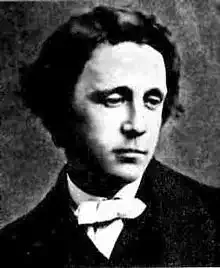
Lewis Carroll
Fit the Eighth (Hunting of the Snark )
The Vanishing
They sought it with thimbles, they sought it with care;
They pursued it with forks and hope;
They threatened its life with a railwayshare;
They charmed it with smiles and soap.
They shuddered to think that the chase might fail,
And the Beaver, excited at last,
Went bounding along on the tip of its tail,
For the daylight was nearly past.
"There is Thingumbob shouting!" the Bellman said.
"He is shouting like mad, only hark!
He is waving his hands, he is wagging his head,
He has certainly found a Snark!"
They gazed in delight, while the Butcher exclaimed
"He was always a desperate wag!"
They beheld himtheir
Bakertheir
hero unnamed
On
the top of a neighbouring crag,
Erect and sublime, for one moment of time,
In the next, that wild figure they saw
(As if stung by a spasm) plunge into a chasm,
While they waited and listened in awe.
"It's a Snark!" was the sound that first came to their ears,
And seemed almost too good to be true.
Then followed a torrent of laughter and cheers:
Then the ominous words "It's a Boo"
Then, silence. Some fancied they heard in the air
A weary and wandering sigh
That sounded like "jum!"
but the others declare
It was only a breeze that went by.
They hunted till darkness came on, but they found
Not a button, or feather, or mark,
By which they could tell that they stood on the ground
Where the Baker had met with the Snark.
In the midst of the word he was trying to say
In the midst of his laughter and glee,
He had softly and suddenly vanished away
For
the Snark was a Boojum, you see.
184
Robert W. Service
Picture Dealer
There were twin artists A. and B.
Who painted pictures two,
And hung them in my galley
For everyone to view;
The one exhibited by A.
The name "A Sphere" did bear,
While strangely brother B's display
Was catalogued: "A Square".
Now although A. (and this is queer)
Could squeeze a pretty tube,
The picture that he called a Sphere
Was blocky as a cube;
While B. (though no hint he disclosed
To pull the public leg)
The Square he placidly exposed
Was oval as an egg.
Thought I: To sell these pictures two
I never will be able;
There's only one thing I can do,
That's change around the label.
The rotund one I called a Sphere,
The cornered one a Square . . .
And yet, I thought: It's very queer,
Unbought they linger there.
Then strange as it may well appear,
Derision did I bare,
And blandly dubbed the Square a Sphere
And tabbed the Sphere a Square.
Behold the answer I had found,
For to my glad dismay
The curious came crowding round:
A sold the daubs next day.
Well, maybe A. and B. were right,
Not mugs like you and me,
With something missing in our sight
That only artists see.
So what it is and what it ain't
I'll never more discuss . . .
These guys believe in what they paint,
Or . . . are they spoofing us?
185
Edward Lear
Limerick: There was an Old Man of Kamschatka
There was an Old Man of Kamschatka,
Who possessed a remarkable fat cur;
His gait and his waddle
Were held as a model
To all the fat dogs in Kamschatka.
Who possessed a remarkable fat cur;
His gait and his waddle
Were held as a model
To all the fat dogs in Kamschatka.
180
Edward Lear
Limerick:There was an Old Man of Aôsta
There was an Old Man of Aôsta,
Who possessed a large cow, but he lost her;
But they said, 'Don't you see
She has rushed up a tree?
You invidious Old Man of Aôsta!'
Who possessed a large cow, but he lost her;
But they said, 'Don't you see
She has rushed up a tree?
You invidious Old Man of Aôsta!'
181
Edward Lear
Limerick:There was an Old Man, on whose nose
There was an Old Man, on whose nose,
Most birds of the air could repose;
But they all flew away
At the closing of day,
Which relieved that Old Man and his nose.
Most birds of the air could repose;
But they all flew away
At the closing of day,
Which relieved that Old Man and his nose.
177
Robert W. Service
My Dentist
Sitting in the dentist's chair,
Wishing that I wasn't there,
To forget and pass the time
I have made this bit of rhyme.
I had a rendez-vous at ten;
I rushed to get in line,
But found a lot of dames and men
Had waited there since nine;
I stared at them, then in an hour
Was blandly ushered in;
But though my face was grim and sour
He met me with a grin.
He told me of his horse of blood,
And how it "also ran",
He plans to own a racing stud (
He seems a wealthy man.)
And then he left me there until
I growled: "At any rate,
I hope he'll not charge in his bill
For all the time I wait."
His wife has sables on her back,
With jewels she's ablaze;
She drives a stately Cadillac,
And I'm the mug who pays:
At least I'm one of those who peer
With pessimistic gloom
At magazines of yester-year
In his damn waiting room.
I am a Christian Scientist;
I don't believe in pain;
My dentist had a powerful wrist,
He tries and tries in vain
To make me grunt or groan or squeal
With probe or rasp or drill. . . .
But oh, what agony I feel
When HE PRESENTS HIS BILL!
Sitting in the dental chair,
Don't you wish you weren't there:
Well, your cup of woe to fill,
Just think of his infernal bill.
171
Edward Lear
Limerick:There was an Old Lady of Prague
There was an Old Lady of Prague,
Whose language was horribly vague;
When they said, 'Are these caps?'
She answered, 'Perhaps!'
That oracular Lady of Prague.
Whose language was horribly vague;
When they said, 'Are these caps?'
She answered, 'Perhaps!'
That oracular Lady of Prague.
162
Jack Prelutsky
Dora Diller
'My stomach's full of butterflies!'
lamented Dora Diller.
Her mother sighed. 'That's no surprise,
you ate a caterpillar!'
lamented Dora Diller.
Her mother sighed. 'That's no surprise,
you ate a caterpillar!'
156
Edward Lear
Limerick: There was an Old Man of the Hague
There was an Old Man of the Hague,
Whose ideas were excessively vague;
He built a balloon
To examine the moon,
That deluded Old Man of the Hague.
Whose ideas were excessively vague;
He built a balloon
To examine the moon,
That deluded Old Man of the Hague.
161
Jack Prelutsky
As Soon as Fred Gets Out of Bed
As soon as Fred gets out of bed,
his underwear goes on his head.
His mother laughs, "Don't put it there,
a head's no place for underwear!"
But near his ears, above his brains,
is where Fred's underwear remains.
At night when Fred goes back to bed,
he deftly plucks it off his head.
His mother switches off the light
and softly croons, "Good night! Good night!"
And then, for reasons no one knows,
Fred's underwear goes on his toes.
164

Siegfried Sassoon
Blighters
The House is crammed: tier beyond tier they grin
And cackle at the Show, while prancing ranks
Of harlots shrill the chorus, drunk with din;
‘We’re sure the Kaiser loves our dear old Tanks!’
I’d like to see a Tank come down the stalls,
Lurching to rag-time tunes, or ‘Home, sweet Home’,
And there’d be no more jokes in Music-halls
To mock the riddled corpses round Bapaume.
119
Previous
Page 9