
Creativity and Inspiration

Emily Dickinson
Perhaps I Asked Too Large
Perhaps I asked too large --
I take -- no less than skies --
For Earths, grow thick as
Berries, in my native town --
My Basked holds -- just -- Firmaments --
Those -- dangle easy -- on my arm,
But smaller bundles -- Cram.
I take -- no less than skies --
For Earths, grow thick as
Berries, in my native town --
My Basked holds -- just -- Firmaments --
Those -- dangle easy -- on my arm,
But smaller bundles -- Cram.
285

Robert W. Service
Amateur Poet
You see that sheaf of slender books
Upon the topmost shelf,
At which no browser ever looks,
Because they're by . . . myself;
They're neatly bound in navy blue,
But no one ever heeds;
Their print is clear and candid too,
Yet no one ever reads.
Poor wistful books! How much they cost
To me in time and gold!
I count them now as labour lost,
For none I ever sold;
No copy could I give away,
For all my friends would shrink,
And look at me as if to say:
"What waste of printer's ink!"
And as I gaze at them on high,
Although my eyes are sad,
I cannot help but breathe a sigh
To think what joy I had -
What ecstasy as I would seek
To make my rhyme come right,
And find at last the phrase unique
Flash fulgent in my sight.
Maybe that rapture was my gain
Far more than cheap success;
So I'll forget my striving vain,
And blot out bitterness.
Oh records of my radiant youth,
No broken heart I'll rue,
For all my best of love and truth
Is there, alive in you.
281
Emily Dickinson
Before you thought of spring
Before you thought of spring,
Except as a surmise,
You see, God bless his suddenness,
A fellow in the skies
Of independent hues,
A little weather-worn,
Inspiriting habiliments
Of indigo and brown.
With specimens of song,
As if for you to choose,
Discretion in the interval,
With gay delays he goes
To some superior tree
Without a single leaf,
And shouts for joy to nobody
But his seraphic self!
278

Muhammad Iqbal
Jawab-e-Shik
Whatever comes out of the heart is effective
It has no wings but has the power of flight
It has holy origins, it aims at elegance
It rises from dust, but has access to the celestial world
My love was seditious, rebellious and clever
My fearless wailing rent through the sky
On hearing it the sun said, 'Somewhere there is somebody! '
The planets said, 'At the 'Arsh-i-Bar
272

William Wordsworth
Most Sweet it is
. Most sweet it is with unuplifted eyes
To pace the ground, if path be there or none,
While a fair region round the traveller lies
Which he forbears again to look upon;
Pleased rather with some soft ideal scene,
The work of Fancy, or some happy tone
Of meditation, slipping in between
The beauty coming and the beauty gone.
If Thought and Love desert us, from that day
Let us break off all commerce with the Muse:
With Thought and Love companions of our way,
Whate'er the senses take or may refuse,
The Mind's internal heaven shall shed her dews
Of inspiration on the humblest lay.
272
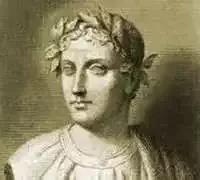
Horácio
BkIII:IV Temper Power With Wisdom
O royal Calliope, come from heaven,
and play a lengthy melody on the flute,
or, if you prefer, use your clear voice,
or pluck at the strings of Apollo’s lute.
Do you hear her, or does some lovely fancy
toy with me? I hear, and seem to wander, now,
through the sacred groves, where delightful
waters steal, where delightful breezes stray.
In my childhood, once, on pathless Vultur’s slopes,
beyond the bounds of nurturing Apulia,
exhausted with my play and weariness,
the fabled doves covered me with new leaves,
which was a wonder to everyone who holds
Acherontia’s high nest, and Bantia’s
woodland pastures, and the rich meadows
of low-lying Forentum, since I slept
safe from the bears and from the dark vipers,
the sacred laurel and the gathered myrtle
spread above me, a courageous child,
though it was thanks to the power of the gods.
Yours Muses, yours, I climb the high Sabine Hills,
or I’m carried off to my cool Praeneste,
to the slopes of Tibur, if I please,
or the cloudless loveliness of Baiae.
A friend of your sacred fountains and your
choirs, the rout of the army at Philippi
failed to kill me, and that accursed
tree, and Palinurus’ Sicilian Sea.
Whenever you are with me, as a sailor
I’ll attempt the raging Bosphorus, or be
a traveller in the burning sands
of the Syrian shore: as a stranger
I’ll see the fierce inhospitable Britons,
the Spaniards that love drinking horses’ blood,
I’ll see the quiver-bearing Thracians,
and, unharmed, visit the Scythian stream.
It’s you then who refresh our noble Caesar,
in your Pierian caves, when he’s settled
his weary troops in all the cities,
and he’s ready to complete his labours.
You give calm advice, and you delight in that
giving, kindly ones. We know how the evil
Titans, how their savage supporters
were struck down by the lightning from above,
by him who rules the silent earth, the stormy
sea, the cities, and the kingdoms of darkness,
alone, in imperial justice,
commanding the gods and the mortal crowd.
Great terror was visited on Jupiter
by all those bold warriors bristling with hands,
and by the brothers who tried to set
Pelion on shadowy Olympus.
But what power could Giant Typhoeus have,
or mighty Mimas, or that Porphyrion
with his menacing stance, Rhoetus,
or Enceladus, audacious hurler
of uprooted trees, against the bronze breastplate,
Minerva’s aegis? On one side stood eager
Vulcan, on the other maternal
Juno, and Apollo of Patera
and Delos, who is never without the bow
on his shoulder, who bathes his flowing hair
in Castalia’s pure dew, who holds
the forests, and thickets of Lycia.
Power without wisdom falls by its own weight:
The gods themselves advance temperate power:
and likewise hate force that, with its whole
consciousness, is intent on wickedness.
Let hundred-handed Gyas be the witness
to my statement: Orion too, well-known as
chaste Dian’s attacker, and tamed
by the arrows of the virgin goddess.
Earth, heaped above her monstrous children, laments
and grieves for her offspring, hurled down to murky
Orcus by the lightning bolt: The swift
fires have not yet eaten Aetna, set there,
nor the vultures ceased tearing at the liver
of intemperate Tityus, those guardians placed
over his sin: and three hundred chains
hold the amorous Pirithous fast.
257

Henry Lawson
The Song of the Waste-Paper Basket
O BARD of fortune, you deem me nought
But a mark for your careless scorn.
For I am the echo-less grave of thought
That is strangled before it’s born.
You think perchance that I am a doom
Which only a dunce should dread—
Nor dream I’ve been the dishonoured tomb
Of the noblest and brightest dead.
The brightest fancies that e’er can fly
From the labouring minds of men
Are often written in lines awry,
And marred by a blundering pen;
And thus it comes that I gain a part
Of what to the world is loss—
Of genius lost for the want of art,
Of pearls that are set in dross.
And though I am of a lowly birth
My fame has been cheaply bought,
A power am I, for I rob the earth
Of the brightest gems of thought;
The Press gains much of my lawful share,
I am wronged without redress—
But I have revenge, for I think it fair
That I should plunder the Press.
You’d pause in wonder to read behind
The lines of some songs I see;
The soul of the singer I often find
In songs that are thrown to me.
But the song of the singer I bury deep
With the scrawl of the dunce and clown,
And both from the eyes of the world I keep,
And the hopes of both I drown.
254
Robert W. Service
My Picture
I made a picture; all my heart
I put in it, and all I knew
Of canvas-cunning and of Art,
Of tenderness and passion true.
A worshipped Master came to see;
Oh he was kind and gentle, too.
He studied it with sympathy,
And sensed what I had sought to do.
Said he: "Your paint is fresh and fair,
And I can praise it without cease;
And yet a touch just here and there
Would make of it a masterpiece."
He took the brush from out my hand;
He touched it here, he touched it there.
So well he seemed to understand,
And momently it grew more fair.
Oh there was nothing I could say,
And there was nothing I could do.
I thanked him, and he went his way,
And then - I slashed my picture through.
For though his brush with soft caress
Had made my daub a thing divine,
Oh God! I wept with bitterness,
. . . It wasn't mine, it wasn't mine.
254
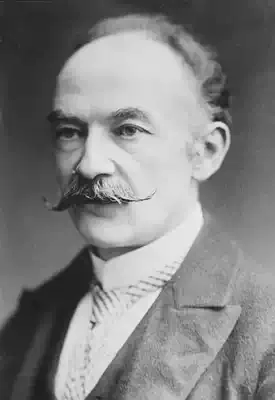
Thomas Hardy
Rome: The Vatican--Sala Delle Muse ()
I sat in the Muses' Hall at the mid of the day,
And it seemed to grow still, and the people to pass away,
And the chiselled shapes to combine in a haze of sun,
Till beside a Carrara column there gleamed forth One.
She was nor this nor that of those beings divine,
But each and the whole--an essence of all the Nine;
With tentative foot she neared to my halting-place,
A pensive smile on her sweet, small, marvellous face.
"Regarded so long, we render thee sad?" said she.
"Not you," sighed I, "but my own inconstancy!
I worship each and each; in the morning one,
And then, alas! another at sink of sun.
"To-day my soul clasps Form; but where is my troth
Of yesternight with Tune: can one cleave to both?"
- "Be not perturbed," said she. "Though apart in fame,
As I and my sisters are one, those, too, are the same.
- "But my loves go further--to Story, and Dance, and Hymn,
The lover of all in a sun-sweep is fool to whim -
Is swayed like a river-weed as the ripples run!"
- "Nay, wight, thou sway'st not. These are but phases of one;
"And that one is I; and I am projected from thee,
One that out of thy brain and heart thou causest to be -
Extern to thee nothing. Grieve not, nor thyself becall,
Woo where thou wilt; and rejoice thou canst love at all!
243
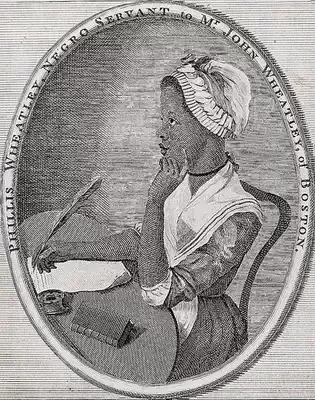
Phillis Wheatley
To Maecenas
MAECENAS, you, beneath the myrtle shade,
Read o'er what poets sung, and shepherds play'd.
What felt those poets but you feel the same?
Does not your soul possess the sacred flame?
Their noble strains your equal genius shares
In softer language, and diviner airs.
While Homer paints, lo! circumfus'd in air,
Celestial Gods in mortal forms appear;
Swift as they move hear each recess rebound,
Heav'n quakes, earth trembles, and the shores resound.
Great Sire of verse, before my mortal eyes,
The lightnings blaze across the vaulted skies,
And, as the thunder shakes the heav'nly plains,
A deep felt horror thrills through all my veins.
When gentler strains demand thy graceful song,
The length'ning line moves languishing along.
When great Patroclus courts Achilles' aid,
The grateful tribute of my tears is paid;
Prone on the shore he feels the pangs of love,
And stern Pelides tend'rest passions move.
Great Maro's strain in heav'nly numbers flows,
The Nine inspire, and all the bosom glows.
O could I rival thine and Virgil's page,
Or claim the Muses with the Mantuan Sage;
Soon the same beauties should my mind adorn,
And the same ardors in my soul should burn:
Then should my song in bolder notes arise,
And all my numbers pleasingly surprise;
But here I sit, and mourn a grov'ling mind,
That fain would mount, and ride upon the wind.
Not you, my friend, these plaintive strains become,
Not you, whose bosom is the Muses home;
When they from tow'ring Helicon retire,
They fan in you the bright immortal fire,
But I less happy, cannot raise the song,
The fault'ring music dies upon my tongue.
The happier Terence* all the choir inspir'd,
His soul replenish'd, and his bosom fir'd;
But say, ye Muses, why this partial grace,
To one alone of Afric's sable race;
From age to age transmitting thus his name
With the finest glory in the rolls of fame?
Thy virtues, great Maecenas! shall be sung
In praise of him, from whom those virtues sprung:
While blooming wreaths around thy temples spread,
I'll snatch a laurel from thine honour'd head,
While you indulgent smile upon the deed.
*He was an African by birth.
As long as Thames in streams majestic flows,
Or Naiads in their oozy beds repose
While Phoebus reigns above the starry train
While bright Aurora purples o'er the main,
So long, great Sir, the muse thy praise shall sing,
So long thy praise shal' make Parnassus ring:
Then grant, Maecenas, thy paternal rays,
Hear me propitious, and defend my lays.
242
Robert W. Service
Toilet Seats
While I am emulating Keats
My brother fabrics toilet seats,
The which, they say, are works of art,
Aesthetic features of the mart;
So exquisitely are they made
With plastic of a pastel shade,
Of topaz, ivory or rose,
Inviting to serene repose.
Rajahs I'm told have seats of gold,-(
They must, I fear, be very cold).
But Tom's have thermostatic heat,
With sympathy your grace to greet.
Like silver they are neon lit,
Making a halo as you sit:
Then lo! they play with dulset tone
A melody by Mendelssohn.
Oh were I lyrical as Yeats
I would not sing of toilet seats,
But rather serenade a star,--
Yet I must take things as they are.
For even kings must coyly own
Them as essential as a throne:
So as I tug the Muse's teats
I envy Tom his toilet seats.
232

John Greenleaf Whittier
Raphael
I shall not soon forget that sight
The glow of Autumn's westering day,
A hazy warmth, a dreamy light,
On Raphael's picture lay.
It was a simple print I saw,
The fair face of a musing boy;
Yet, while I gazed, a sense of awe
Seemed blending with my joy.
A simple print,--the graceful flow
Of boyhood's soft and wavy hair,
And fresh young lip and cheek, and brow
Unmarked and clear, were there.
Yet through its sweet and calm repose
I saw the inward spirit shine;
It was as if before me rose
The white veil of a shrine.
As if, as Gothland's sage has told,
The hidden life, the man within,
Dissevered from its frame and mould,
By mortal eye were seen.
Was it the lifting of that eye,
The waving of that pictured hand?
Loose as a cloud-wreath on the sky,
I saw the walls expand.
The narrow room had vanished,--space,
Broad, luminous, remained alone,
Through which all hues and shapes of grace
And beauty looked or shone.
Around the mighty master came
The marvels which his pencil wrought,
Those miracles of power whose fame
Is wide as human thought.
There drooped thy more than mortal face,
O Mother, beautiful and mild
Enfolding in one dear embrace
Thy Saviour and thy Child!
The rapt brow of the Desert John;
The awful glory of that day
When all the Father's brightness shone
Through manhood's veil of clay.
And, midst gray prophet forms, and wild
Dark visions of the days of old,
How sweetly woman's beauty smiled
Through locks of brown and gold!
There Fornarina's fair young face
Once more upon her lover shone,
Whose model of an angel's grace
He borrowed from her own.
Slow passed that vision from my view,
But not the lesson which it taught;
The soft, calm shadows which it threw
Still rested on my thought:
The truth, that painter, bard, and sage,
Even in Earth's cold and changeful clime,
Plant for their deathless heritage
The fruits and flowers of time.
We shape ourselves the joy or fear
Of which the coming life is made,
And fill our Future's atmosphere
With sunshine or with shade.
The tissue of the Life to be
We weave with colors all our own,
And in the field of Destiny
We reap as we have sown.
Still shall the soul around it call
The shadows which it gathered here,
And, painted on the eternal wall,
The Past shall reappear.
Think ye the notes of holy song
On Milton's tuneful ear have died?
Think ye that Raphael's angel throng
Has vanished from his side?
Oh no!--We live our life again;
Or warmly touched, or coldly dim,
The pictures of the Past remain,--Man's
works shall follow him!
232
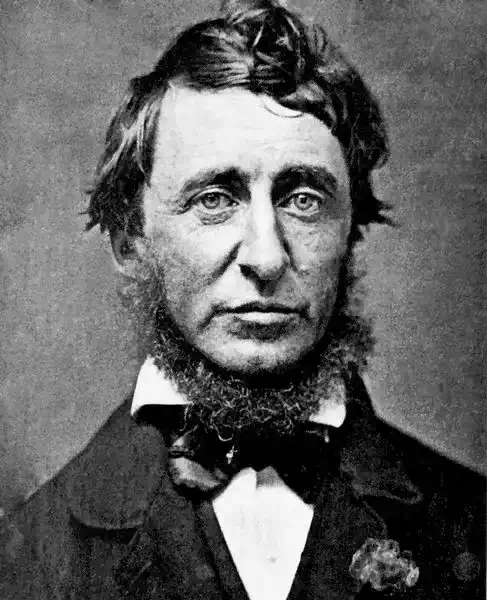
Henry David Thoreau
Inspiration
Whate'er we leave to God, God does,
And blesses us;
The work we choose should be our own,
God leaves alone.
If with light head erect I sing,
Though all the Muses lend their force,
From my poor love of anything,
The verse is weak and shallow as its source.
But if with bended neck I grope
Listening behind me for my wit,
With faith superior to hope,
More anxious to keep back than forward it;
Making my soul accomplice there
Unto the flame my heart hath lit,
Then will the verse forever wear--
Time cannot bend the line which God hath writ.
Always the general show of things
Floats in review before my mind,
And such true love and reverence brings,
That sometimes I forget that I am blind.
But now there comes unsought, unseen,
Some clear divine electuary,
And I, who had but sensual been,
Grow sensible, and as God is, am wary.
I hearing get, who had but ears,
And sight, who had but eyes before,
I moments live, who lived but years,
And truth discern, who knew but learning's lore.
I hear beyond the range of sound,
I see beyond the range of sight,
New earths and skies and seas around,
And in my day the sun doth pale his light.
A clear and ancient harmony
Pierces my soul through all its din,
As through its utmost melody--
Farther behind than they, farther within.
More swift its bolt than lightning is,
Its voice than thunder is more loud,
It doth expand my privacies
To all, and leave me single in the crowd.
It speaks with such authority,
With so serene and lofty tone,
That idle Time runs gadding by,
And leaves me with Eternity alone.
Now chiefly is my natal hour,
And only now my prime of life;
Of manhood's strength it is the flower,
'Tis peace's end and war's beginning strife.
It comes in summer's broadest noon,
By a grey wall or some chance place,
Unseasoning Time, insulting June,
And vexing day with its presuming face.
Such fragrance round my couch it makes,
More rich than are Arabian drugs,
That my soul scents its life and wakes
The body up beneath its perfumed rugs.
Such is the Muse, the heavenly maid,
The star that guides our mortal course,
Which shows where life's true kernel's laid,
Its wheat's fine flour, and its undying force.
She with one breath attunes the spheres,
And also my poor human heart,
With one impulse propels the years
Around, and gives my throbbing pulse its start.
I will not doubt for evermore,
Nor falter from a steadfast faith,
For thought the system be turned o'er,
God takes not back the word which once He saith.
I will not doubt the love untold
Which not my worth nor want has bought,
Which wooed me young, and woos me old,
And to this evening hath me brought.
My memory I'll educate
To know the one historic truth,
Remembering to the latest date
The only true and sole immortal youth.
Be but thy inspiration given,
No matter through what danger sought,
I'll fathom hell or climb to heaven,
And yet esteem that cheap which love has bought.
Fame cannot tempt the bard
Who's famous with his God,
Nor laurel him reward
Who has his Maker's nod.
230
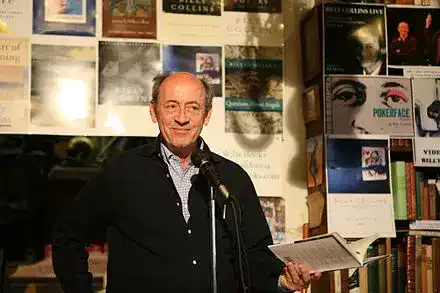
Billy Collins
Invention
Tonight the moon is a cracker,
with a bite out of it
floating in the night,
and in a week or so
according to the calendar
it will probably look
like a silver football,
and nine, maybe ten days ago
it reminded me of a thin bright claw.
But eventually -by
the end of the month,
I reckon -
it will waste away
to nothing,
nothing but stars in the sky,
and I will have a few nights
to myself,
a little time to rest my jittery pen.
230
Henry David Thoreau
The Poet's Delay
IN vain I see the morning rise,
In vain observe the western blaze,
Who idly look to other skies,
Expecting life by other ways.
Amidst such boundless wealth without,
I only still am poor within,
The birds have sung their summer out,
But still my spring does not begin.
Shall I then wait the autumn wind,
Compelled to seek a milder day,
And leave no curious nest behind,
No woods still echoing to my lay?
227
Robert W. Service
Dedication To Providence
I loved to toy with tuneful rhyme,
My fancies into verse to weave;
For as I walked my words would chime
So bell-like I could scarce believe;
My rhymes rippled like a brook,
My stanzas bloomed like blossoms gay:
And that is why I dream this book
A verseman's holiday.
The palm-blades brindle in the blaze
Of sunsets splendouring the sea;
The Gloaming is a lilac haze
That impish stars stab eagerly. . . .
O Land of Song! Oh golden clime!
O happy me, whose work is play!
Please take this tribute of my rhymes:
A verseman's holiday.
224
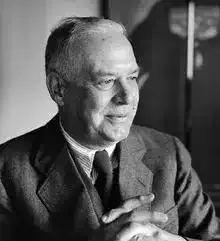
Wallace Stevens
Nomad Exquisite
As the immense dew of Florida
Brings forth
The big-finned palm
And green vine angering for life,
As the immense dew of Florida
Brings forth hymn and hymn
From the beholder,
Beholding all these green sides
And gold sides of green sides,
And blessed mornings,
Meet for the eye of the young alligator,
And lightning colors
So, in me, comes flinging
Forms, flames, and the flakes of flames.
220
Robert W. Service
My Masterpiece
It's slim and trim and bound in blue;
Its leaves are crisp and edged with gold;
Its words are simple, stalwart too;
Its thoughts are tender, wise and bold.
Its pages scintillate with wit;
Its pathos clutches at my throat:
Oh, how I love each line of it!
That Little Book I Never Wrote.
In dreams I see it praised and prized
By all, from plowman unto peer;
It's pencil-marked and memorized,
It's loaned (and not returned, I fear);
It's worn and torn and travel-tossed,
And even dusky natives quote
That classic that the world has lost,
The Little Book I Never Wrote.
Poor ghost! For homes you've failed to cheer,
For grieving hearts uncomforted,
Don't haunt me now. . . . Alas! I fear
The fire of Inspiration's dead.
A humdrum way I go to-night,
From all I hoped and dreamed remote:
Too late . . . a better man must write
That Little Book I Never Wrote.
213
Robert W. Service
Prelude
To smite Apollo's lyre I am unable;
Of loveliness, alas! I cannot sing.
My lot it i, across the tavern table,
To start a chorus to the strumming string.
I have no gift to touch your heart to pity;
I have no power to ring the note of pain:
All I can do is pipe a pot-house ditty,
Or roar a Rabelaisian refrain.
Behold yon minstrel of the empty belly,
Who seeks to please the bored and waiting throng,
Outside the Opera with ukulele,
And raucous strains of syncopated song.
His rag-time mocks their eager hearts a-hunger
For golden voices, melody divine:
Yet . . . throw a penny to the ballad-monger;
Yet . . . listen idly to this song of mine.
For with a humble heart I clank rhyme's fetters,
And bare my buttocks to the critic knout;
A graceless hobo in the Land of Letters,
Piping my ditties of the down-and-out.
A bar-room bard . . . so if a coin you're flinging,
Pay me a pot, and let me dream and booze;
To stars of scorn my dour defiance ringing,
With battered banjo and a strumpet Muse.
205
Robert W. Service
Farewell To Verse
In youth when oft my muse was dumb,
My fancy nighly dead,
To make my inspiration come
I stood upon my head;
And thus I let the blood down flow
Into my cerebellum,
And published every Spring or so
Slim tomes in vellum.
Alas! I am rheumatic now,
Grey is my crown;
I can no more with brooding brow
Stand upside-down.
I fear I might in such a pose
Burst brain blood-vessel;
And that would be a woeful close
To my rhyme wrestle.
If to write verse I must reverse
I fear I'm stymied;
In ink of prose I must immerse
A pen de-rhymèd.
No more to spank the lyric lyre
Like Keats or Browning,
May I inspire the Sacred Fire
My Upside-downing.
202

Wilfred Owen
Spells and Incantations
A vague pearl, a wan pearl
You showed me once; I peered through far-gone winters
Until my mind was fog-bound in that gem.
Blue diamonds, cold diamonds
You shook before me, so that out of them
Glittered and glowed vast diamond dawns of spring.
Tiger-eyed rubies, wrathful rubies
You rolled. I watched their hot hearts fling
Flames from each glaring summer of my life.
Quiet amber, mellow amber
You lifted; and behold the whole air rife
With evening, and the auburn autumn cloud.
But pale skin, your pearl skin
Show this to me, and I shall have surprise
Of every snow-lit dawn before it break.
But clear eyes, your fresh eyes
Open; that I may laugh, and lightly take
All air of early April in one hour.
But brown curls, O shadow me with curls,
Full of September mist, half-gleam, half-glower,
And I shall roam warm nights in lands far south.
189
Robert W. Service
Picture Dealer
There were twin artists A. and B.
Who painted pictures two,
And hung them in my galley
For everyone to view;
The one exhibited by A.
The name "A Sphere" did bear,
While strangely brother B's display
Was catalogued: "A Square".
Now although A. (and this is queer)
Could squeeze a pretty tube,
The picture that he called a Sphere
Was blocky as a cube;
While B. (though no hint he disclosed
To pull the public leg)
The Square he placidly exposed
Was oval as an egg.
Thought I: To sell these pictures two
I never will be able;
There's only one thing I can do,
That's change around the label.
The rotund one I called a Sphere,
The cornered one a Square . . .
And yet, I thought: It's very queer,
Unbought they linger there.
Then strange as it may well appear,
Derision did I bare,
And blandly dubbed the Square a Sphere
And tabbed the Sphere a Square.
Behold the answer I had found,
For to my glad dismay
The curious came crowding round:
A sold the daubs next day.
Well, maybe A. and B. were right,
Not mugs like you and me,
With something missing in our sight
That only artists see.
So what it is and what it ain't
I'll never more discuss . . .
These guys believe in what they paint,
Or . . . are they spoofing us?
185
Robert W. Service
Inspiration
How often have I started out
With no thought in my noodle,
And wandered here and there about,
Where fancy bade me toddle;
Till feeling faunlike in my glee
I've voiced some gay distiches,
Returning joyfully to tea,
A poem in my britches.
A-squatting on a thymy slope
With vast of sky about me,
I've scribbled on an envelope
The rhymes the hills would shout me;
The couplets that the trees would call,
The lays the breezes proffered . . .
Oh no, I didn't think at all -
I took what Nature offered.
For that's the way you ought to write -
Without a trace of trouble;
Be super-charged with high delight
And let the words out-bubble;
Be voice of vale and wood and stream
Without design or proem:
Then rouse from out a golden dream
To find you've made a poem.
So I'll go forth with mind a blank,
And sea and sky will spell me;
And lolling on a thymy bank
I'll take down what they tell me;
As Mother Nature speaks to me
Her words I'll gaily docket,
So I'll come singing home to tea
A poem in my pocket.
174

Siegfried Sassoon
Limitations
If you could crowd them into forty lines!
Yes; you can do it, once you get a start;
All that you want is waiting in your head,
For long-ago you’ve learnt it off by heart.
. . . .
Begin: your mind’s the room where you have slept,
(Don’t pause for rhymes), till twilight woke you early.
The window stands wide-open, as it stood
When tree-tops loomed enchanted for a child
Hearing the dawn’s first thrushes through the wood
Warbling (you know the words) serene and wild.
You’ve said it all before: you dreamed of Death,
A dim Apollo in the bird-voiced breeze
That drifts across the morning veiled with showers,
While golden weather shines among dark trees.
You’ve got your limitations; let them sing,
And all your life will waken with a cry:
Why should you halt when rapture’s on the wing
And you’ve no limit but the cloud-flocked sky?...
But some chap shouts, ‘Here, stop it; that’s been done!’—
As God might holloa to the rising sun,
And then relent, because the glorying rays
Remind Him of green-glinting Eden days,
And Adam’s trustful eyes as he looks up
From carving eagles on his beechwood cup.
Young Adam knew his job; he could condense
Life to an eagle from the unknown immense....
Go on, whoever you are; your lines can be
A whisper in the music from the weirs
Of song that plunge and tumble toward the sea
That is the uncharted mercy of our tears.
. . . .
I told you it was easy! ... Words are fools
Who follow blindly, once they get a lead.
But thoughts are kingfishers that haunt the pools
Of quiet; seldom-seen: and all you need
Is just that flash of joy above your dream.
So, when those forty platitudes are done,
You’ll hear a bird-note calling from the stream
That wandered through your childhood; and the sun
Will strike the old flaming wonder from the waters....
And there’ll be forty lines not yet begun.
136