
Freedom
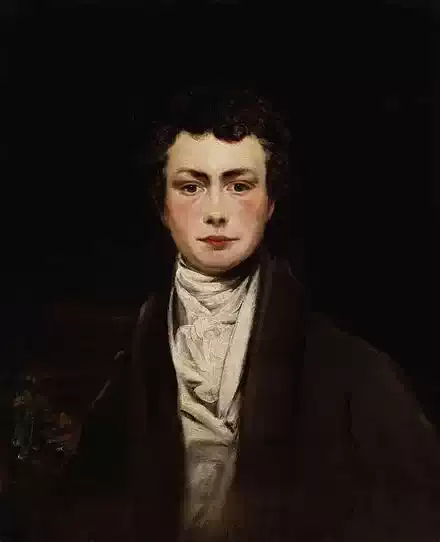
Thomas Moore
The Dream of Those Days
The dream of those days when first I sung thee is o'er
Thy triumph hath stain'd the charm thy sorrows then wore;
And even the light which Hope once shed o'er thy chains,
Alas, not a gleam to grace thy freedom remains.
Say, is it that slavery sunk so deep in thy heart,
That still the dark brand is there, though chainless thou art;
And Freedom's sweet fruit, for which thy spirit long burn'd,
Now, reaching at last thy lip, to ashes hath turn'd?
Up Liberty's steep by Truth and Eloquence led,
With eyes on her temple fix'd, how proud was thy tread!
Ah, better thou ne'er hadst lived that summit to gain,
Denied in the porch, than thus dishonour the fane.
214
Thomas Moore
The Irish Peasant to his Mistress
Through grief and through danger thy smile hath cheer'd my way,
Till hope seem'd to bud from each thorn that round me lay;
The darker our fortune, the brighter our pure love burn'd,
Till shame into glory, till fear into zeal was turn'd;
Yes, slave as I was, in thy arms my spirit felt free,
And bless'd even the sorrows that made me more dear to thee.
Thy rival was honour'd, while thou wert wrong'd and scorn'd,
Thy crown was of briers, while gold her brows adorn'd;
She woo'd me to temples, while thou lay'st hid in caves,
Her friends were all masters, while thine, alas! were slaves;
Yet cold in the earth, at thy feet, I would rather be,
Then wed what I loved not, or turn one thought from thee.
They slander thee sorely, who say thy vows are frail --
Hadst thou been a false one, thy cheek had look'd less pale.
They say, too, so long thou hast worn those lingering chains --
That deep in thy heart they have printed their servile stains --
Oh! foul is the slander -- no chain could that soul subdue --
Where shineth thy spirit, there liberty shineth too!
214

Henry Lawson
The Rovers
Some born of homely parents
For ages settled down—
The steady generations
Of village, farm, and town:
And some of dusky fathers
Who wandered since the flood—
The fairest skin or darkest
Might hold the roving blood—
Some born of brutish peasants,
And some of dainty peers,
In poverty or plenty
They pass their early years;
But, born in pride of purple,
Or straw and squalid sin,
In all the far world corners
The wanderers are kin.
A rover or a rebel,
Conceived and born to roam,
As babies they will toddle
With faces turned from home;
They’ve fought beyond the vanguard
Wherever storm has raged,
And home is but a prison
They pace like lions caged.
They smile and are not happy;
They sing and are not gay;
They weary, yet they wander;
They love, and cannot stay;
They marry, and are single
Who watch the roving star,
For, by the family fireside,
Oh, lonely men they are!
They die of peace and quiet—
The deadly ease of life;
They die of home and comfort;
They live in storm and strife;
No poverty can tie them,
Nor wealth nor place restrain—
Girl, wife, or child might draw them,
But they’ll be gone again!
Across the glowing desert;
Through naked trees and snow;
Across the rolling prairies
The skies have seen them go;
They fought to where the ocean
Receives the setting sun;—
But where shall fight the rovers
When all the lands are won?
They thirst on Greenland snowfields,
On Never-Never sands;
Where man is not to conquer
They conquer barren lands;
They feel that most are cowards,
That all depends on ‘nerve,’
They lead who cannot follow,
They rule who cannot serve.
Across the plains and ranges,
Away across the seas,
On blue and green horizons
They camp by twos and threes;
They hold on stormy borders
Of states that trouble earth
The honour of the country
That only gave them birth.
Unlisted, uncommissioned,
Untaught of any school,
In far-away world corners
Unconquered tribes they rule;
The lone hand and revolver—
Sad eyes that never quail—
The lone hand and the rifle
That win where armies fail.
They slumber sound where murder
And treachery are bare—
The pluck of self-reliance,
The pluck of past despair;
Thin brown men in pyjamas—
The thin brown wiry men!—
The helmet and revolver
That lie beside the pen.
Through drought and desolation
They won the way Out Back;
The commonplace and selfish
Have followed on their track;
They conquer lands for others,
For others find the gold,
But where shall go the rovers
When all the lands are old?
A rover and a rebel—
And so the worlds commence!
Their hearts shall beat as wildly
Ten generations hence;
And when the world is crowded—
’Tis signed and sealed by Fate—
The roving blood will rise to make
The countries desolate.
211

Robert W. Service
Beachcomber
When I have come with happy heart to sixty years and ten,
I'll buy a boat and sail away upon a summer sea;
And in a little lonely isle that's far and far from men,
In peace and praise I'll spend the days the Gods allow to me.
For I am weary of a strife so pitiless and vain;
And in a far and fairy isle, bewilderingly bright,
I'll learn to know the leap and glow of rapture once again,
And welcome every living dawn with wonder and delight.
And there I'll build a swan-white house above the singing foam,
With brooding eaves, where joyously rich roses climb and cling;
With crotons in a double row, like wine and honeycomb,
And flame trees dripping golden rain, and palms pavilioning.
And there I'll let the wind and wave do what they will with me;
And I will dwell unto the end with loveliness and joy;
And drink from out the crystal spring, and eat from off the tree,
As simple as a savage is, as careless as a boy.
For I have come to think that Life's a lamentable tale,
And all we break our hearts to win is little worth our while;
For fame and fortune in the end are comfortless and stale,
And it is best to dream and rest upon a radiant isle.
So I'll blot out the bitter years of sufferance and scorn,
And I'll forget the fear and fret, the poverty and pain;
And in a shy and secret isle I'll be a man newborn,
And fashion life to heart's desire, and seek my soul again.
For when I come with happy heart to sixty years and ten,
I fondly hope the best of life will yet remain to me;
And so I'll burn my foolish books and break my futile pen,
And seek a tranced and tranquil isle, that dreams eternally.
I'll turn my back on all the world, I'll bid my friends adieu;
Unto the blink I'll leave behind what gold I have to give;
And in a jewelled solitude I'll mould my life anew,
And nestling close to Nature's heart, I'll learn at last . . . to live.
213

John Greenleaf Whittier
The Watchers
BESIDE a stricken field I stood;
On the torn turf, on grass and wood,
Hung heavily the dew of blood.
Still in their fresh mounds lay the slain,
But all the air was quick with pain
And gusty sighs and tearful rain.
Two angels, each with drooping head
And folded wings and noiseless tread,
Watched by that valley of the dead.
The one, with forehead saintly bland
And lips of blessing, not command,
Leaned, weeping, on her olive wand.
The other's brows were scarred and knit,
His restless eyes were watch-fires lit,
His hands for battle-gauntlets fit.
'How long!' — I knew the voice of Peace, —
'Is there no respite? no release?
When shall the hopeless quarrel cease?
'O Lord, how long! One human soul
Is more than any parchment scroll,
Or any flag thy winds unroll.
'What price was Ellsworth's, young and brave?
How weigh the gift that Lyon gave,
Or count the cost of Winthrop's grave?
'O brother! if thine eye can see,
Tell how and when the end shall be,
What hope remains for thee and me.'
Then Freedom sternly said: 'I shun
No strife nor pang beneath the sun,
When human rights are staked and won.
'I knelt with Ziska's hunted flock,
I watched in Toussaint's cell of rock,
I walked with Sidney to the block.
'The moor of Marston felt my tread,
Through Jersey snows the march I led,
My voice Magenta's charges sped.
'But now, through weary day and night,
I watch a vague and aimless fight
For leave to strike one blow aright.
'On either side my foe they own:
One guards through love his ghastly throne,
And one through fear to reverence grown.
'Why wait we longer, mocked, betrayed,
By open foes, or those afraid
To speed thy coming through my aid?
'Why watch to see who win or fall?
I shake the dust against them all,
I leave them to their senseless brawl.'
'Nay,' Peace implored: 'yet longer wait;
The doom is near, the stake is great:
God knoweth if it be too late.
'Still wait and watch; the way prepare
Where I with folded wings of prayer
May follow, weaponless and bare.'
'Too late!' the stern, sad voice replied,
'Too late!' its mournful echo sighed,
In low lament the answer died.
A rustling as of wings in flight,
An upward gleam of lessening white,
So passed the vision, sound and sight.
But round me, like a silver bell
Rung down the listening sky to tell
Of holy help, a sweet voice fell.
'Still hope and trust,' it sang; 'the rod
Must fall, the wine-press must be trod,
But all is possible with God!'
212
Robert W. Service
Grey Gull
'Twas on an iron, icy day
I saw a pirate gull down-plane,
And hover in a wistful way
Nigh where my chickens picked their grain.
An outcast gull, so grey and old,
Withered of leg I watched it hop,
By hunger goaded and by cold,
To where each fowl full-filled its crop.
They hospitably welcomed it,
And at the food rack gave it place;
It ate and ate, it preened a bit,
By way way of gratitude and grace.
It parleyed with my barnyard cock,
Then resolutely winged away;
But I am fey in feather talk,
And this is what I heard it say:
"I know that you and all your tribe
Are shielded warm and fenced from fear;
With food and comfort you would bribe
My weary wings to linger here.
An outlaw scarred and leather-lean,
I battle with the winds of woe:
You think me scaly and unclean...
And yet my soul you do not know,
"I storm the golden gates of day,
I wing the silver lanes of night;
I plumb the deep for finny prey,
On wave I sleep in tempest height.
Conceived was I by sea and sky,
Their elements are fused in me;
Of brigand birds that float and fly
I am the freest of the free.
"From peak to plain, from palm to pine
I coast creation at my will;
The chartless solitudes are mine,
And no one seeks to do me ill.
Until some cauldron of the sea
Shall gulp for me and I shall cease...
Oh I have lived enormously
And I shall have prodigious peace."
With yellow bill and beady eye
This spoke, I think, that old grey gull;
And as I watched it Southward fly
Life seemed to be a-sudden dull.
For I have often held this thought -
If I could change this mouldy me,
By heaven! I would choose the lot,
Of all the gypsy birds, to be
A gull that spans the spacious sea.
208
John Greenleaf Whittier
The World’s Convention Of The Friends Of Emancipation, Held In London In
YES, let them gather! Summon forth
The pledged philanthropy of Earth.
From every land, whose hills have heard
The bugle blast of Freedom waking;
Or shrieking of her symbol-bird
From out his cloudy eyrie breaking:
Where Justice hath one worshipper,
Or truth one altar built to her;
Where'er a human eye is weeping
O'er wrongs which Earth's sad children know;
Where'er a single heart is keeping
Its prayerful watch with human woe:
Thence let them come, and greet each other,
And know in each a friend and brother!
Yes, let them come! from each green vale
Where England's old baronial halls
Still bear upon their storied walls
The grim crusader's rusted mail,
Battered by Paynim spear and brand
On Malta's rock or Syria's sand.!
And mouldering pennon-staves once set
Within the soil of Palestine,
By Jordan and Gennesaret;
Or, borne with England's battle line,
O'er Acre's shattered turrets stooping,
Or, midst the camp their banners drooping,
With dews from hallowed Hermon wet,
A holier summons now is given
Than that gray herinit's voice of old,
Which unto all the winds of heaven
The banners of the Cross unrolled!
Not for the long-deserted shrine;
Not for the dull unconscious sod,
Which tells not by one lingering sign
That there the hope of Israel trod;
But for that truth, for which alone
In pilgrim eyes are sanctified
The garden moss, the mountain stone,
Whereon His holy sandals pressed, —
The fountain which His lip hath blessed, —
Whate'er hath touched His garment's hem
At Bethany or Bethlehem,
Or Jordan's river-side.
For Freedom in the name of Him
Who came to raise Earth's drooping poor,
To break the chain from every limb,
The bolt from every prison door!
For these, o'er all the earth hath passed
An ever-deepening trumpet blast,
As if an angel's breath had lent
Its vigor to the instrument.
And Wales, from Snowrich's mountain wall,
Shall startle at that thrilling call,
As if she heard her bards again;
And Erin's 'harp on Tara's wall'
Give out its ancient strain,
Mirthful and sweet, yet sad withal, —
The melody which Erin loves,
When o'er that harp, 'mid bursts of gladness
And slogan cries and lyke-wake sadness,
The hand of her O'Connell moves!
Scotland, from lake and tarn and rill,
And mountain hold, and heathery hill,
Shall catch and echo back the note,
As if she heard upon the air
Once more her Cameronian's prayer.
And song of Freedom float.
And cheering echoes shall reply
From each remote dependency,
Where Britain's mighty sway is known,
In tropic sea or frozen zone;
Where'er her sunset flag is furling,
Or morning gun-fire's smoke is curling;
From Indian Bengal's groves of palm
And rosy fields and gales of balm,
Where Eastern pomp and power are rolled
Through regal Ava's gates of gold;
And from the lakes and ancient woods
And dim Canadian solitudes,
Whence, sternly from her rocky throne,
Queen of the North, Quebec looks down;
And from those bright and ransomed Isles
Where all unwonted Freedom smiles,
And the dark laborer still retains
The scar of slavery's broken chains!
From the hoar Alps, which sentinel
The gateways of the land of Tell,
Where morning's keen and earliest glance
On Jura's rocky wall is thrown,
And from the olive bowers of France
And vine groves garlanding the Rhone, —
'Friends of the Blacks,' as true and tried
As those who stood by Oge's side,
And heard the Haytien's tale of wrong,
Shall gather at that summons strong;
Broglie, Passy, and he whose song
Breathed over Syria's holy sod,
And in the paths which Jesus trod,
And murmured midst the hills which hem
Crownless and sad Jerusalem,
Hath echoes whereso'er the tone
Of Israel's prophey-lyre is known.
Still let them come; from Quito's walls,
And from the Orinoco's tide,
From Lima's Inca-haunted halls,
From Santa Fe and Yucatan, —
Men who by swart Guerrero's side
Proclaimed the deathless rights of man,
Broke every bond and fetter off,
And hailed in every sable serf
A free and brother Mexican!
Chiefs who across the Andes' chain
Have followed Freedom's flowing pennon,
And seen on Junin's fearful plain,
Glare o'er the broken ranks of Spain
The fire-burst of Bolivar's cannon!
And Hayti, from her mountain land,
Shall send the sons of those who hurled
Defiance from her blazing strand,
The war-gage from her Petition's hand,
Alone against a hostile world.
Nor all unmindful, thou, the while,
Land of the dark and mystic Nile!
Thy Moslem mercy yet may shame
All tyrants of a Christian name,
When in the shade of Gizeh's pile,
Or, where, from Abyssinian hills
El Gerek's upper fountain fills,
Or where from Mountains of the Moon
El Abiad bears his watery boon,
Where'er thy lotus blossoms swim
Within their ancient hallowed waters;
Where'er is heard the Coptic hymn,
Or song of Nubia's sable daughters;
The curse of slavery and the crime,
Thy bequest from remotest time,
At thy dark Mehemet's decree
Forevermore shall pass from thee;
And chains forsake each captive's limb
Of all those tribes, whose hills around
Have echoed back the cymbal sound
And victor horn of Ibrahim.
And thou whose glory and whose crime
To earth's remotest bound and clime,
In mingled tones of awe and scorn,
The echoes of a world have borne,
My country! glorious at thy birth,
A day-star flashing brightly forth,
The herald-sign of Freedom's dawn!
Oh, who could dream that saw thee then,
And watched thy rising from afar,
That vapors from oppression's fen
Would cloud the upward tending star?
Or, that earth's tyrant powers, which heard,
Awe-struck, the shout which hailed thy dawning,
Would rise so soon, prince, peer, and king,
To mock thee with their welcoming,
Like Hades when her thrones were stirred
To greet the down-east Star of Morning!
'Aha! and art thou fallen thus?
Art thou become as one of us?'
Land of my fathers! there will stand,
Amidst that world-assembled band,
Those owning thy maternal claim
Unweakened by thy crime and shame;
The sad reprovers of thy wrong;
The children thou hast spurned so long.
Still with affection's fondest yearning
To their unnatural mother turning.
No traitors they! but tried and leal,
Whose own is but thy general weal,
Still blending with the patriot's zeal
The Christian's love for human kind,
To caste and climate unconfined.
A holy gathering! peaceful all:
No threat of war, no savage call
For vengeance on an erring brother!
But in their stead the godlike plan
To teach the brotherhood of man
To love and reverence one another,
As sharers of a common blood,
The children of a common God!
Yet, even at its lightest word,
Shall Slavery's darkest depths be stirred:
Spain, watching from her Moro's keep
Her slave-ships traversing the deep,
And Rio, in her strength and pride,
Lifting, along her mountain-side,
Her snowy battlements and towers,
Her lemon-groves and tropic bowers,
With bitter hate and sullen fear
Its freedom-giving voice shall hear;
And where my country's flag is flowing,
On breezes from Mount Vernon blowing,
Above the Nation's council halls,
Where Freedom's praise is loud and long,
While close beneath the outward walls
The driver plies his reeking thong;
The hammer of the man-thief falls,
O'er hypocritic cheek and brow
The crimson flush of shame shall glow
And all who for their native land
Are pledging life and heart and hand,
Worn watchers o'er her changing weal,
Who for her tarnished honor feel,
Through cottage door and council-hall
Shall thunder an awakening call.
The pen along its page shall burn
With all intolerable scorn;
An eloquent rebuke shall go
On all the winds that Southward blow;
From priestly lips, now sealed and dumb,
Warning and dread appeal shall come,
Like those which Israel heard from him,
The Prophet of the Cherubim;
Or those which sad Esaias hurled
Against a sin-accursed world!
Its wizard leaves the Press shall fling
Unceasing from its iron wing,
With characters inscribed thereon,
As fearful in the despot's hall
As to the pomp of Babylon
The fire-sign on the palace wall!
And, from her dark iniquities,
Methinks I see my country rise:
Not challenging the nations round
To note her tardy justice done;
Her captives from their chains unbound,
Her prisons opening to the sun:
But tearfully her arms extending
Over the poor and unoffending;
Her regal emblem now no longer
A bird of prey with talons reeking,
Above the dying captive shrieking,
But, spreading out her ample wing,
A broad, impartial covering,
The weaker sheltered by the stronger!
Oh, then to Faith's anointed eyes
The promised token shall be given;
And on a nation's sacrifice,
Atoning for the sin of years,
And wet with penitential tears,
The fire shall fall from Heaven!
208
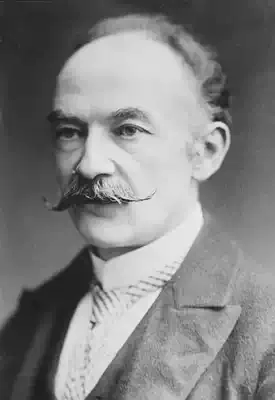
Thomas Hardy
The Caged Thrush Freed and Home Again (Villanelle)
"Men know but little more than we,
Who count us least of things terrene,
How happy days are made to be!
"Of such strange tidings what think ye,
O birds in brown that peck and preen?
Men know but little more than we!
"When I was borne from yonder tree
In bonds to them, I hoped to glean
How happy days are made to be,
"And want and wailing turned to glee;
Alas, despite their mighty mien
Men know but little more than we!
"They cannot change the Frost's decree,
They cannot keep the skies serene;
How happy days are made to be
"Eludes great Man's sagacity
No less than ours, O tribes in treen!
Men know but little more than we
How happy days are made to be."
210
Thomas Moore
Sublime Was the Warning
Sublime was the warning that liberty spoke,
And grand was the moment when Spaniards awoke
Into life and revenge from the conqueror's chain.
Oh, Liberty! let not this spirit have rest,
Till it move, like a breeze, o'er the waves of the west --
Give the light of your look to each sorrowing spot,
Nor, oh, be the Shamrock of Erin forgot
While you add to your garland the Olive of Spain.
If the fame of our fathers, bequeathed with their rights,
Give to country its charm, and to home its delights;
If deceit be a wound, and suspicion a stain,
Then, ye men of Iberia, our cause is the same!
And oh! may his tomb want a tear and a name,
Who would ask for a nobler, a holier death,
Than to turn his last sigh into victory's breath,
For the Shamrock of Erin and the Olive of Spain!
Ye Blakes and O'Donnels, whose fathers resign'd
The green hills of their youth, among strangers to find
That repose which, at home, they had sigh'd for in vain,
Join, join in our hope that the flame, which you light,
May be felt yet in Erin, as calm and as bright,
And forgive even Albion while blushing she draws,
Like a truant, her sword, in the long-slighted cause
Of the Shamrock of Erin and Olive of Spain!
God prosper the cause! -- oh, it cannot but thrive,
While the pulse of one patriot heart is alive,
Its devotion to feel, and its rights to maintain;
Then, how sainted by sorrow its martyrs will die!
The finger of Glory shall point where they lie;
While, far from the footstep of coward or slave,
The young spirit of Freedom shall shelter their grave,
Beneath Shamrocks of Erin and Olives of Spain!
208
John Greenleaf Whittier
The Branded Hand
WELCOME home again, brave seaman! with thy thoughtful brow and gray,
And the old heroic spirit of our earlier, better day;
With that front of calm endurance, on whose steady nerve in vain
Pressed the iron of the prison, smote the fiery shafts of pain!
Is the tyrant's brand upon thee? Did the brutal cravens aim
To make God's truth thy falsehood, His holiest work thy shame?
When, all blood-quenched, from the torture the iron was withdrawn,
How laughed their evil angel the baffled fools to scorn!
They change to wrong the duty which God hath written out
On the great heart of humanity, too legible for doubt!
They, the loathsome moral lepers, blotched from footsole up to crown,
Give to shame what God hath given unto honor and renown!
Why, that brand is highest honor! than its traces never yet
Upon old armorial hatchments was a prouder blazon set;
And thy unborn generations, as they tread our rocky strand,
Shall tell with pride the story of their father's branded hand!
As the Templar home was welcome, bearing back from Syrian wars
The scars of Arab lances and of Paynim scimitars,
The pallor of the prison, and the shackle's crimson span,
So we meet thee, so we greet thee, truest friend of God and man.
He suffered for the ransom of the dear Redeemer's grave,
Thou for His living presence in the bound and bleeding slave;
He for a soil no longer by the feet of angels trod,
Thou for the true Shechinah, the present home of God!
For, while the jurist, sitting with the slave-whip o'er him swung,
From the tortured truths of freedom the lie of slavery wrung,
And the solemn priest to Moloch, on each God-deserted shrine,
Broke the bondman's heart for bread, poured the bondman's blood for wine;
While the multitude in blindness to a far-off Saviour knelt
And spurned, the while, the temple where a present Saviour dwelt;
Thou beheld'st Him in the task-field, in the prison shadows dim,
And thy mercy to the bondman, it was mercy unto Him!
In thy lone and long night-watches, sky above and wave below,
Thou didst learn a higher wisdom than the babbling schoolmen know;
God's stars and silence taught thee, as His angels only can,
That the one sole sacred thing beneath the cope of heaven is Man!
That he who treads profanely on the scrolls of law and creed,
In the depth of God's great goodness may find mercy in his need;
But woe to him who crushes the soul with chain and rod,
And herds with lower natures the awful form of God!.
Then lift that manly right-hand, bold ploughman of the wave!
Its branded palm shall prophesy, 'Salvation to the Slave!'
Hold up its fire-wrought language, that whoso reads may feel
His heart swell strong within him, his sinews change to steel.
Hold it up before our sunshine, up against our Northern air;
Ho! men of Massachusetts, for the love of God, look there!
Take it henceforth for your standard, like the Bruce's heart of yore,
In the dark strife closing round ye, let that hand be seen before!
And the masters of the slave-land shall tremble at that sign,
When it points its finger Southward along the Puritan line
Can the craft of State avail them? Can a Christless church withstand,
In the van of Freedom's onset, the coming of that hand?
206
Robert W. Service
Captivity
O meadow lark, so wild and free,
It cannot be, it cannot be,
That men to merchandise your spell
Do close you in a wicker hell!
O hedgerow thrush so mad with glee,
it cannot be, it cannot be,
They rape you from your hawthorn foam
To make a cell of steel your home!
O blackbird in the orchard tree,
In cannot be, it cannot be,
That devils in a narrow cage
Would prison your melodic rage!
O you who live for liberty,
Can you believe that it can be,
That we of freedom's faith destroy
In dungeons, innocence and joy?
O decent folk who read this page,
If you should own a bird in cage,
Throw wide the door, - God gave it wings:
Then hear how in your heart it sings!
202
Robert W. Service
I Will Not Fight
I will not fight: though proud of pith
I hold no one worth striving with;
And should resentment burn my breast
I deem that silence serves me best:
So having not a word to say,
Contemptuous I turn away.
I will not fret: my rest of life
Free I will keep from hate and strife;
Let lust and sin and anger sleep,
I will not delve the subsoil deep,
But be content with inch of earth,
Where daisies have their birth.
I will not grieve: Till day be done
I will be tranquil in the sun,
With garden glow and quiet nook,
And song of bird and spell of book . . .
God bless you all! I will not fight,
But love and dream until--Goodnight!
203
Thomas Moore
The Wine-Cup is Circling
The wine-cup is circling in Almhin's hall,
And its Chief, 'mid his heroes reclining,
Looks up, with a sigh to the trophied wall,
Where his sword hangs idly shining.
When, hark, that shout
From the vale without --
"Arm ye quick, the Dane, the Dane is nigh!"
Every Chief starts up
From his foaming cup,
And "To battle, to battle!" is the Finian's cry.
The minstrels have seized their harps of gold,
And they sing such thrilling numbers --
'Tis like the voice of the Brave, of old,
Breaking forth from their place of slumber!
Spear to buckler rang,
As the minstrels sang,
And the Sun-burst o'er them floated wide;
While remembering the yoke
Which their fathers broke,
"On for liberty, for liberty!" the Finians cried.
Like clouds of the night the Northmen came,
O'er the valley of Almhin lowering;
While onward moved, in the light of its fame,
That banner of Erin, towering.
With the mingling shock
Rung cliff and rock,
While, rank on rank, the invaders die:
And the shout, that last
O'er the dying pass'd,
Was "victory! victory!" -- the Finian's cry.
200
Robert W. Service
My Garret
Here is my Garret up five flights of stairs;
Here's where I deal in dreams and ply in fancies,
Here is the wonder-shop of all my wares,
My sounding sonnets and my red romances.
Here's where I challenge Fate and ring my rhymes,
And grope at glory -- aye, and starve at times.
Here is my Stronghold: stout of heart am I,
Greeting each dawn as songful as a linnet;
And when at night on yon poor bed I lie
(Blessing the world and every soul that's in it),
Here's where I thank the Lord no shadow bars
My skylight's vision of the valiant stars.
Here is my Palace tapestried with dreams.
Ah! though to-night ten sous are all my treasure,
While in my gaze immortal beauty gleams,
Am I not dowered with wealth beyond all measure?
Though in my ragged coat my songs I sing,
King of my soul, I envy not the king.
Here is my Haven: it's so quiet here;
Only the scratch of pen, the candle's flutter;
Shabby and bare and small, but O how dear!
Mark you -- my table with my work a-clutter,
My shelf of tattered books along the wall,
My bed, my broken chair -- that's nearly all.
Only four faded walls, yet mine, all mine.
Oh, you fine folks, a pauper scorns your pity.
Look, where above me stars of rapture shine;
See, where below me gleams the siren city . . .
Am I not rich? -- a millionaire no less,
If wealth be told in terms of Happiness.
199
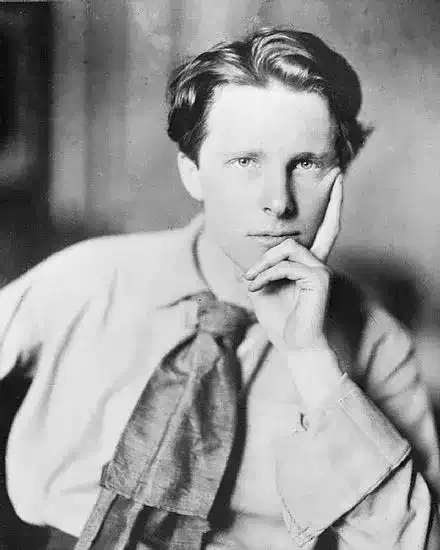
Rupert Brooke
II: Safety
Dear! of all happy in the hour, most blest
He who has found our hid security,
Assured in the dark tides of the world that rest,
And heard our word, 'Who is so safe as we?'
We have found safety with all things undying,
The winds, and morning, tears of men and mirth,
The deep night, and birds singing, and clouds flying,
And sleep, and freedom, and the autumnal earth.
We have built a house that is not for Time's throwing.
We have gained a peace unshaken by pain for ever.
War knows no power. Safe shall be my going,
Secretly armed against all death's endeavour;
Safe though all safety's lost; safe where men fall;
And if these poor limbs die, safest of all.
196
Thomas Moore
Silence is in Our Festal Halls
Silence is in our festal halls --
Sweet son of song! thy course is o'er;
In vain on thee sad Erin calls,
Her minstrel's voice responds no more; --
All silent as the Eolian shell
Sleeps at the close of some bright day,
When the sweet breeze, that waked its swell
At sunny morn, hath died away.
Yet, at our feasts, thy spirit long,
Awaked by music's spell, shall rise;
For, name so link'd with deathless song
Partakes its charm and never dies;
And even within the holy fane,
When music wafts the soul to heaven,
One thought to him, whose earliest strain
Was echoed there, shall long be given.
But where is now the cheerful day,
The social night, when by thy side,
He who now weaves this parting lay
His skilless voice with thine allied;
And sung those songs whose every tone,
When bard and minstrel long have past,
Shall still, in sweetness all their own,
Embalm'd by fame, undying last.
Yes, Erin, shine alone the fame --
Or, if thy bard have shared the crown,
From thee the borrow'd glory came,
And at thy feet is now laid down.
Enough, if Freedom still inspire,
His latest song, and still there be,
As evening closes round his lyre,
One ray upon its chords from thee.
192

William Wordsworth
The Sonnet i
NUNS fret not at their convent's narrow room,
And hermits are contented with their cells,
And students with their pensive citadels;
Maids at the wheel, the weaver at his loom,
Sit blithe and happy; bees that soar for bloom,
High as the highest peak of Furness fells,
Will murmur by the hour in foxglove bells:
In truth the prison unto which we doom
Ourselves no prison is: and hence for me,
In sundry moods, 'twas pastime to be bound
Within the Sonnet's scanty plot of ground;
Pleased if some souls (for such there needs must be)
Who have felt the weight of too much liberty,
Should find brief solace there, as I have found.
195
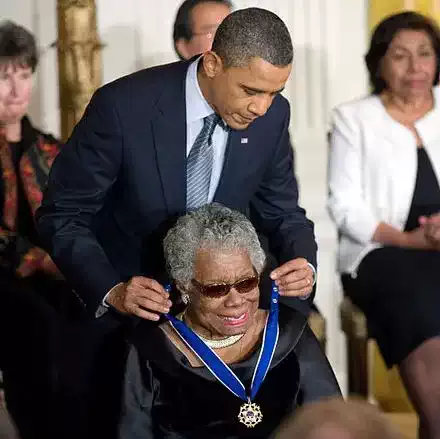
Maya Angelou
Touched by an Angel
We, unaccustomed to courage
exiles from delight
live coiled in shells of loneliness
until love leaves its high holy temple
and comes into our sight
to liberate us into life.
Love arrives
and in its train come ecstasies
old memories of pleasure
ancient histories of pain.
Yet if we are bold,
love strikes away the chains of fear
from our souls.
We are weaned from our timidity
In the flush of love's light
we dare be brave
And suddenly we see
that love costs all we are
and will ever be.
Yet it is only love
which sets us free.
193
Thomas Moore
Erin, Oh Erin
Like the bright lamp, that shone in Kildare's holy fane,
And burn'd through long ages of darkness and storm,
Is the heart that sorrows have frown'd on in vain,
Whose spirit outlives them, unfading and warm.
Erin, oh Erin, thus bright through the tears
Of a long night of bondage, thy spirit appears.
The nations have fallen, and thou still art young,
Thy sun is but rising, when others are set;
And though slavery's cloud o'er thy morning hath hung,
The full noon of freedom shall beam round thee yet.
Erin, oh Erin, though long in the shade,
Thy star will shine out when the proudest shall fade.
Unchill'd by the rain, and unwaked by the wind,
The lily lies sleeping through winter's cold hour,
Till Spring's light touch her fetters unbind,
And daylight and liberty bless the young flower.
Thus Erin, oh Erin, thy winter is past,
And the hope that lived through it shall blossom at last.
190
Thomas Moore
Sing, Sweet Harp
Sing, sweet Harp, oh sing to me
Some song of ancient days,
Whose sounds, in this sad memory,
Long-buried dreams shall raise; --
Some lay that tells of vanish'd fame,
Whose light once round us shone,
Of noble pride, now turn'd to shame,
And hopes for ever gone.
Sing, sad Harp, thus sing to me;
Alike our doom is cast,
Both lost to all but memory,
We live but in the past.
How mournfully the midnight air
Among thy chords doth sigh,
As if it sought some echo there,
Of voices long gone by; --
Of chieftains, now forgot, who seem'd
The foremost then in fame;
Of Bards who, once immortal deem'd,
Now sleep without a name.
In vain, sad Harp, the midnight air
Among thy chords doth sigh;
In vain it seeks an echo there
Of voices long gone by.
Couldst thou but call those spirits round,
Who once, in bower and hall,
Sate listening to thy magic sound,
Now mute and mouldering all; --
But, no; they would but wake to weep
Their children's slavery;
Then leave them in their dreamless sleep,
The dead, at least are free!
Hush, hush, sad Harp, that dreary tone,
That knell of Freedom's day;
Or, listening to its death-like moan,
Let me, too, die away.
186
Thomas Moore
Forget Not the Field
Forget not the field where they perish'd,
The truest, the last of the brave,
All gone -- and the bright hope we cherish'd
Gone with them, and quench'd in their grave!
Oh! could we from death but recover
Those hearts as they bounded before,
In the face of high heaven to fight over
That combat for freedom once more; --
Could the chain for an instant be riven
Which Tyranny flung round us then,
No, 'tis not in Man, nor in Heaven,
To let Tyranny bind it again!
But 'tis past -- and, though blazon'd in story
The name of our Victor may be,
Accurst is the march of that glory
Which treads o'er the hearts of the free.
For dearer the grave or the prison,
Illumed by one patriot name,
Than the trophies of all who have risen
On Liberty's ruins to fame.
191
William Wordsworth
The Power of Armies Is a Visible Thing
The power of Armies is a visible thing,
Formal, and circumscribed in time and space;
But who the limits of that power shall trace
Which a brave People into light can bring
Or hide, at will,--for freedom combating
By just revenge inflamed? No foot may chase,
No eye can follow, to a fatal place
That power, that spirit, whether on the wing
Like the strong wind, or sleeping like the wind
Within its awful caves.--From year to year
Springs this indigenous produce far and near;
No craft this subtle element can bind,
Rising like water from the soil, to find
In every nook a lip that it may cheer.
186
Thomas Moore
Fairest! Put on a While
Fairest! put on a while
These pinions of light I bring thee,
And o'er thy own green isle
In fancy let me wing thee.
Never did Ariel's plume,
At golden sunset, hover
O'er scenes so full of bloom
As I shall waft thee over.
Fields, where the Spring delays
And fearlessly meets the ardour
Of the warm Summer's gaze,
With only her tears to guard her;
Rocks, through myrtle boughs
In grace majestic frowning,
Like some bold warrior's brows
That Love hath just been crowning.
Islets, so freshly fair,
That never hath bird come nigh them,
But, from his course through air,
He hath been won down by them; --
Types, sweet maid, of thee,
Whose look, whose blush inviting,
Never did Love yet see
From heaven, without alighting.
Lakes, where the pearl lies hid,
And caves, where the gem is sleeping,
Bright as the tears thy lid
Lets fall in lonely weepin.
Glens, where Ocean comes,
To 'scape the wild wind's rancour;
And harbours, worthiest homes
Where Freedom's fleet can anchor.
Then, if, while scenes so grand,
So beautiful, shine before thee,
Pride for thy own dear land
Should haply be stealing o'er thee,
Oh, let grief come first,
O'er pride itself victorious --
Thinking how man hath curst
What Heaven hath made so glorious.
182
Robert W. Service
Spanish Peasant
We have no aspiration vain
For paradise Utopian,
And here in our sun-happy Spain,
Though man exploit his fellow man,
To high constraint we humbly yield,
And turn from politics to toil,
Content to till a kindly field
And bring forth bounty from the soil.
They tell us wars will never cease;
They sy the world is out of joint.
How well we Know! But peace is peace
Even imposed at pistol point.
And we have learnt our lesson well,
By many a death, by many a tear;
So let us live a feudal spell, -
The cost of freedom is too dear.
Let us be the cattle kind,
Praying the goad be not a sword;
In servitude obeying blind
The tyrant ruling of our Lord.
His army can be swift to slay,
His Church teach us humility . . .
But never never will we pay
Again blood-price for Liberty.
161