
Work and Profession

Jonathan Swift
On A Corkscrew
Though I, alas! a prisoner be,
My trade is prisoners to set free.
No slave his lord's commands obeys
With such insinuating ways.
My genius piercing, sharp, and bright,
Wherein the men of wit delight.
The clergy keep me for their ease,
And turn and wind me as they please.
A new and wondrous art I show
Of raising spirits from below;
In scarlet some, and some in white;
They rise, walk round, yet never fright.
In at each mouth the spirits pass,
Distinctly seen as through a glass:
O'er head and body make a rout,
And drive at last all secrets out;
And still, the more I show my art,
The more they open every heart.
A greater chemist none than I
Who, from materials hard and dry,
Have taught men to extract with skill
More precious juice than from a still.
Although I'm often out of case,
I'm not ashamed to show my face.
Though at the tables of the great
I near the sideboard take my seat;
Yet the plain 'squire, when dinner's done,
Is never pleased till I make one;
He kindly bids me near him stand,
And often takes me by the hand.
I twice a-day a-hunting go;
Nor ever fail to seize my foe;
And when I have him by the poll,
I drag him upwards from his hole;
Though some are of so stubborn kind,
I'm forced to leave a limb behind.
I hourly wait some fatal end;
For I can break, but scorn to bend.
221

Henry Lawson
How the Land was Won
The future was dark and the past was dead
As they gazed on the sea once more –
But a nation was born when the immigrants said
"Good-bye!" as they stepped ashore!
In their loneliness they were parted thus
Because of the work to do,
A wild wide land to be won for us
By hearts and hands so few.
The darkest land 'neath a blue sky's dome,
And the widest waste on earth;
The strangest scenes and the least like home
In the lands of our fathers' birth;
The loneliest land in the wide world then,
And away on the furthest seas,
A land most barren of life for men –
And they won it by twos and threes!
With God, or a dog, to watch, they slept
By the camp-fires' ghastly glow,
Where the scrubs were dark as the blacks that crept
With "nulla" and spear held low;
Death was hidden amongst the trees,
And bare on the glaring sand
They fought and perished by twos and threes –
And that's how they won the land!
It was two that failed by the dry creek bed,
While one reeled on alone –
The dust of Australia's greatest dead
With the dust of the desert blown!
Gaunt cheek-bones cracking the parchment skin
That scorched in the blazing sun,
Black lips that broke in a ghastly grin –
And that's how the land was won!
Starvation and toil on the tracks they went,
And death by the lonely way;
The childbirth under the tilt or tent,
The childbirth under the dray!
The childbirth out in the desolate hut
With a half-wild gin for nurse –
That's how the first were born to bear
The brunt of the first man's curse!
They toiled and they fought through the shame of it –
Through wilderness, flood, and drought;
They worked, in the struggles of early days,
Their sons' salvation out.
The white girl-wife in the hut alone,
The men on the boundless run,
The miseries suffered, unvoiced, unknown –
And that's how the land was won.
No armchair rest for the old folk then –
But, ruined by blight and drought,
They blazed the tracks to the camps again
In the big scrubs further out.
The worn haft, wet with a father's sweat,
Gripped hard by the eldest son,
The boy's back formed to the hump of toil –
And that's how the land was won!
And beyond Up Country, beyond Out Back,
And the rainless belt, they ride,
The currency lad and the ne'er-do-well
And the black sheep, side by side;
In wheeling horizons of endless haze
That disk through the Great North-west,
They ride for ever by twos and by threes –
And that's how they win the rest.
221

Robert W. Service
Jane
My daughter Jane makes dresses
For beautiful Princesses;
But though she's plain is Jane,
Of needlework she's vain,
And makes such pretty things
For relatives of Kings.
She reads the picture papers
Where Royalties cut capers,
And often says to me:
'How wealthy they must be,
That nearly every day
A new robe they can pay.'
Says I: 'If your Princesses
Could fabric pretty dresses,
Though from a throne they stem
I would think more of them.
Peeress and shopgirl are
To my mind on a par.'
Says Jane: 'But for their backing
I might be sewing sacking.
Instead, I work with joy
In exquisite employ,
Embroidering rich dresses
For elegant Princesses . . .
Damn social upsetters
Who criticise their betters!'
217
Robert W. Service
The Black Dudeen
Humping it here in the dug-out,
Sucking me black dudeen,
I'd like to say in a general way,
There's nothing like Nickyteen;
There's nothing like Nickyteen, me boys,
Be it pipes or snipes or cigars;
So be sure that a bloke
Has plenty to smoke,
If you wants him to fight your wars.
When I've eat my fill and my belt is snug,
I begin to think of my baccy plug.
I whittle a fill in my horny palm,
And the bowl of me old clay pipe I cram.
I trim the edges, I tamp it down,
I nurse a light with an anxious frown;
I begin to draw, and my cheeks tuck in,
And all my face is a blissful grin;
And up in a cloud the good smoke goes,
And the good pipe glimmers and fades and glows;
In its throat it chuckles a cheery song,
For I likes it hot and I likes it strong.
Oh, it's good is grub when you're feeling hollow,
But the best of a meal's the smoke to follow.
There was Micky and me on a night patrol,
Having to hide in a fizz-bang hole;
And sure I thought I was worse than dead
Wi' them crump-crumps hustlin' over me head.
Sure I thought 'twas the dirty spot,
Hammer and tongs till the air was hot.
And mind you, water up to your knees.
And cold! A monkey of brass would freeze.
And if we ventured our noses out
A "typewriter" clattered its pills about.
The Field of Glory! Well, I don't think!
I'd sooner be safe and snug in clink.
Then Micky, he goes and he cops one bad,
He always was having ill-luck, poor lad.
Says he: "Old chummy, I'm booked right through;
Death and me 'as a wrongday voo.
But . . . 'aven't you got a pinch of shag? -I'd
sell me perishin' soul for a fag."
And there he shivered and cussed his luck,
So I gave him me old black pipe to suck.
And he heaves a sigh, and he takes to it
Like a babby takes to his mammy's tit;
Like an infant takes to his mother's breast,
Poor little Micky! he went to rest.
But the dawn was near, though the night was black,
So I left him there and I started back.
And I laughed as the silly old bullets came,
For the bullet ain't made wot's got me name.
Yet some of 'em buzzed onhealthily near,
And one little blighter just chipped me ear.
But there! I got to the trench all right,
When sudden I jumped wi' a start o' fright,
And a word that doesn't look well in type:
I'd clean forgotten me old clay pipe.
So I had to do it all over again,
Crawling out on that filthy plain.
Through shells and bombs and bullets and all --
Only this time -- I do not crawl.
I run like a man wot's missing a train,
Or a tom-cat caught in a plump of rain.
I hear the spit of a quick-fire gun
Tickle my heels, but I run, I run.
Through crash and crackle, and flicker and flame,
(Oh, the packet ain't issued wot's got me name!)
I run like a man that's no ideer
Of hunting around for a sooveneer.
I run bang into a German chap,
And he stares like an owl, so I bash his map.
And just to show him that I'm his boss,
I gives him a kick on the parados.
And I marches him back with me all serene,
Wiv, tucked in me grup, me old dudeen.
Sitting here in the trenches
Me heart's a-splittin' with spleen,
For a parcel o' lead comes missing me head,
But it smashes me old dudeen.
God blast that red-headed sniper!
I'll give him somethin' to snipe;
Before the war's through
Just see how I do
That blighter that smashed me pipe.
218
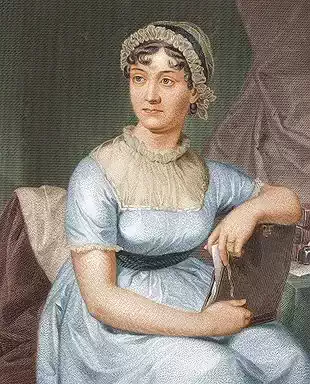
Jane Austen
Happy the Lab'rer
Happy the lab'rer in his Sunday clothes!
In light-drab coat, smart waistcoat, well-darn'd hose,
Andhat upon his head, to church he goes;
As oft, with conscious pride, he downward throws
A glance upon the ample cabbage rose
That, stuck in button-hole, regales his nose,
He envies not the gayest London beaux.
In church he takes his seat among the rows,
Pays to the place the reverence he owes,
Likes best the prayers whose meaning least he knows,
Lists to the sermon in a softening doze,
And rouses joyous at the welcome close.
218
Jonathan Swift
Market Women’s Cries
APPLES
COME buy my fine wares,
Plums, apples and pears.
A hundred a penny,
In conscience too many:
Come, will you have any?
My children are seven,
I wish them in Heaven;
My husband ’s a sot,
With his pipe and his pot,
Not a farthen will gain them,
And I must maintain them.
ONIONS
Come, follow me by the smell,
Here are delicate onions to sell;
I promise to use you well.
They make the blood warmer,
You’ll feed like a farmer;
For this is every cook’s opinion,
No savoury dish without an onion;
But, lest your kissing should be spoiled,
Your onions must be thoroughly boiled:
Or else you may spare
Your mistress a share,
The secret will never be known:
She cannot discover
The breath of her lover,
But think it as sweet as her own.
HERRINGS
Be not sparing,
Leave off swearing.
Buy my herring
Fresh from Malahide,
Better never was tried.
Come, eat them with pure fresh butter and mustard,
Their bellies are soft, and as white as a custard.
Come, sixpence a dozen, to get me some bread,
Or, like my own herrings, I soon shall be dead.
216
Henry Lawson
The Squatter, Three Cornstalks, and the Well
There was a Squatter in the land—
So runs the truthful tale I tell—
There also were three cornstalks, and
There also was the Squatter’s Well.
Singing (slowly): “Sin and sorrer, sin and sor-rer, sin and sor-r-r-rer.”
The Squatter he was full of pluck,
The Cornstalks they were full of sin,
The well it was half full of muck
That many rains had drifted in.
Singing (with increased feeling): “Sin, &c.”
The Squatter hired the Cornstalks Three
To cleanse the well of mud and clay;
And so they started willing-lee
At five-and-twenty bob a day.
Singing (apprehensively): “Sin, &c.”
At five-and-twenty bob the lot—
That’s eight-and-four the day would bring
To each; and so they thought they’d got
A rather soft and easy thing.
Singing (sadly): “Sin, &c.”
The Cornstalks cleaned the well within
A day or two, or thereabout—
And then they worked an awful sin—
A scheme to make the job last out.
Singing (reproachfully): “Sin and sorrer, &c.”
For when the well was cleaned out quite
Of all its logs and muck and clay
They tipped a drayload down at night
And worked to haul it up next day.
Singing (dismally): “Sin, &c.”
But first the eldest, christened Hodge,
He greased the dray-wheel axles, so
The super wouldn’t smell the dodge
And couldn’t let the Squatter know.
Singing (hopelessly): “Sin and sorrer, &c.”
The stuff they surfaced out each day
With some surprise the Squatter saw.
He never dreamt the sand and clay
Was three miles off the night before.
Singing (mournfully): “Sin and sorrer, &c.”
But he got something in his eye;
It wasn’t green, that’s very plain.
He said the well was rather dry,
And they could fill it up again.
Singing (mournfully and dismally): “Sin and sorrer, &c.”
The Cornstalks went to work next day
In hope, of course, of extra tin—
The Squatter watched, and, sad to say,
The mullock wouldn’t all go in.
Singing (with great pathos): “Sin and sorrer, &c.”
And though the Cornstalks twigged the ruse
Whereby the boss had done ’em brown,
They argued that the clay was loose,
And wanted time to settle down.
Singing (hopelessly): “Sin and sorrer, &c.”
The boss began to rave and tear,
And yelled with a most awful frown,
“I will not settle up, I swear,
Till that there clay is settled down!”
Singing (hopefully): “Sin, &c.”
“Before my cheques yer’Il pocket, boys,
Yer’ll put a mountain in a well”—
The Cornstalks didn’t make a noise,
They only murmured sadly—!
Singing (triumphantly): “Sin and sorrer, &c.”
MORAL:
There is a moral to my rhyme—
A moral to the dirge I sing—
That when you do go in for crime
You mustn’t overdoo the thing.
Singing (more dismally than ever): “Sin and sorrer, s-i-n and sor-r-r-r-rer!”
216
Robert W. Service
Pavement Poet
God's truth! these be the bitter times.
In vain I sing my sheaf of rhymes,
And hold my battered hat for dimes.
And then a copper collars me,
Barking: "It's begging that you be;
Come on, dad; you're in custody."
And then the Beak looks down and says:
"Sheer doggerel I deem your lays:
I send you down for seven days."
So for the week I won't disturb
The peace by singing at the curb.
I don't mind that, but oh it's hell
To have my verse called doggerel.
208

Emily Dickinson
I made slow Riches but my Gain
I made slow Riches but my Gain
Was steady as the Sun
And every Night, it numbered more
Than the preceding One
All Days, I did not earn the same
But my perceiveless Gain
Inferred the less by Growing than
The Sum that it had grown.
Was steady as the Sun
And every Night, it numbered more
Than the preceding One
All Days, I did not earn the same
But my perceiveless Gain
Inferred the less by Growing than
The Sum that it had grown.
205
Lewis Carroll
Fit the First: ( Hunting of the Snark )
The Landing
"Just the place for a Snark!" the Bellman cried,
As he landed his crew with care;
Supporting each man on the top of the tide
By a finger entwined in his hair.
"Just the place for a Snark! I have said it twice:
That alone should encourage the crew.
Just the place for a Snark! I have said it thrice:
What I tell you three times is true."
The crew was complete: it included a BootsA
maker of Bonnets and HoodsA
Barrister, brought to arrange their disputes
And
a Broker, to value their goods.
A Billiardmarker,
whose skill was immense,
Might perhaps have won more than his share
But
a Banker, engaged at enormous expense,
Had the whole of their cash in his care.
There was also a Beaver, that paced on the deck,
Or would sit making lace in the bow:
And had often (the Bellman said) saved them from wreck
Though none of the sailors knew how.
There was one who was famed for the number of things
He forgot when he entered the ship:
His umbrella, his watch, all his jewels and rings,
And the clothes he had bought for the trip.
He had fortytwo
boxes, all carefully packed,
With his name painted clearly on each:
But, since he omitted to mention the fact,
They were all left behind on the beach.
The loss of his clothes hardly mattered, because
He had seven coats on when he came,
With three pair of bootsbut
the worst of is was,
He had wholly forgotten his name.
He would answer to "Hi!" or to any loud cry,
Such as "Fry me!" or "Fritter my wig!"
To "Whatyoumaycallum!"
or "Whatwashisname!"
But especially "Thingumajig!"
While, for those who preferred a more forcible word,
He had different names from these:
His intimate friends called him "Candleends",
And his enemies "Toastedcheese"
"His form is ungainlyhis
intellect small"
(So the Bellman would often remark)"
But his courage is perfect! And that, after all,
Is the thing that one needs with a Snark."
He would joke with hyaenas, returning their stare
With an impudent wag of the head:
And he once went a walk, pawinpaw,
with a bear,
"Just to keep up its spirits," he said.
He came as a Baker: but owned, when too late
And
it drove the poor Bellman halfmad
He
could only bake Bridecakefor
which, I may state,
No materials were to be had.
The last of the crew needs especial remark,
Though he looked an incredible dunce:
He had just one ideabut,
that one being "Snark",
The good Bellman engaged him at once.
He came as a Butcher: but gravely declared,
When the ship had been sailing a week,
He could only kill Beavers. The Bellman looked scared,
And was almost too frightened to speak:
But at length he explained, in a tremulous tone,
There was only one Beaver on board;
And that was a tame one he had of his own,
Whose death would be deeply deplored.
The Beaver, who happened to hear the remark,
Protested, with tears in its eyes,
That not even the rapture of hunting the Snark
Could atone for that dismal surprise!
It strongly advised that the Butcher should be
Conveyed in a separate ship:
But the Bellman declared that would never agree
With the plans he had made for the trip:
Navigation was always a difficult art,
Though with only one ship and one bell:
And he feared he must really decline, for his part,
Undertaking another as well.
The Beaver's best course was, no doubt, to procure
A secondhand
daggerproof
coat
So
the baker advised itand
next, to insure
Its life in some Office of note:
This the Baker suggested, and offered for hire
(On moderate terms), or for sale,
Two excellent Policies, one Against Fire
And one Against Damage From Hail.
Yet still, ever after that sorrowful day,
Whenever the Butcher was by,
The Beaver kept looking the opposite way,
And appeared unaccountably shy.
204
Henry Lawson
That Great Waiting Silence
Where shall we go for prophecy? Where shall we go for proof?
The holiday street is crowded, pavement, window and roof;
Band and banner pass by us, and the old tunes rise and fall—
But that great waiting silence is on the people all!
Where is the cheering and laughter of the eight-hour days gone by?
When the holiday heart was careless, and the holiday spirit high—
The friendly jostling and banter, the wit and the jovial call?
But that great waiting silence is over the people all.
Oh! but my heart beats faster—and a gush that was nearly tears:
Clatter of hammers on iron! and Australian Engineers!
Goods from Australian workshops—proud to the world at last
(And I see, in a flash from the future, Australian guns go past).
The morning sun-glare, softened by a veil, like frosted glass—
There is no breath of a head-breeze as the Labour banners pass,
There seems no sign of a danger or a change for the workers now—
But for some great, new-born spirit the banners seem to bow.
Where shall we go for our platforms? Where shall we go, indeed?
Shall we follow the cackle of women that follow the jesting Reid,
Through indifferent-seeming cities—and the browned men straight and tall?
But that great waiting silence is on the people all.
Twist and tangle and mystify, bully, and weep and bluff;
Marry the truth to a glaring lie, and say it is good enough;
Boast of your vice and villainy—in your virtue rant and bawl—
But that great waiting silence is over the people all!
Brothers, who work with shovel or pen, labour by day and night:
Brothers, who think of the hearts of men, ponder and speak and write;
Work for Australia’s destiny, content till you hear the call,
For the spirit that builds a nation is over the people all.
196
Robert W. Service
Old Engine Driver
For five and twenty years I've run
A famous train;
But now my spell of speed is done,
No more I'll strain
My sight along the treadless tracks,
The gleamy rails:
My hand upon the throttle slacks,
My vision fails.
No more I'll urge my steed of steel
Through hostile nights;
No more the mastery I'll feel
Of monster might.
I'll miss the hiss of giant steam,
The clank, the roar;
The agony of brakes that scream
I'll hear no more.
Oh I have held within my hand
A million lives;
And now my son takes command
And proudly drives;
While from my cottage wistfully
I watch his train,
And wave and wave and seem to see
Myself again.
200
Henry Lawson
Riding Round the Lines
Dust and smoke against the sunrise out where grim disaster lurks
And a broken sky-line looming like unfinished railway works,
And a trot, trot, trot and canter down inside the belt of mines:
It is General Greybeard Shrapnel who is riding round his lines.
And the scarecrows from the trenches, haggard eyes and hollow cheeks,
War-stained uniforms and ragged that have not been off for weeks;
They salute him and they cheer him and they watch his face for signs;
Ah! they try to read old Greybeard while he’s riding round the lines.
There’s a crack, crack, crack and rattle; there’s a thud and there’s a crash;
In the battery over yonder there is something gone to smash,
Then a hush and sudden movement, and its meaning he divines,
And he patches up a blunder while he’s riding round his lines.
Pushing this position forward, bringing that position back,
While his officers, with orders, ride like hell down hell’s own track;
Making hay—and to what purpose?—while his sun of winter shines,
But his work is just beginning when he’s ridden round his lines.
There are fifty thousand rifles and a hundred batteries
All a-playing battle music, with his fingers on the keys,
And if for an hour, exhausted, on his camp bed he reclines,
In his mind he still is riding—he is riding round his lines.
He’s the brains of fifty thousand, blundering at their country’s call;
He’s the one hope of his nation, and the loneliest man of all;
He is flesh and blood and human, though he never shews the signs:
He is General Greybeard Shrapnel who is fixing up his lines.
It is thankless work and weary, and, for all his neighbour knows,
He may sometimes feel as if he doesn’t half care how it goes;
But for all that can be gathered from his eyes of steely blue
He might be a great contractor who has some big job to do.
There’s the son who died in action—it may be a week ago;
There’s the wife and other troubles that most men have got to know—
(And we’ll say the grey-haired mother underneath the porch of vines):
Does he ever think of these things while he’s riding round his lines?
He is bossed by bitter boobies who can never understand;
He is hampered by the asses and the robbers of the land,
And I feel inclined to wonder what his own opinions are
Of the Government, the country, of the war and of the Czar.
He’s the same when he’s advancing, he’s the same in grim retreat;
For he wears one mask in triumph and the same mask in defeat;
Of the brave he is the bravest, he is strongest of the strong:
General Greybeard Shrapnel never shows that anything is wrong.
But we each and all are lonely, and we have our work to do;
We must fight for wife and children or our country and our screw
In the everlasting struggle to the end that fate destines;
In the war that men call living we are riding round our lines.
I ride round my last defences, where the bitter jibes are flung,
I am patching up the blunders that I made when I was young,
And I may be digging pitfalls and I may be laying mines;
For I sometimes feel like Shrapnel while I’m riding round my lines.
192

Siegfried Sassoon
What the Captain Said at the Point-to-Point
I’ve had a good bump round; my little horse
Refused the brook first time,
Then jumped it prime;
And ran out at the double,
But of course
There’s always trouble at a double:
And then—I don’t know how
It was—he turned it up
At that big, hairy fence before the plough;
And some young silly pup
(I don’t know which),
Near as a toucher knocked me into the ditch;
But we finished full of running, and quite sound:
And anyhow I’ve had a good bump round.
181

Homero
The Odyssey: Book 14
Ulysses now left the haven, and took the rough track up through
the wooded country and over the crest of the mountain till he
reached the place where Minerva had said that he would find the
swineherd, who was the most thrifty servant he had. He found him
sitting in front of his hut, which was by the yards that he had
built on a site which could be seen from far. He had made them
spacious and fair to see, with a free ran for the pigs all round them;
he had built them during his master's absence, of stones which he
had gathered out of the ground, without saying anything to Penelope or
Laertes, and he had fenced them on top with thorn bushes. Outside
the yard he had run a strong fence of oaken posts, split, and set
pretty close together, while inside lie had built twelve sties near
one another for the sows to lie in. There were fifty pigs wallowing in
each sty, all of them breeding sows; but the boars slept outside and
were much fewer in number, for the suitors kept on eating them, and
die swineherd had to send them the best he had continually. There were
three hundred and sixty boar pigs, and the herdsman's four hounds,
which were as fierce as wolves, slept always with them. The
swineherd was at that moment cutting out a pair of sandals from a good
stout ox hide. Three of his men were out herding the pigs in one place
or another, and he had sent the fourth to town with a boar that he had
been forced to send the suitors that they might sacrifice it and
have their fill of meat.
When the hounds saw Ulysses they set up a furious barking and flew
at him, but Ulysses was cunning enough to sit down and loose his
hold of the stick that he had in his hand: still, he would have been
torn by them in his own homestead had not the swineherd dropped his ox
hide, rushed full speed through the gate of the yard and driven the
dogs off by shouting and throwing stones at them. Then he said to
Ulysses, "Old man, the dogs were likely to have made short work of
you, and then you would have got me into trouble. The gods have
given me quite enough worries without that, for I have lost the best
of masters, and am in continual grief on his account. I have to attend
swine for other people to eat, while he, if he yet lives to see the
light of day, is starving in some distant land. But come inside, and
when you have had your fill of bread and wine, tell me where you
come from, and all about your misfortunes."
On this the swineherd led the way into the hut and bade him sit
down. He strewed a good thick bed of rushes upon the floor, and on the
top of this he threw the shaggy chamois skin- a great thick one- on
which he used to sleep by night. Ulysses was pleased at being made
thus welcome, and said "May Jove, sir, and the rest of the gods
grant you your heart's desire in return for the kind way in which
you have received me."
To this you answered, O swineherd Eumaeus, "Stranger, though a still
poorer man should come here, it would not be right for me to insult
him, for all strangers and beggars are from Jove. You must take what
you can get and be thankful, for servants live in fear when they
have young lords for their masters; and this is my misfortune now, for
heaven has hindered the return of him who would have been always
good to me and given me something of my own- a house, a piece of land,
a good looking wife, and all else that a liberal master allows a
servant who has worked hard for him, and whose labour the gods have
prospered as they have mine in the situation which I hold. If my
master had grown old here he would have done great things by me, but
he is gone, and I wish that Helen's whole race were utterly destroyed,
for she has been the death of many a good man. It was this matter that
took my master to Ilius, the land of noble steeds, to fight the
Trojans in the cause of kin Agamemnon."
As he spoke he bound his girdle round him and went to the sties
where the young sucking pigs were penned. He picked out two which he
brought back with him and sacrificed. He singed them, cut them up, and
spitted on them; when the meat was cooked he brought it all in and set
it before Ulysses, hot and still on the spit, whereon Ulysses
sprinkled it over with white barley meal. The swineherd then mixed
wine in a bowl of ivy-wood, and taking a seat opposite Ulysses told
him to begin.
"Fall to, stranger," said he, "on a dish of servant's pork. The
fat pigs have to go to the suitors, who eat them up without shame or
scruple; but the blessed gods love not such shameful doings, and
respect those who do what is lawful and right. Even the fierce
free-booters who go raiding on other people's land, and Jove gives
them their spoil- even they, when they have filled their ships and got
home again live conscience-stricken, and look fearfully for judgement;
but some god seems to have told these people that Ulysses is dead
and gone; they will not, therefore, go back to their own homes and
make their offers of marriage in the usual way, but waste his estate
by force, without fear or stint. Not a day or night comes out of
heaven, but they sacrifice not one victim nor two only, and they
take the run of his wine, for he was exceedingly rich. No other
great man either in Ithaca or on the mainland is as rich as he was; he
had as much as twenty men put together. I will tell you what he had.
There are twelve herds of cattle upon the mainland, and as many flocks
of sheep, there are also twelve droves of pigs, while his own men
and hired strangers feed him twelve widely spreading herds of goats.
Here in Ithaca he runs even large flocks of goats on the far end of
the island, and they are in the charge of excellent goatherds. Each
one of these sends the suitors the best goat in the flock every day.
As for myself, I am in charge of the pigs that you see here, and I
have to keep picking out the best I have and sending it to them."
This was his story, but Ulysses went on eating and drinking
ravenously without a word, brooding his revenge. When he had eaten
enough and was satisfied, the swineherd took the bowl from which he
usually drank, filled it with wine, and gave it to Ulysses, who was
pleased, and said as he took it in his hands, "My friend, who was this
master of yours that bought you and paid for you, so rich and so
powerful as you tell me? You say he perished in the cause of King
Agamemnon; tell me who he was, in case I may have met with such a
person. Jove and the other gods know, but I may be able to give you
news of him, for I have travelled much."
Eumaeus answered, "Old man, no traveller who comes here with news
will get Ulysses' wife and son to believe his story. Nevertheless,
tramps in want of a lodging keep coming with their mouths full of
lies, and not a word of truth; every one who finds his way to Ithaca
goes to my mistress and tells her falsehoods, whereon she takes them
in, makes much of them, and asks them all manner of questions,
crying all the time as women will when they have lost their
husbands. And you too, old man, for a shirt and a cloak would
doubtless make up a very pretty story. But the wolves and birds of
prey have long since torn Ulysses to pieces, or the fishes of the
sea have eaten him, and his bones are lying buried deep in sand upon
some foreign shore; he is dead and gone, and a bad business it is
for all his friends- for me especially; go where I may I shall never
find so good a master, not even if I were to go home to my mother
and father where I was bred and born. I do not so much care,
however, about my parents now, though I should dearly like to see them
again in my own country; it is the loss of Ulysses that grieves me
most; I cannot speak of him without reverence though he is here no
longer, for he was very fond of me, and took such care of me that
whereever he may be I shall always honour his memory."
"My friend," replied Ulysses, "you are very positive, and very
hard of belief about your master's coming home again, nevertheless I
will not merely say, but will swear, that he is coming. Do not give me
anything for my news till he has actually come, you may then give me a
shirt and cloak of good wear if you will. I am in great want, but I
will not take anything at all till then, for I hate a man, even as I
hate hell fire, who lets his poverty tempt him into lying. I swear
by king Jove, by the rites of hospitality, and by that hearth of
Ulysses to which I have now come, that all will surely happen as I
have said it will. Ulysses will return in this self same year; with
the end of this moon and the beginning of the next he will be here
to do vengeance on all those who are ill treating his wife and son."
To this you answered, O swineherd Eumaeus, "Old man, you will
neither get paid for bringing good news, nor will Ulysses ever come
home; drink you wine in peace, and let us talk about something else.
Do not keep on reminding me of all this; it always pains me when any
one speaks about my honoured master. As for your oath we will let it
alone, but I only wish he may come, as do Penelope, his old father
Laertes, and his son Telemachus. I am terribly unhappy too about
this same boy of his; he was running up fast into manhood, and bade
fare to be no worse man, face and figure, than his father, but some
one, either god or man, has been unsettling his mind, so he has gone
off to Pylos to try and get news of his father, and the suitors are
lying in wait for him as he is coming home, in the hope of leaving the
house of Arceisius without a name in Ithaca. But let us say no more
about him, and leave him to be taken, or else to escape if the son
of Saturn holds his hand over him to protect him. And now, old man,
tell me your own story; tell me also, for I want to know, who you
are and where you come from. Tell me of your town and parents, what
manner of ship you came in, how crew brought you to Ithaca, and from
what country they professed to come- for you cannot have come by
land."
And Ulysses answered, "I will tell you all about it. If there were
meat and wine enough, and we could stay here in the hut with nothing
to do but to eat and drink while the others go to their work, I
could easily talk on for a whole twelve months without ever
finishing the story of the sorrows with which it has pleased heaven to
visit me.
"I am by birth a Cretan; my father was a well-to-do man, who had
many sons born in marriage, whereas I was the son of a slave whom he
had purchased for a concubine; nevertheless, my father Castor son of
Hylax (whose lineage I claim, and who was held in the highest honour
among the Cretans for his wealth, prosperity, and the valour of his
sons) put me on the same level with my brothers who had been born in
wedlock. When, however, death took him to the house of Hades, his sons
divided his estate and cast lots for their shares, but to me they gave
a holding and little else; nevertheless, my valour enabled me to marry
into a rich family, for I was not given to bragging, or shirking on
the field of battle. It is all over now; still, if you look at the
straw you can see what the ear was, for I have had trouble enough
and to spare. Mars and Minerva made me doughty in war; when I had
picked my men to surprise the enemy with an ambuscade I never gave
death so much as a thought, but was the first to leap forward and
spear all whom I could overtake. Such was I in battle, but I did not
care about farm work, nor the frugal home life of those who would
bring up children. My delight was in ships, fighting, javelins, and
arrows- things that most men shudder to think of; but one man likes
one thing and another another, and this was what I was most
naturally inclined to. Before the Achaeans went to Troy, nine times
was I in command of men and ships on foreign service, and I amassed
much wealth. I had my pick of the spoil in the first instance, and
much more was allotted to me later on.
"My house grew apace and I became a great man among the Cretans, but
when Jove counselled that terrible expedition, in which so many
perished, the people required me and Idomeneus to lead their ships
to Troy, and there was no way out of it, for they insisted on our
doing so. There we fought for nine whole years, but in the tenth we
sacked the city of Priam and sailed home again as heaven dispersed us.
Then it was that Jove devised evil against me. I spent but one month
happily with my children, wife, and property, and then I conceived the
idea of making a descent on Egypt, so I fitted out a fine fleet and
manned it. I had nine ships, and the people flocked to fill them.
For six days I and my men made feast, and I found them many victims
both for sacrifice to the gods and for themselves, but on the
seventh day we went on board and set sail from Crete with a fair North
wind behind us though we were going down a river. Nothing went ill
with any of our ships, and we had no sickness on board, but sat
where we were and let the ships go as the wind and steersmen took
them. On the fifth day we reached the river Aegyptus; there I
stationed my ships in the river, bidding my men stay by them and
keep guard over them while I sent out scouts to reconnoitre from every
point of vantage.
"But the men disobeyed my orders, took to their own devices, and
ravaged the land of the Egyptians, killing the men, and taking their
wives and children captive. The alarm was soon carried to the city,
and when they heard the war cry, the people came out at daybreak
till the plain was filled with horsemen and foot soldiers and with the
gleam of armour. Then Jove spread panic among my men, and they would
no longer face the enemy, for they found themselves surrounded. The
Egyptians killed many of us, and took the rest alive to do forced
labour for them. Jove, however, put it in my mind to do thus- and I
wish I had died then and there in Egypt instead, for there was much
sorrow in store for me- I took off my helmet and shield and dropped my
spear from my hand; then I went straight up to the king's chariot,
clasped his knees and kissed them, whereon he spared my life, bade
me get into his chariot, and took me weeping to his own home. Many
made at me with their ashen spears and tried to kil me in their
fury, but the king protected me, for he feared the wrath of Jove the
protector of strangers, who punishes those who do evil.
"I stayed there for seven years and got together much money among
the Egyptians, for they all gave me something; but when it was now
going on for eight years there came a certain Phoenician, a cunning
rascal, who had already committed all sorts of villainy, and this
man talked me over into going with him to Phoenicia, where his house
and his possessions lay. I stayed there for a whole twelve months, but
at the end of that time when months and days had gone by till the same
season had come round again, he set me on board a ship bound for
Libya, on a pretence that I was to take a cargo along with him to that
place, but really that he might sell me as a slave and take the
money I fetched. I suspected his intention, but went on board with
him, for I could not help it.
"The ship ran before a fresh North wind till we had reached the
sea that lies between Crete and Libya; there, however, Jove counselled
their destruction, for as soon as we were well out from Crete and
could see nothing but sea and sky, he raised a black cloud over our
ship and the sea grew dark beneath it. Then Jove let fly with his
thunderbolts and the ship went round and round and was filled with
fire and brimstone as the lightning struck it. The men fell all into
the sea; they were carried about in the water round the ship looking
like so many sea-gulls, but the god presently deprived them of all
chance of getting home again. I was all dismayed; Jove, however,
sent the ship's mast within my reach, which saved my life, for I clung
to it, and drifted before the fury of the gale. Nine days did I
drift but in the darkness of the tenth night a great wave bore me on
to the Thesprotian coast. There Pheidon king of the Thesprotians
entertained me hospitably without charging me anything at all for
his son found me when I was nearly dead with cold and fatigue, whereon
he raised me by the hand, took me to his father's house and gave me
clothes to wear.
"There it was that I heard news of Ulysses, for the king told me
he had entertained him, and shown him much hospitality while he was on
his homeward journey. He showed me also the treasure of gold, and
wrought iron that Ulysses had got together. There was enough to keep
his family for ten generations, so much had he left in the house of
king Pheidon. But the king said Ulysses had gone to Dodona that he
might learn Jove's mind from the god's high oak tree, and know whether
after so long an absence he should return to Ithaca openly, or in
secret. Moreover the king swore in my presence, making drink-offerings
in his own house as he did so, that the ship was by the water side,
and the crew found, that should take him to his own country. He sent
me off however before Ulysses returned, for there happened to be a
Thesprotian ship sailing for the wheat-growing island of Dulichium,
and he told those in charge of her to be sure and take me safely to
King Acastus.
"These men hatched a plot against me that would have reduced me to
the very extreme of misery, for when the ship had got some way out
from land they resolved on selling me as a slave. They stripped me
of the shirt and cloak that I was wearing, and gave me instead the
tattered old clouts in which you now see me; then, towards
nightfall, they reached the tilled lands of Ithaca, and there they
bound me with a strong rope fast in the ship, while they went on shore
to get supper by the sea side. But the gods soon undid my bonds for
me, and having drawn my rags over my head I slid down the rudder
into the sea, where I struck out and swam till I was well clear of
them, and came ashore near a thick wood in which I lay concealed. They
were very angry at my having escaped and went searching about for
me, till at last they thought it was no further use and went back to
their ship. The gods, having hidden me thus easily, then took me to
a good man's door- for it seems that I am not to die yet awhile."
To this you answered, O swineherd Eumaeus, "Poor unhappy stranger, I
have found the story of your misfortunes extremely interesting, but
that part about Ulysses is not right; and you will never get me to
believe it. Why should a man like you go about telling lies in this
way? I know all about the return of my master. The gods one and all of
them detest him, or they would have taken him before Troy, or let
him die with friends around him when the days of his fighting were
done; for then the Achaeans would have built a mound over his ashes
and his son would have been heir to his renown, but now the storm
winds have spirited him away we know not whither.
"As for me I live out of the way here with the pigs, and never go to
the town unless when Penelope sends for me on the arrival of some news
about Ulysses. Then they all sit round and ask questions, both those
who grieve over the king's absence, and those who rejoice at it
because they can eat up his property without paying for it. For my own
part I have never cared about asking anyone else since the time when I
was taken in by an Aetolian, who had killed a man and come a long
way till at last he reached my station, and I was very kind to him. He
said he had seen Ulysses with Idomeneus among the Cretans, refitting
his ships which had been damaged in a gale. He said Ulysses would
return in the following summer or autumn with his men, and that he
would bring back much wealth. And now you, you unfortunate old man,
since fate has brought you to my door, do not try to flatter me in
this way with vain hopes. It is not for any such reason that I shall
treat you kindly, but only out of respect for Jove the god of
hospitality, as fearing him and pitying you."
Ulysses answered, "I see that you are of an unbelieving mind; I have
given you my oath, and yet you will not credit me; let us then make
a bargain, and call all the gods in heaven to witness it. If your
master comes home, give me a cloak and shirt of good wear, and send me
to Dulichium where I want to go; but if he does not come as I say he
will, set your men on to me, and tell them to throw me from yonder
precepice, as a warning to tramps not to go about the country
telling lies."
"And a pretty figure I should cut then," replied Eumaeus, both now
and hereafter, if I were to kill you after receiving you into my hut
and showing you hospitality. I should have to say my prayers in good
earnest if I did; but it is just supper time and I hope my men will
come in directly, that we may cook something savoury for supper."
Thus did they converse, and presently the swineherds came up with
the pigs, which were then shut up for the night in their sties, and
a tremendous squealing they made as they were being driven into
them. But Eumaeus called to his men and said, "Bring in the best pig
you have, that I may sacrifice for this stranger, and we will take
toll of him ourselves. We have had trouble enough this long time
feeding pigs, while others reap the fruit of our labour."
On this he began chopping firewood, while the others brought in a
fine fat five year old boar pig, and set it at the altar. Eumaeus
did not forget the gods, for he was a man of good principles, so the
first thing he did was to cut bristles from the pig's face and throw
them into the fire, praying to all the gods as he did so that
Ulysses might return home again. Then he clubbed the pig with a billet
of oak which he had kept back when he was chopping the firewood, and
stunned it, while the others slaughtered and singed it. Then they
cut it up, and Eumaeus began by putting raw pieces from each joint
on to some of the fat; these he sprinkled with barley meal, and laid
upon the embers; they cut the rest of the meat up small, put the
pieces upon the spits and roasted them till they were done; when
they had taken them off the spits they threw them on to the dresser in
a heap. The swineherd, who was a most equitable man, then stood up
to give every one his share. He made seven portions; one of these he
set apart for Mercury the son of Maia and the nymphs, praying to
them as he did so; the others he dealt out to the men man by man. He
gave Ulysses some slices cut lengthways down the loin as a mark of
especial honour, and Ulysses was much pleased. "I hope, Eumaeus," said
he, "that Jove will be as well disposed towards you as I am, for the
respect you are showing to an outcast like myself."
To this you answered, O swineherd Eumaeus, "Eat, my good fellow, and
enjoy your supper, such as it is. God grants this, and withholds that,
just as he thinks right, for he can do whatever he chooses."
As he spoke he cut off the first piece and offered it as a burnt
sacrifice to the immortal gods; then he made them a drink-offering,
put the cup in the hands of Ulysses, and sat down to his own
portion. Mesaulius brought them their bread; the swineherd had
bought this man on his own account from among the Taphians during
his master's absence, and had paid for him with his own money
without saying anything either to his mistress or Laertes. They then
laid their hands upon the good things that were before them, and
when they had had enough to eat and drink, Mesaulius took away what
was left of the bread, and they all went to bed after having made a
hearty supper.
Now the night came on stormy and very dark, for there was no moon.
It poured without ceasing, and the wind blew strong from the West,
which is a wet quarter, so Ulysses thought he would see whether
Eumaeus, in the excellent care he took of him, would take off his
own cloak and give it him, or make one of his men give him one.
"Listen to me," said he, "Eumaeus and the rest of you; when I have
said a prayer I will tell you something. It is the wine that makes
me talk in this way; wine will make even a wise man fall to singing;
it will make him chuckle and dance and say many a word that he had
better leave unspoken; still, as I have begun, I will go on. Would
that I were still young and strong as when we got up an ambuscade
before Troy. Menelaus and Ulysses were the leaders, but I was in
command also, for the other two would have it so. When we had come
up to the wall of the city we crouched down beneath our armour and lay
there under cover of the reeds and thick brush-wood that grew about
the swamp. It came on to freeze with a North wind blowing; the snow
fell small and fine like hoar frost, and our shields were coated thick
with rime. The others had all got cloaks and shirts, and slept
comfortably enough with their shields about their shoulders, but I had
carelessly left my cloak behind me, not thinking that I should be
too cold, and had gone off in nothing but my shirt and shield. When
the night was two-thirds through and the stars had shifted their their
places, I nudged Ulysses who was close to me with my elbow, and he
at once gave me his ear.
"'Ulysses,' said I, 'this cold will be the death of me, for I have
no cloak; some god fooled me into setting off with nothing on but my
shirt, and I do not know what to do.'
"Ulysses, who was as crafty as he was valiant, hit upon the
following plan:
"'Keep still,' said he in a low voice, 'or the others will hear
you.' Then he raised his head on his elbow.
"'My friends,' said he, 'I have had a dream from heaven in my sleep.
We are a long way from the ships; I wish some one would go down and
tell Agamemnon to send us up more men at once.'
"On this Thoas son of Andraemon threw off his cloak and set out
running to the ships, whereon I took the cloak and lay in it
comfortably enough till morning. Would that I were still young and
strong as I was in those days, for then some one of you swineherds
would give me a cloak both out of good will and for the respect due to
a brave soldier; but now people look down upon me because my clothes
are shabby."
And Eumaeus answered, "Old man, you have told us an excellent story,
and have said nothing so far but what is quite satisfactory; for the
present, therefore, you shall want neither clothing nor anything
else that a stranger in distress may reasonably expect, but
to-morrow morning you have to shake your own old rags about your
body again, for we have not many spare cloaks nor shirts up here,
but every man has only one. When Ulysses' son comes home again he will
give you both cloak and shirt, and send you wherever you may want to
go."
With this he got up and made a bed for Ulysses by throwing some
goatskins and sheepskins on the ground in front of the fire. Here
Ulysses lay down, and Eumaeus covered him over with a great heavy
cloak that he kept for a change in case of extraordinarily bad
weather.
Thus did Ulysses sleep, and the young men slept beside him. But
the swineherd did not like sleeping away from his pigs, so he got
ready to go and Ulysses was glad to see that he looked after his
property during his master's absence. First he slung his sword over
his brawny shoulders and put on a thick cloak to keep out the wind. He
also took the skin of a large and well fed goat, and a javelin in case
of attack from men or dogs. Thus equipped he went to his rest where
the pigs were camping under an overhanging rock that gave them shelter
from the North wind.
Translated by Samuel Butler
181
Robert W. Service
The Aftermath
Although my blood I've shed
In war's red wrath,
Oh how I darkly dread
Its aftermath!
Oh how I fear the day
Of my release,
When I must face the fray
Of phoney peace!
When I must fend again
In labour strife;
And toil with sweat and strain
For kids and wife.
The world is so upset
I battled for,
That grimly I regret
The peace of war.
The wounds are hard to heal
Of shell and shard,
But O the way to weal
Is bitter hard!
Though looking back I see
A gory path,
How bloody black can be
War's Aftermath!
185
Robert W. Service
The Logger
In the moonless, misty night, with my little pipe alight,
I am sitting by the camp-fire's fading cheer;
Oh, the dew is falling chill on the dim, deer-haunted hill,
And the breakers in the bay are moaning drear.
The toilful hours are sped, the boys are long abed,
And I alone a weary vigil keep;
In the sightless, sullen sky I can hear the night-hawk cry,
And the frogs in frenzied chorus from the creek.
And somehow the embers' glow brings me back the long ago,
The days of merry laughter and light song;
When I sped the hours away with the gayest of the gay
In the giddy whirl of fashion's festal throng.
Oh, I ran a grilling race and I little recked the pace,
For the lust of youth ran riot in my blood;
But at last I made a stand in this God-forsaken land
Of the pine-tree and the mountain and the flood.
And now I've got to stay, with an overdraft to pay,
For pleasure in the past with future pain;
And I'm not the chap to whine, for if the chance were mine
I know I'd choose the old life once again.
With its woman's eyes a-shine, and its flood of golden wine;
Its fever and its frolic and its fun;
The old life with its din, its laughter and its sin -And
chuck me in the gutter when it's done.
Ah, well! it's past and gone, and the memory is wan,
That conjures up each old familiar face;
And here by fortune hurled, I am dead to all the world,
And I've learned to lose my pride and keep my place.
My ways are hard and rough, and my arms are strong and tough,
And I hew the dizzy pine till darkness falls;
And sometimes I take a dive, just to keep my heart alive,
Among the gay saloons and dancing halls.
In the distant, dinful town just a little drink to drown
The cares that crowd and canker in my brain;
Just a little joy to still set my pulses all a-thrill,
Then back to brutish labour once again.
And things will go on so until one day I shall know
That Death has got me cinched beyond a doubt;
Then I'll crawl away from sight, and morosely in the night
My weary, wasted life will peter out.
Then the boys will gather round, and they'll launch me in the ground,
And pile the stones the timber wolf to foil;
And the moaning pine will wave overhead a nameless grave,
Where the black snake in the sunshine loves to coil.
And they'll leave me there alone, and perhaps with softened tone
Speak of me sometimes in the camp-fire's glow,
As a played-out, broken chum, who has gone to Kingdom Come,
And who went the pace in England long ago.
174

William Ernest Henley
Barmaid
Though, if you ask her name, she says Elise,
Being plain Elizabeth, e'en let it pass,
And own that, if her aspirates take their ease,
She ever makes a point, in washing glass,
Handling the engine, turning taps for tots,
And countering change, and scorning what men say,
Of posing as a dove among the pots,
Nor often gives her dignity away.
Her head's a work of art, and, if her eyes
Be tired and ignorant, she has a waist;
Cheaply the Mode she shadows; and she tries
From penny novels to amend her taste;
And, having mopped the zinc for certain years,
And faced the gas, she fades and disappears.
174
Robert W. Service
Ernie Pyle
I wish I had a simple style
In writing verse,
As in his prose had Ernie Pyle,
So true and terse;
Springing so forthright from the heart
With guileless art.
I wish I could put back a dram
As Ernie could;
I wish that I could cuss and damn
As soldier should;
And fain with every verse would I
Ernie outvie.
Alas! I cannot claim his high
Humanity;
Nor emulate his pungent, dry
Profanity;
Nor share his love of common folk
Who bear life's yolk.
Oh Ernie, who on earth I knew
In war and wine,
Though frail of fame, in soul how you
Were pure and fine!
I'm proud that once when we were plastered
You called me 'bastard.'
170
Robert W. Service
My Dentist
Sitting in the dentist's chair,
Wishing that I wasn't there,
To forget and pass the time
I have made this bit of rhyme.
I had a rendez-vous at ten;
I rushed to get in line,
But found a lot of dames and men
Had waited there since nine;
I stared at them, then in an hour
Was blandly ushered in;
But though my face was grim and sour
He met me with a grin.
He told me of his horse of blood,
And how it "also ran",
He plans to own a racing stud (
He seems a wealthy man.)
And then he left me there until
I growled: "At any rate,
I hope he'll not charge in his bill
For all the time I wait."
His wife has sables on her back,
With jewels she's ablaze;
She drives a stately Cadillac,
And I'm the mug who pays:
At least I'm one of those who peer
With pessimistic gloom
At magazines of yester-year
In his damn waiting room.
I am a Christian Scientist;
I don't believe in pain;
My dentist had a powerful wrist,
He tries and tries in vain
To make me grunt or groan or squeal
With probe or rasp or drill. . . .
But oh, what agony I feel
When HE PRESENTS HIS BILL!
Sitting in the dental chair,
Don't you wish you weren't there:
Well, your cup of woe to fill,
Just think of his infernal bill.
171
Robert W. Service
Our Pote
A pote is sure a goofy guy;
He ain't got guts like you or I
To tell the score;
He ain't goy gumption 'nuff to know
The game of life's to get the dough,
Then get some more.
Take Brother Bill, he used to be
The big shot of the family,
The first at school;
But since about a year ago,
Through readin' Longfeller and Poe,
He's most a fool.
He mopes around with dimwit stare;
You might as well jest not be there,
The way he looks;
You'd think he shuns the human race,
The how he buries down his face
In highbrow books.
I've seen him stand for near an hour,
Jest starin' at a simple flower
Sich waste o' time;
The scribblin' on an envelope . . .
Why, most of all his silly dope
Don't even rhyme.
Now Brother's Jim's an engineer,
And Brother Tim's a bank cashier,
While I keep store;
Yet Bill, the brightest of the flock,
Might be a lawyer or a doc,
And then some more.
But no, he moons and loafs about,
As if he tried to figger out
Why skies are blue;
Instead o' gittin' down to grips
Wi' life an' stackin' up the chips
Like me an' you.
* * * * * * * * * *
Well, since them final lines I wrote,
We're mournin' for our Brother Pote:
Bill crossed the sea
And solved his problem with the beat,
For now he lies in peace and rest
In Normandie.
He died the bravest of the brave,
And here I'm standin' by his grave
So far from home;
With just a wooden cross to tell
How in the blaze of battle hell
As gloriously there he fell Bill
wrote his "pome".
166
Homero
The Odyssey: Book 18
Now there came a certain common tramp who used to go begging all
over the city of Ithaca, and was notorious as an incorrigible
glutton and drunkard. This man had no strength nor stay in him, but he
was a great hulking fellow to look at; his real name, the one his
mother gave him, was Arnaeus, but the young men of the place called
him Irus, because he used to run errands for any one who would send
him. As soon as he came he began to insult Ulysses, and to try and
drive him out of his own house.
"Be off, old man," he cried, "from the doorway, or you shall be
dragged out neck and heels. Do you not see that they are all giving me
the wink, and wanting me to turn you out by force, only I do not
like to do so? Get up then, and go of yourself, or we shall come to
blows."
Ulysses frowned on him and said, "My friend, I do you no manner of
harm; people give you a great deal, but I am not jealous. There is
room enough in this doorway for the pair of us, and you need not
grudge me things that are not yours to give. You seem to be just
such another tramp as myself, but perhaps the gods will give us better
luck by and by. Do not, however, talk too much about fighting or you
will incense me, and old though I am, I shall cover your mouth and
chest with blood. I shall have more peace to-morrow if I do, for you
will not come to the house of Ulysses any more."
Irus was very angry and answered, "You filthy glutton, you run on
trippingly like an old fish-fag. I have a good mind to lay both
hands about you, and knock your teeth out of your head like so many
boar's tusks. Get ready, therefore, and let these people here stand by
and look on. You will never be able to fight one who is so much
younger than yourself."
Thus roundly did they rate one another on the smooth pavement in
front of the doorway, and when Antinous saw what was going on he
laughed heartily and said to the others, "This is the finest sport
that you ever saw; heaven never yet sent anything like it into this
house. The stranger and Irus have quarreled and are going to fight,
let us set them on to do so at once."
The suitors all came up laughing, and gathered round the two
ragged tramps. "Listen to me," said Antinous, "there are some goats'
paunches down at the fire, which we have filled with blood and fat,
and set aside for supper; he who is victorious and proves himself to
be the better man shall have his pick of the lot; he shall be free
of our table and we will not allow any other beggar about the house at
all."
The others all agreed, but Ulysses, to throw them off the scent,
said, "Sirs, an old man like myself, worn out with suffering, cannot
hold his own against a young one; but my irrepressible belly urges
me on, though I know it can only end in my getting a drubbing. You
must swear, however that none of you will give me a foul blow to
favour Irus and secure him the victory."
They swore as he told them, and when they had completed their oath
Telemachus put in a word and said, "Stranger, if you have a mind to
settle with this fellow, you need not be afraid of any one here.
Whoever strikes you will have to fight more than one. I am host, and
the other chiefs, Antinous and Eurymachus, both of them men of
understanding, are of the same mind as I am."
Every one assented, and Ulysses girded his old rags about his loins,
thus baring his stalwart thighs, his broad chest and shoulders, and
his mighty arms; but Minerva came up to him and made his limbs even
stronger still. The suitors were beyond measure astonished, and one
would turn towards his neighbour saying, "The stranger has brought
such a thigh out of his old rags that there will soon be nothing
left of Irus."
Irus began to be very uneasy as he heard them, but the servants
girded him by force, and brought him [into the open part of the court]
in such a fright that his limbs were all of a tremble. Antinous
scolded him and said, "You swaggering bully, you ought never to have
been born at all if you are afraid of such an old broken-down creature
as this tramp is. I say, therefore- and it shall surely be- if he
beats you and proves himself the better man, I shall pack you off on
board ship to the mainland and send you to king Echetus, who kills
every one that comes near him. He will cut off your nose and ears, and
draw out your entrails for the dogs to eat."
This frightened Irus still more, but they brought him into the
middle of the court, and the two men raised their hands to fight. Then
Ulysses considered whether he should let drive so hard at him as to
make an end of him then and there, or whether he should give him a
lighter blow that should only knock him down; in the end he deemed
it best to give the lighter blow for fear the Achaeans should begin to
suspect who he was. Then they began to fight, and Irus hit Ulysses
on the right shoulder; but Ulysses gave Irus a blow on the neck
under the ear that broke in the bones of his skull, and the blood came
gushing out of his mouth; he fell groaning in the dust, gnashing his
teeth and kicking on the ground, but the suitors threw up their
hands and nearly died of laughter, as Ulysses caught hold of him by
the foot and dragged him into the outer court as far as the
gate-house. There he propped him up against the wall and put his staff
in his hands. "Sit here," said he, "and keep the dogs and pigs off;
you are a pitiful creature, and if you try to make yourself king of
the beggars any more you shall fare still worse."
Then he threw his dirty old wallet, all tattered and torn, over
his shoulder with the cord by which it hung, and went back to sit down
upon the threshold; but the suitors went within the cloisters,
laughing and saluting him, "May Jove, and all the other gods," said
they, 'grant you whatever you want for having put an end to the
importunity of this insatiable tramp. We will take him over to the
mainland presently, to king Echetus, who kills every one that comes
near him."
Ulysses hailed this as of good omen, and Antinous set a great goat's
paunch before him filled with blood and fat. Amphinomus took two
loaves out of the bread-basket and brought them to him, pledging him
as he did so in a golden goblet of wine. "Good luck to you," he
said, "father stranger, you are very badly off at present, but I
hope you will have better times by and by."
To this Ulysses answered, "Amphinomus, you seem to be a man of
good understanding, as indeed you may well be, seeing whose son you
are. I have heard your father well spoken of; he is Nisus of
Dulichium, a man both brave and wealthy. They tell me you are his son,
and you appear to be a considerable person; listen, therefore, and
take heed to what I am saying. Man is the vainest of all creatures
that have their being upon earth. As long as heaven vouchsafes him
health and strength, he thinks that he shall come to no harm
hereafter, and even when the blessed gods bring sorrow upon him, he
bears it as he needs must, and makes the best of it; for God
Almighty gives men their daily minds day by day. I know all about
it, for I was a rich man once, and did much wrong in the
stubbornness of my pride, and in the confidence that my father and
my brothers would support me; therefore let a man fear God in all
things always, and take the good that heaven may see fit to send him
without vainglory. Consider the infamy of what these suitors are
doing; see how they are wasting the estate, and doing dishonour to the
wife, of one who is certain to return some day, and that, too, not
long hence. Nay, he will be here soon; may heaven send you home
quietly first that you may not meet with him in the day of his coming,
for once he is here the suitors and he will not part bloodlessly."
With these words he made a drink-offering, and when he had drunk
he put the gold cup again into the hands of Amphinomus, who walked
away serious and bowing his head, for he foreboded evil. But even so
he did not escape destruction, for Minerva had doomed him fall by
the hand of Telemachus. So he took his seat again at the place from
which he had come.
Then Minerva put it into the mind of Penelope to show herself to the
suitors, that she might make them still more enamoured of her, and win
still further honour from her son and husband. So she feigned a
mocking laugh and said, "Eurynome, I have changed my and have a
fancy to show myself to the suitors although I detest them. I should
like also to give my son a hint that he had better not have anything
more to do with them. They speak fairly enough but they mean
mischief."
"My dear child," answered Eurynome, "all that you have said is true,
go and tell your son about it, but first wash yourself and anoint your
face. Do not go about with your cheeks all covered with tears; it is
not right that you should grieve so incessantly; for Telemachus,
whom you always prayed that you might live to see with a beard, is
already grown up."
"I know, Eurynome," replied Penelope, "that you mean well, but do
not try and persuade me to wash and to anoint myself, for heaven
robbed me of all my beauty on the day my husband sailed; nevertheless,
tell Autonoe and Hippodamia that I want them. They must be with me
when I am in the cloister; I am not going among the men alone; it
would not be proper for me to do so."
On this the old woman went out of the room to bid the maids go to
their mistress. In the meantime Minerva bethought her of another
matter, and sent Penelope off into a sweet slumber; so she lay down on
her couch and her limbs became heavy with sleep. Then the goddess shed
grace and beauty over her that all the Achaeans might admire her.
She washed her face with the ambrosial loveliness that Venus wears
when she goes dancing with the Graces; she made her taller and of a
more commanding figure, while as for her complexion it was whiter than
sawn ivory. When Minerva had done all this she went away, whereon
the maids came in from the women's room and woke Penelope with the
sound of their talking.
"What an exquisitely delicious sleep I have been having," said
she, as she passed her hands over her face, "in spite of all my
misery. I wish Diana would let me die so sweetly now at this very
moment, that I might no longer waste in despair for the loss of my
dear husband, who possessed every kind of good quality and was the
most distinguished man among the Achaeans."
With these words she came down from her upper room, not alone but
attended by two of her maidens, and when she reached the suitors she
stood by one of the bearing-posts supporting the roof of the cloister,
holding a veil before her face, and with a staid maid servant on
either side of her. As they beheld her the suitors were so overpowered
and became so desperately enamoured of her, that each one prayed he
might win her for his own bed fellow.
"Telemachus," said she, addressing her son, "I fear you are no
longer so discreet and well conducted as you used to be. When you were
younger you had a greater sense of propriety; now, however, that you
are grown up, though a stranger to look at you would take you for
the son of a well-to-do father as far as size and good looks go,
your conduct is by no means what it should be. What is all this
disturbance that has been going on, and how came you to allow a
stranger to be so disgracefully ill-treated? What would have
happened if he had suffered serious injury while a suppliant in our
house? Surely this would have been very discreditable to you."
"I am not surprised, my dear mother, at your displeasure," replied
Telemachus, "I understand all about it and know when things are not as
they should be, which I could not do when I was younger; I cannot,
however, behave with perfect propriety at all times. First one and
then another of these wicked people here keeps driving me out of my
mind, and I have no one to stand by me. After all, however, this fight
between Irus and the stranger did not turn out as the suitors meant it
to do, for the stranger got the best of it. I wish Father Jove,
Minerva, and Apollo would break the neck of every one of these
wooers of yours, some inside the house and some out; and I wish they
might all be as limp as Irus is over yonder in the gate of the outer
court. See how he nods his head like a drunken man; he has had such
a thrashing that he cannot stand on his feet nor get back to his home,
wherever that may be, for has no strength left in him."
Thus did they converse. Eurymachus then came up and said, "Queen
Penelope, daughter of Icarius, if all the Achaeans in Iasian Argos
could see you at this moment, you would have still more suitors in
your house by tomorrow morning, for you are the most admirable woman
in the whole world both as regards personal beauty and strength of
understanding."
To this Penelope replied, "Eurymachus, heaven robbed me of all my
beauty whether of face or figure when the Argives set sail for Troy
and my dear husband with them. If he were to return and look after
my affairs, I should both be more respected and show a better presence
to the world. As it is, I am oppressed with care, and with the
afflictions which heaven has seen fit to heap upon me. My husband
foresaw it all, and when he was leaving home he took my right wrist in
his hand- 'Wife, 'he said, 'we shall not all of us come safe home
from Troy, for the Trojans fight well both with bow and spear. They
are excellent also at fighting from chariots, and nothing decides
the issue of a fight sooner than this. I know not, therefore,
whether heaven will send me back to you, or whether I may not fall
over there at Troy. In the meantime do you look after things here.
Take care of my father and mother as at present, and even more so
during my absence, but when you see our son growing a beard, then
marry whom you will, and leave this your present home. This is what he
said and now it is all coming true. A night will come when I shall
have to yield myself to a marriage which I detest, for Jove has
taken from me all hope of happiness. This further grief, moreover,
cuts me to the very heart. You suitors are not wooing me after the
custom of my country. When men are courting a woman who they think
will be a good wife to them and who is of noble birth, and when they
are each trying to win her for himself, they usually bring oxen and
sheep to feast the friends of the lady, and they make her
magnificent presents, instead of eating up other people's property
without paying for it."
This was what she said, and Ulysses was glad when he heard her
trying to get presents out of the suitors, and flattering them with
fair words which he knew she did not mean.
Then Antinous said, "Queen Penelope, daughter of Icarius, take as
many presents as you please from any one who will give them to you; it
is not well to refuse a present; but we will not go about our business
nor stir from where we are, till you have married the best man among
us whoever he may be."
The others applauded what Antinous had said, and each one sent his
servant to bring his present. Antinous's man returned with a large and
lovely dress most exquisitely embroidered. It had twelve beautifully
made brooch pins of pure gold with which to fasten it. Eurymachus
immediately brought her a magnificent chain of gold and amber beads
that gleamed like sunlight. Eurydamas's two men returned with some
earrings fashioned into three brilliant pendants which glistened
most beautifully; while king Pisander son of Polyctor gave her a
necklace of the rarest workmanship, and every one else brought her a
beautiful present of some kind.
Then the queen went back to her room upstairs, and her maids brought
the presents after her. Meanwhile the suitors took to singing and
dancing, and stayed till evening came. They danced and sang till it
grew dark; they then brought in three braziers to give light, and
piled them up with chopped firewood very and dry, and they lit torches
from them, which the maids held up turn and turn about. Then Ulysses
said:
"Maids, servants of Ulysses who has so long been absent, go to the
queen inside the house; sit with her and amuse her, or spin, and
pick wool. I will hold the light for all these people. They may stay
till morning, but shall not beat me, for I can stand a great deal."
The maids looked at one another and laughed, while pretty Melantho
began to gibe at him contemptuously. She was daughter to Dolius, but
had been brought up by Penelope, who used to give her toys to play
with, and looked after her when she was a child; but in spite of all
this she showed no consideration for the sorrows of her mistress,
and used to misconduct herself with Eurymachus, with whom she was in
love.
"Poor wretch," said she, "are you gone clean out of your mind? Go
and sleep in some smithy, or place of public gossips, instead of
chattering here. Are you not ashamed of opening your mouth before your
betters- so many of them too? Has the wine been getting into your
head, or do you always babble in this way? You seem to have lost
your wits because you beat the tramp Irus; take care that a better man
than he does not come and cudgel you about the head till he pack you
bleeding out of the house."
"Vixen," replied Ulysses, scowling at her, "I will go and tell
Telemachus what you have been saying, and he will have you torn limb
from limb."
With these words he scared the women, and they went off into the
body of the house. They trembled all aver, for they thought he would
do as he said. But Ulysses took his stand near the burning braziers,
holding up torches and looking at the people- brooding the while on
things that should surely come to pass.
But Minerva would not let the suitors for one moment cease their
insolence, for she wanted Ulysses to become even more bitter against
them; she therefore set Eurymachus son of Polybus on to gibe at him,
which made the others laugh. "Listen to me," said he, "you suitors
of Queen Penelope, that I may speak even as I am minded. It is not for
nothing that this man has come to the house of Ulysses; I believe
the light has not been coming from the torches, but from his own headfor
his hair is all gone, every bit of it."
Then turning to Ulysses he said, "Stranger, will you work as a
servant, if I send you to the wolds and see that you are well paid?
Can you build a stone fence, or plant trees? I will have you fed all
the year round, and will find you in shoes and clothing. Will you
go, then? Not you; for you have got into bad ways, and do not want
to work; you had rather fill your belly by going round the country
begging."
"Eurymachus," answered Ulysses, "if you and I were to work one
against the other in early summer when the days are at their
longest- give me a good scythe, and take another yourself, and let
us see which will fast the longer or mow the stronger, from dawn
till dark when the mowing grass is about. Or if you will plough
against me, let us each take a yoke of tawny oxen, well-mated and of
great strength and endurance: turn me into a four acre field, and
see whether you or I can drive the straighter furrow. If, again, war
were to break out this day, give me a shield, a couple of spears and a
helmet fitting well upon my temples- you would find me foremost in the
fray, and would cease your gibes about my belly. You are insolent
and cruel, and think yourself a great man because you live in a little
world, ind that a bad one. If Ulysses comes to his own again, the
doors of his house are wide, but you will find them narrow when you
try to fly through them."
Eurymachus was furious at all this. He scowled at him and cried,
"You wretch, I will soon pay you out for daring to say such things
to me, and in public too. Has the wine been getting into your head
or do you always babble in this way? You seem to have lost your wits
because you beat the tramp Irus. With this he caught hold of a
footstool, but Ulysses sought protection at the knees of Amphinomus of
Dulichium, for he was afraid. The stool hit the cupbearer on his right
hand and knocked him down: the man fell with a cry flat on his back,
and his wine-jug fell ringing to the ground. The suitors in the
covered cloister were now in an uproar, and one would turn towards his
neighbour, saying, "I wish the stranger had gone somewhere else, bad
luck to hide, for all the trouble he gives us. We cannot permit such
disturbance about a beggar; if such ill counsels are to prevail we
shall have no more pleasure at our banquet."
On this Telemachus came forward and said, "Sirs, are you mad? Can
you not carry your meat and your liquor decently? Some evil spirit has
possessed you. I do not wish to drive any of you away, but you have
had your suppers, and the sooner you all go home to bed the better."
The suitors bit their lips and marvelled at the boldness of his
speech; but Amphinomus the son of Nisus, who was son to Aretias, said,
"Do not let us take offence; it is reasonable, so let us make no
answer. Neither let us do violence to the stranger nor to any of
Ulysses' servants. Let the cupbearer go round with the
drink-offerings, that we may make them and go home to our rest. As for
the stranger, let us leave Telemachus to deal with him, for it is to
his house that he has come."
Thus did he speak, and his saying pleased them well, so Mulius of
Dulichium, servant to Amphinomus, mixed them a bowl of wine and
water and handed it round to each of them man by man, whereon they
made their drink-offerings to the blessed gods: Then, when they had
made their drink-offerings and had drunk each one as he was minded,
they took their several ways each of them to his own abode.
Translated by Samuel Butler
170
Robert W. Service
The Missal Makers
To visit the Escurial
We took a motor bus,
And there a guide mercurial
Took charge of us.
He showed us through room after room,
And talked hour after hour,
Of place, crypt and royal tomb,
Of pomp and power.
But in bewilderment of grace
What pleased me most of all
Were ancient missals proud in place
In stately hall.
A thousand tomes there were at least,
All luminously bright,
That each a score of years some priest
Had toiled to write.
Poor patient monk who brushed and penned
From rise to set of sun!
And when his book came to an end,
His life was done.
With heart of love to God above
For guidance he would pray,
And here behold his art of gold
Undimmed today.
And as our homeward way we took,
The thought occurred to me -
If scribes would only write one book,
How good 'twould be!
Or if our authors had to scroll
Their words on vellum fair,
Their output might be very small,
But oh how rare!
So writers of today take note,
If you your souls would save,
Let every line be one to quote
And to engrave.
Then though you dismally are dead,
You will be cheered to know
your precious prose may still be read
-Ten years or so.
157
Siegfried Sassoon
The Goldsmith
This job’s the best I’ve done.’ He bent his head
Over the golden vessel that he’d wrought.
A bird was singing. But the craftsman’s thought
Is a forgotten language, lost and dead.
He sighed and stretch’d brown arms. His friend came in
And stood beside him in the morning sun.
The goldwork glitter’d.... ‘That’s the best I’ve done.
‘And now I’ve got a necklace to begin.’
This was at Gnossos, in the isle of Crete...
A girl was selling flowers along the street.
128