
Travel and Horizons

William Wordsworth
Elegiac Stanzas
Lulled by the sound of pastoral bells,
Rude Nature's Pilgrims did we go,
From the dread summit of the Queen
Of mountains, through a deep ravine,
Where, in her holy chapel, dwells
"Our Lady of the Snow."
The sky was blue, the air was mild;
Free were the streams and green the bowers;
As if, to rough assaults unknown,
The genial spot had 'ever' shown
A countenance that as sweetly smiled--
The face of summer-hours.
And we were gay, our hearts at ease;
With pleasure dancing through the frame
We journeyed; all we knew of care--
Our path that straggled here and there;
Of trouble--but the fluttering breeze;
Of Winter--but a name.
If foresight could have rent the veil
Of three short days--but hush--no more!
Calm is the grave, and calmer none
Than that to which thy cares are gone,
Thou Victim of the stormy gale;
Asleep on ZURICH'S shore!
O GODDARD! what art thou?--a name--
A sunbeam followed by a shade!
Nor more, for aught that time supplies,
The great, the experienced, and the wise:
Too much from this frail earth we claim,
And therefore are betrayed.
We met, while festive mirth ran wild,
Where, from a deep lake's mighty urn,
Forth slips, like an enfranchised slave,
A sea-green river, proud to lave,
With current swift and undefiled,
The towers of old LUCERNE.
We parted upon solemn ground
Far-lifted towards the unfading sky;
But all our thoughts were 'then' of Earth,
That gives to common pleasures birth;
And nothing in our hearts we found
That prompted even a sigh.
Fetch, sympathising Powers of air,
Fetch, ye that post o'er seas and lands,
Herbs, moistened by Virginian dew,
A most untimely grave to strew,
Whose turf may never know the care
Of 'kindred' human hands!
Beloved by every gentle Muse
He left his Transatlantic home:
Europe, a realised romance,
Had opened on his eager glance;
What present bliss!--what golden views!
What stores for years to come!
Though lodged within no vigorous frame,
His soul her daily tasks renewed,
Blithe as the lark on sun-gilt wings
High poised--or as the wren that sings
In shady places, to proclaim
Her modest gratitude.
Not vain is sadly-uttered praise;
The words of truth's memorial vow
Are sweet as morning fragrance shed
From flowers 'mid GOLDAU'S ruins bred;
As evening's fondly-lingering rays,
On RIGHI'S silent brow.
Lamented Youth! to thy cold clay
Fit obsequies the Stranger paid;
And piety shall guard the Stone
Which hath not left the spot unknown
Where the wild waves resigned their prey--
And 'that' which marks thy bed.
And, when thy Mother weeps for Thee,
Lost Youth! a solitary Mother;
This tribute from a casual Friend
A not unwelcome aid may lend,
To feed the tender luxury,
The rising pang to smother.
266

Mao Tsé-Tung
New Year's Day
Ninghua, Chingliu, Kueihua
What narrow paths, deep woods and slippery moss!
Whither are we bound today?
Straight to the foot of Wuyi Mountain.
To the mountain, the foot of the mountain,
Red flags stream in the wind in a blaze of glory.
What narrow paths, deep woods and slippery moss!
Whither are we bound today?
Straight to the foot of Wuyi Mountain.
To the mountain, the foot of the mountain,
Red flags stream in the wind in a blaze of glory.
267

Henry Lawson
The Bard of Furthest Out
He longed to be a Back-Blocks Bard,
And fame he wished to win—
He wrote at night and studied hard
(He read The Bulletin);
He sent in “stuff” unceasingly,
But couldn’t get it through;
And so, at last, he came to me
To see what I could do.
The poet’s light was in his eye,
He aimed to be a man;
He bought a bluey and a fly,
A brand new billy-can.
I showed him how to roll his swag
And “sling it” with the best;
I gave him my old water-bag,
And pointed to the west.
“Now you can take the train as far
As Blazes if you like—
The wealthy go by motor-car
(Some travellers go by bike);
They race it through without a rest,
And find it very tame—
But if you tramp it to the west
You’ll get there just the same.
“(No matter if the hour is late,
The morning goes Out-Back),
You do not need a dog nor mate,
You’ll find them on the track.
You must avoid such deadly rhymes
As ‘self’ and ‘elf’ and ‘shelf’.
But were it as in other times,
I’d go with you myself.
“Those days are done for me, but ah!
On hills where you shall be,
The wattle and the waratah
Are good to smell and see.
But there’s a scent, my heart believes,
That ‘travellers’ set higher
Than wattle—’tis the dried gum leaves
That light the evening fire.
“The evening fire and morning fire
Are one fire in the Bush.
(You’ll find the points that you require
As towards the west you push.)
And as you pass by ancient ways,
Old camps, and mountain springs,
The spirits of the Roaring Days
Will whisper many things.
“The lonely ridge-and-gully belt—
The spirit of the whole
It must be seen; it must be felt—
Must sink into your soul!
The summer silence-creek-oaks’ sigh—
The windy, rainy “woosh”—
’Tis known to other men, and I—
The Spirit of the Bush!
“So on, and on, through dust and heat,
When past the spurs you be—
And you shall meet whom you shall meet,
And see what you shall see,
You need not claim the stranger’s due,
They yield it everywhere,
And mateship is a thing that you
Must take for granted there.
“And in the land of Lord-knows-where—
Right up and furthest out—
You find a new Australia there
That we know nought about.
Live as they live, fight as they fight,
Succeed as they succeed,
And then come back again and write
For all the world to read.”
I’ve got a note from Hungerford,
’Tis written frank and fair;
The bushman’s grim philosophy—
The bushman’s grin are there.
And tramping on through rain and drought—
Unlooked for and unmissed—
I may have sent to furthest out
The Great Bush Novelist.
265
Henry Lawson
Billy of Queensland
“Queensland,” he heads his letters—that’s all:
The date, and the month, and the year in brief;
He often sends me a cheerful scrawl,
With an undertone of ancient grief.
The first seems familiar, but might have changed,
As often the writing of wanderers will;
He seems all over the world to have ranged,
And he signs himself William, or Billy, or Bill.
He might have been an old mate of mine—
A shearer, or one of the station hands.
(There were some of ’em died, who drop me a line,
Signing other names, and in other hands.
There was one who carried his swag with me
On the western tracks, when the world was young,
And now he is spouting democracy
In another land with another tongue.)
He cheers me up like an old mate, quite,
And swears at times like an old mate, too;
(Perhaps he knows that I never write
Except to say that I’m going to).
He says he is tired of telling lies
For a Blank he knows for a Gory Scamp—
But—I note the tone where the sunset dies
On the Outside Track or the cattle camp.
Who are you, Billy? But never mind—
Come to think of it, I forgot—
There were so many in days behind,
And all so true that it matters not.
It may be out in the Mulga scrub,
In the southern seas, or a London street—
(I hope it’s close to a bar or pub )
But I have a feeling that we shall meet.
265

Ogden Nash
No, You Be A Lone Eagle
I find it very hard to be fair-minded
About people who go around being air-minded.
I just can't see any fun
In soaring up up up into the sun
When the chances are still a fresh cool orchid to a paper geranium
That you'll unsoar down down down onto your (to you) invaluable
cranium.
I know the constant refrain
About how safer up in God's trafficless heaven than in an automobile
or a train
But ...
My God, have you ever taken a good look at a strut?
Then that one about how you're in Boston before you can say antidisestablishmentarianism
So that preferring to take five hours by rail is a pernicious example of
antiquarianism.
At least when I get on the Boston train I have a good chance of landing
in the South Station
And not in that part of the daily press which is reserved for victims of
aviation.
Then, despite the assurance that aeroplanes are terribly comfortable I
notice that when you are railroading or automobiling
You don't have to take a paper bag along just in case of a funny feeling.
It seems to me that no kind of depravity
Brings such speedy retribution as ignoring the law of gravity.
Therefore nobody could possibly indict me for perjury
When I swear that I wish the Wright brothers had gone in for silver
fox farming or tree surgery.
265

Thomas Hardy
At Lulworth Cove a Century Back
Had I but lived a hundred years ago
I might have gone, as I have gone this year,
By Warmwell Cross on to a Cove I know,
And Time have placed his finger on me there:
"You see that man?" -- I might have looked, and said,
"O yes: I see him. One that boat has brought
Which dropped down Channel round Saint Alban's Head.
So commonplace a youth calls not my thought."
"You see that man?" -- "Why yes; I told you; yes:
Of an idling town-sort; thin; hair brown in hue;
And as the evening light scants less and less
He looks up at a star, as many do."
"You see that man?" -- "Nay, leave me!" then I plead,
"I have fifteen miles to vamp across the lea,
And it grows dark, and I am weary-kneed:
I have said the third time; yes, that man I see!"
"Good. That man goes to Rome -- to death, despair;
And no one notes him now but you and I:
A hundred years, and the world will follow him there,
And bend with reverence where his ashes lie."
263

Robert W. Service
A Rolling Stone
There's sunshine in the heart of me,
My blood sings in the breeze;
The mountains are a part of me,
I'm fellow to the trees.
My golden youth I'm squandering,
Sun-libertine am I;
A-wandering, a-wandering,
Until the day I die.
I was once, I declare, a Stone-Age man,
And I roomed in the cool of a cave;
I have known, I will swear, in a new life-span,
The fret and the sweat of a slave:
For far over all that folks hold worth,
There lives and there leaps in me
A love of the lowly things of earth,
And a passion to be free.
To pitch my tent with no prosy plan,
To range and to change at will;
To mock at the mastership of man,
To seek Adventure's thrill.
Carefree to be, as a bird that sings;
To go my own sweet way;
To reck not at all what may befall,
But to live and to love each day.
To make my body a temple pure
Wherein I dwell serene;
To care for the things that shall endure,
The simple, sweet and clean.
To oust out envy and hate and rage,
To breathe with no alarm;
For Nature shall be my anchorage,
And none shall do me harm.
To shun all lures that debauch the soul,
The orgied rites of the rich;
To eat my crust as a rover must
With the rough-neck down in the ditch.
To trudge by his side whate'er betide;
To share his fire at night;
To call him friend to the long trail-end,
And to read his heart aright.
To scorn all strife, and to view all life
With the curious eyes of a child;
From the plangent sea to the prairie,
From the slum to the heart of the Wild.
From the red-rimmed star to the speck of sand,
From the vast to the greatly small;
For I know that the whole for good is planned,
And I want to see it all.
To see it all, the wide world-way,
From the fig-leaf belt to the Pole;
With never a one to say me nay,
And none to cramp my soul.
In belly-pinch I will pay the price,
But God! let me be free;
For once I know in the long ago,
They made a slave of me.
In a flannel shirt from earth's clean dirt,
Here, pal, is my calloused hand!
Oh, I love each day as a rover may,
Nor seek to understand.
To enjoy is good enough for me;
The gipsy of God am I;
Then here's a hail to each flaring dawn!
And here's a cheer to the night that's gone!
And may I go a-roaming on
Until the day I die!
Then every star shall sing to me
Its song of liberty;
And every morn shall bring to me
Its mandate to be free.
In every throbbing vein of me
I'll feel the vast Earth-call;
O body, heart and brain of me
Praise Him who made it all!
263
Henry Lawson
The Bonny Port of Sydney
The lovely Port of Sydney
Lies laughing to the sky,
The bonny Port of Sydney,
Where the ships of nations lie.
You shall never see such beauty,
Though you sail the wide world o’er,
As the sunny Port of Sydney,
As we see it from the Shore.
The shades of night are falling
On many ports of call,
But the harbour lights of Sydney
Are the grandest of them all;
Such a city set in jewels
Has ne’er been seen before
As the harbour lights of Sydney
As we see them from the Shore.
I must sail for gloomy London,
Where there are no harbour lights,
Where no sun is seen in winter,
And there are no starry nights;
And the bonny port of Sydney—
I may never see it more,
But I’ll always dream about it
As we view it from North Shore.
264
Thomas Hardy
The Bridge of Lodi (Spring, )
I
When of tender mind and body
I was moved by minstrelsy,
And that strain "The Bridge of Lodi"
Brought a strange delight to me.
II
In the battle-breathing jingle
Of its forward-footing tune
I could see the armies mingle,
And the columns cleft and hewn
III
On that far-famed spot by Lodi
Where Napoleon clove his way
To his fame, when like a god he
Bent the nations to his sway.
IV
Hence the tune came capering to me
While I traced the Rhone and Po;
Nor could Milan's Marvel woo me
From the spot englamoured so.
V
And to-day, sunlit and smiling,
Here I stand upon the scene,
With its saffron walls, dun tiling,
And its meads of maiden green,
VI
Even as when the trackway thundered
With the charge of grenadiers,
And the blood of forty hundred
Splashed its parapets and piers . . .
VII
Any ancient crone I'd toady
Like a lass in young-eyed prime,
Could she tell some tale of Lodi
At that moving mighty time.
VIII
So, I ask the wives of Lodi
For traditions of that day;
But alas! not anybody
Seems to know of such a fray.
IX
And they heed but transitory
Marketings in cheese and meat,
Till I judge that Lodi's story
Is extinct in Lodi's street.
X
Yet while here and there they thrid them
In their zest to sell and buy,
Let me sit me down amid them
And behold those thousands die . . .
XI
- Not a creature cares in Lodi
How Napoleon swept each arch,
Or where up and downward trod he,
Or for his memorial March!
XII
So that wherefore should I be here,
Watching Adda lip the lea,
When the whole romance to see here
Is the dream I bring with me?
XIII
And why sing "The Bridge of Lodi"
As I sit thereon and swing,
When none shows by smile or nod he
Guesses why or what I sing? . . .
XIV
Since all Lodi, low and head ones,
Seem to pass that story by,
It may be the Lodi-bred ones
Rate it truly, and not I.
XV
Once engrossing Bridge of Lodi,
Is thy claim to glory gone?
Must I pipe a palinody,
Or be silent thereupon?
XVI
And if here, from strand to steeple,
Be no stone to fame the fight,
Must I say the Lodi people
Are but viewing crime aright?
Nay; I'll sing "The Bridge of Lodi" -
That long-loved, romantic thing,
Though none show by smile or nod he
Guesses why and what I sing!
261
Robert W. Service
My Husky Team
I met an ancient man who mushed
With Peary to the Pole.
Said I, "In all that land so hushed
What most inspired your soul?"
He looked at me with bleary eye,
He scratched a hoary head:
"You know that Sourdoughs jest cain't lie
So here's the dope," he said.
"That hike was like a devil's dream,
Just blizzards, gales and fogs,
But I was leadin' wi' my team
O' seven husky dogs.
Day after day I steered my sleigh,
Yet spry o' heart was I,
And every night the Northern Light
Danced ballys in the sky.
"Them dogs o' mine seemed to divine
Their mighty destiny.
They howled with joy, and like a boy
I jined them in their glee.
While like a spark from out the dark
Fame spurred us to our goal,
On, on we sped, the winnin' sled
To gain the Pole, the POLE.
"I saw it clear, I raised a cheer,
I knowed the prize was won:
The huskies too, like wind they flew -
Them critters sure could run.
The light was dim, the site was grim,
But sunshine swept my soul,
To see - each husky lift a limb
And...irrigate the Pole."
262

Horácio
BkIII:IV Temper Power With Wisdom
O royal Calliope, come from heaven,
and play a lengthy melody on the flute,
or, if you prefer, use your clear voice,
or pluck at the strings of Apollo’s lute.
Do you hear her, or does some lovely fancy
toy with me? I hear, and seem to wander, now,
through the sacred groves, where delightful
waters steal, where delightful breezes stray.
In my childhood, once, on pathless Vultur’s slopes,
beyond the bounds of nurturing Apulia,
exhausted with my play and weariness,
the fabled doves covered me with new leaves,
which was a wonder to everyone who holds
Acherontia’s high nest, and Bantia’s
woodland pastures, and the rich meadows
of low-lying Forentum, since I slept
safe from the bears and from the dark vipers,
the sacred laurel and the gathered myrtle
spread above me, a courageous child,
though it was thanks to the power of the gods.
Yours Muses, yours, I climb the high Sabine Hills,
or I’m carried off to my cool Praeneste,
to the slopes of Tibur, if I please,
or the cloudless loveliness of Baiae.
A friend of your sacred fountains and your
choirs, the rout of the army at Philippi
failed to kill me, and that accursed
tree, and Palinurus’ Sicilian Sea.
Whenever you are with me, as a sailor
I’ll attempt the raging Bosphorus, or be
a traveller in the burning sands
of the Syrian shore: as a stranger
I’ll see the fierce inhospitable Britons,
the Spaniards that love drinking horses’ blood,
I’ll see the quiver-bearing Thracians,
and, unharmed, visit the Scythian stream.
It’s you then who refresh our noble Caesar,
in your Pierian caves, when he’s settled
his weary troops in all the cities,
and he’s ready to complete his labours.
You give calm advice, and you delight in that
giving, kindly ones. We know how the evil
Titans, how their savage supporters
were struck down by the lightning from above,
by him who rules the silent earth, the stormy
sea, the cities, and the kingdoms of darkness,
alone, in imperial justice,
commanding the gods and the mortal crowd.
Great terror was visited on Jupiter
by all those bold warriors bristling with hands,
and by the brothers who tried to set
Pelion on shadowy Olympus.
But what power could Giant Typhoeus have,
or mighty Mimas, or that Porphyrion
with his menacing stance, Rhoetus,
or Enceladus, audacious hurler
of uprooted trees, against the bronze breastplate,
Minerva’s aegis? On one side stood eager
Vulcan, on the other maternal
Juno, and Apollo of Patera
and Delos, who is never without the bow
on his shoulder, who bathes his flowing hair
in Castalia’s pure dew, who holds
the forests, and thickets of Lycia.
Power without wisdom falls by its own weight:
The gods themselves advance temperate power:
and likewise hate force that, with its whole
consciousness, is intent on wickedness.
Let hundred-handed Gyas be the witness
to my statement: Orion too, well-known as
chaste Dian’s attacker, and tamed
by the arrows of the virgin goddess.
Earth, heaped above her monstrous children, laments
and grieves for her offspring, hurled down to murky
Orcus by the lightning bolt: The swift
fires have not yet eaten Aetna, set there,
nor the vultures ceased tearing at the liver
of intemperate Tityus, those guardians placed
over his sin: and three hundred chains
hold the amorous Pirithous fast.
257
Robert W. Service
The Man From Athabaska
Oh the wife she tried to tell me that 'twas nothing but the thrumming
Of a wood-pecker a-rapping on the hollow of a tree;
And she thought that I was fooling when I said it was the drumming
Of the mustering of legions, and 'twas calling unto me;
'Twas calling me to pull my freight and hop across the sea.
And a-mending of my fish-nets sure I started up in wonder,
For I heard a savage roaring and 'twas coming from afar;
Oh the wife she tried to tell me that 'twas only summer thunder,
And she laughed a bit sarcastic when I told her it was War;
'Twas the chariots of battle where the mighty armies are.
Then down the lake came Half-breed Tom with russet sail a-flying,
And the word he said was "War" again, so what was I to do?
Oh the dogs they took to howling, and the missis took to crying,
As I flung my silver foxes in the little birch canoe:
Yes, the old girl stood a-blubbing till an island hid the view.
Says the factor: "Mike, you're crazy! They have soldier men a-plenty.
You're as grizzled as a badger, and you're sixty year or so."
"But I haven't missed a scrap," says I, "since I was one and twenty.
And shall I miss the biggest? You can bet your whiskers -- no!"
So I sold my furs and started . . . and that's eighteen months ago.
For I joined the Foreign Legion, and they put me for a starter
In the trenches of the Argonne with the Boche a step away;
And the partner on my right hand was an apache from Montmartre;
On my left there was a millionaire from Pittsburg, U. S. A.
(Poor fellow! They collected him in bits the other day.)
But I'm sprier than a chipmunk, save a touch of the lumbago,
And they calls me Old Methoosalah, and `blagues' me all the day.
I'm their exhibition sniper, and they work me like a Dago,
And laugh to see me plug a Boche a half a mile away.
Oh I hold the highest record in the regiment, they say.
And at night they gather round me, and I tell them of my roaming
In the Country of the Crepuscule beside the Frozen Sea,
Where the musk-ox runs unchallenged, and the cariboo goes homing;
And they sit like little children, just as quiet as can be:
Men of every crime and colour, how they harken unto me!
And I tell them of the Furland, of the tumpline and the paddle,
Of secret rivers loitering, that no one will explore;
And I tell them of the ranges, of the pack-strap and the saddle,
And they fill their pipes in silence, and their eyes beseech for more;
While above the star-shells fizzle and the high explosives roar.
And I tell of lakes fish-haunted, where the big bull moose are calling,
And forests still as sepulchres with never trail or track;
And valleys packed with purple gloom, and mountain peaks appalling,
And I tell them of my cabin on the shore at Fond du Lac;
And I find myself a-thinking: Sure I wish that I was back.
So I brag of bear and beaver while the batteries are roaring,
And the fellows on the firing steps are blazing at the foe;
And I yarn of fur and feather when the `marmites' are a-soaring,
And they listen to my stories, seven `poilus' in a row,
Seven lean and lousy poilus with their cigarettes aglow.
And I tell them when it's over how I'll hike for Athabaska;
And those seven greasy poilus they are crazy to go too.
And I'll give the wife the "pickle-tub" I promised, and I'll ask her
The price of mink and marten, and the run of cariboo,
And I'll get my traps in order, and I'll start to work anew.
For I've had my fill of fighting, and I've seen a nation scattered,
And an army swung to slaughter, and a river red with gore,
And a city all a-smoulder, and . . . as if it really mattered,
For the lake is yonder dreaming, and my cabin's on the shore;
And the dogs are leaping madly, and the wife is singing gladly,
And I'll rest in Athabaska, and I'll leave it nevermore.
256
Robert W. Service
The Dream
Said Will: "I'll stay and till the land."
Said Jack: "I'll sail the sea."
So one went forth kit-bag in hand,
The other ploughed the lea.
They met again at Christmas-tide,
And wistful were the two.
Said Jack: "you're lucky here to bide."
Said Will: "I envy you."
"For in your eyes a light I see
Of tropic shores agleam."
Said Jack: "You need not envy me,
For still you have the Dream.
"The Dream that lured me out to sea;
'Twas bright as paradise;
Far fairer than the memory
You see within my eyes.
So if my foolish urge you share
In foreign lands to roam,
Take up my kit-bag waiting there
And I will stay at home."
* * * * * * * *
Yet while the years have fated Will
To sow the sober loam,
The eyes of Jack are starry still,
High-riding hills of foam.
256
Henry Lawson
The Lights of Cobb & Co.
Fire lighted; on the table a meal for sleepy men;
A lantern in the stable; a jingle now and then;
The mail-coach looming darkly by light on moon and star;
The growl of sleepy voices; a candle in the bar;
A stumble in the passage of folk with wits abroad;
A swear-word from a bedroom---the shout of "All aboard!"
"Tekh tehk! Git-up!" "Hold fast, there!" and down the range we go;
Five hundred miles of scattered camps will watch for Cobb and Co.
Old coaching towns already decaying for their sins;
Uncounted "Half-way Houses," and scores of "Ten-Mile Inns;"
The riders from the stations by lonely granite peaks;
The black-boy for the shepherds on sheep and cattle creeks;
The roaring camps of Gulgong, and many a Digger’s Rest;"
The diggers on the Lachlan; the huts of Farthest West;
Some twenty thousand exiles who sailed for weal or woe---
The bravest hearts of twenty lands will wait for Cobb and Co.
The morning star has vanished, the frost and fog are gone.
In one of those grand mornings which but on mountains dawn;
A flask of friendly whisky---each other’s hopes we share---
And throw our top-coats open to drink the mountain air.
The roads are rare to travel, and life seems all complete;
The grind of wheels on gravel, the trop of horses’ feet,
The trot, trot, trot and canter, as down the spur we go---
The green sweeps to horizons blue that call for Cobb and Co.
We take a bright girl actress through western dust and damps,
To bear the home-world message, and sing for sinful camps,
To stir our hearts and break them, wind hearts that hope and ache--(
Ah! When she thinks again of these her own must nearly break!)
Five miles this side of the gold-field, a loud, triumphant shout:
Five hundred cheering diggers have snatched the horses out:
With "Auld Lang Syne" in chorus, through roaring camp they go
That cheer for her, and cheer for Home, and cheer for Cobb and Co.
Three lamps above the ridges and gorges dark and deep,
A flash on sandstone cuttings where sheer the sidlings sweep,
A flash on shrouded wagons, on water ghastly white;
Weird brush and scattered remnants of "rushes in the night;"
Across the swollen river a flash beyond the ford:
Ride hard to warn the driver! He’s drunk or mad, good Lord!
But on the bank to westward a broad and cheerful glow---
New camps extend across the plains new routes for Cobb and Co.
Swift scramble up the sidling where teams climb inch by inch;
Pause, bird-like, on the summit--then breakneck down the pinch;
By clear, ridge-country rivers, and gaps where tracks run high,
Where waits the lonely horseman, cut clear against the sky;
Past haunted half-way houses--where convicts made the bricks--Scrub-
yards and new bark shanties, we dash with five and six;
Through stringy-bark and blue-gum, and box and pine we go---
A hundred miles shall see to-night the lights of Cobb and Co!
253
Henry Lawson
The Professional Wanderer
When you’ve knocked about the country—been away from home for years;
When the past, by distance softened, nearly fills your eyes with tears—
You are haunted oft, wherever or however you may roam,
By a fancy that you ought to go and see the folks at home.
You forget the family quarrels—little things that used to jar—
And you think of how they’ll worry—how they wonder where you are;
You will think you served them badly, and your own part you’ll condemn,
And it strikes you that you’ll surely be a novelty to them,
For your voice has somewhat altered, and your face has somewhat changed—
And your views of men and matters over wider fields have ranged.
Then it’s time to save your money, or to watch it (how it goes!);
Then it’s time to get a ‘Gladstone’ and a decent suit of clothes;
Then it’s time to practise daily with a hair-brush and a comb,
Till you drop in unexpected on the folks and friends at home.
When you’ve been at home for some time, and the novelty’s worn off,
And old chums no longer court you, and your friends begin to scoff;
When ‘the girls’ no longer kiss you, crying ‘Jack! how you have changed!’
When you’re stale to your relations, and their manner seems estranged ;
When the old domestic quarrels, round the table thrice a day,
Make it too much like the old times—make you wish you’d stayed away,
When, in short, you’ve spent your money in the fulness of your heart,
And your clothes are getting shabby . . . Then it’s high time to depart.
248
Robert W. Service
Lobster For Lunch
His face was like a lobster red,
His legs were white as mayonnaise:
"I've had a jolly lunch," he said,
That Englishman of pleasant ways.
"Thy do us well at our hotel:
In England food is dull these days."
"We had a big langouste for lunch.
I almost ate the whole of it.
And now I'll smoke and read my Punch,
And maybe siesta a bit;
And then I'll plunge into the sea
And get an appetite for tea."
We saw him plunge into the sea,
With jolly laugh, his wife and I.
"George does enjoy his food," said she;
"In Leeds lobsters are hard to buy.
How lucky we to have a chance
To spend our holiday in France!"
And so we watched him swim and swim
So far and far we scarce could see,
Until his balding head grew dim;
And then there came his children three,
And we all waited there for him, -
Ah yes, a little anxiously.
But George, alas! came never back.
Of him they failed to find a trace;
His wife and kids are wearing black,
And miss a lot his jolly face . . .
But oh how all the lobsters laugh,
And write in wrack his epitaph.
248
Henry Lawson
The Port O'Call
Our hull is seldom painted,
Our decks are seldom stoned;
Our sails are patched and cobbled
And chains by rust marooned.
Our rigging is untidy,
And all things in accord:—
We always sail on Friday
With thirteen souls on board.
For all the days save Friday
Were days of dark despair—
The fourteenth died of fever
Whenever he was there.
Our good ship is the Chancit—
Her oldest name of all;
But, in the ports we’re blown to,
She’s called the ‘Port o’ Call.’
Our captain old Wot Matters—
Our first mate young Hoo Kares,
Our cook is Wen Yew Wan Tit,
And so the Chancit fares.
The sweethearts, wives, and others—
And all we left behind—
Have many names to go by;
But mine is Never Mind.
We fear no hell hereafter,
We hope for no reward—
We always sail on Friday
With thirteen men on board.
And every wind’s a fair wind,
That suits us, one and all,
And every port we’re blown to
We call our port-of-call.
I’ve seen the poor boy striving
For just one chance to rise:
The light of truth and honour
And genius in his eyes.
His school-mates jeered and mocked him,
They mocked him through the town:
And his relatives scarce pitied,
While his parents crushed him down.
I’ve seen the young man fighting
The present and the past,
Till he triumphed in the city,
And fame was his at last!
And generous, but steadfast,
All for his Country then,
Unspoiled and all unconscious
He stood, a prince of men.
I’ve seen the husband ruined,
And drunken in the street,
When the World was all before him,
And the ball was at his feet—
Thrust down by fate most bitter,
Most cruel and unjust;
His children taught to loathe him,
And his name dragged in the dust.
. . . . .
Our hull is never painted,
Our decks are never stoned,
The cabin air is tainted,
The good ship is disowned;
Our rigging is untidy,
And all things in accord—
We always sail on Friday,
With thirteen hands on board.
I’ve seen strong bushmen slaving,
As men ne’er slaved before,
To win homes from the scrublands
And win their country more.
And I’ve seen their children scattered
As work-slaves on the soil;
And the old-age-pension begged for
After fifty years of toil!
And the Bush Muse is discarded,
There’s a wanton on the track,
And her panderers are sneering
At old soldiers of Out Back
The motor cars go racing
Past the Heroes of Long Years,
And the dust is in their faces
And the laughter in their ears.
We care not where we’re bound for,
Nor how the storm might howl;
For every wind’s a fair wind,
And every wind a foul.
There’s nothing left to sail for
Save that we keep our decks,
And watch for other castaways
On rafts from other wrecks.
248
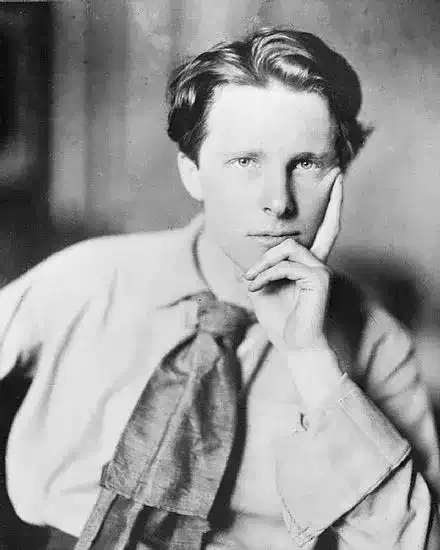
Rupert Brooke
The Old Vicarage, Grantchester
Just now the lilac is in bloom,
All before my little room;
And in my flower-beds, I think,
Smile the carnation and the pink;
And down the borders, well I know,
The poppy and the pansy blow . . .
Oh! there the chestnuts, summer through,
Beside the river make for you
A tunnel of green gloom, and sleep
Deeply above; and green and deep
The stream mysterious glides beneath,
Green as a dream and deep as death.
-- Oh, damn! I know it! and I know
How the May fields all golden show,
And when the day is young and sweet,
Gild gloriously the bare feet
That run to bathe . . .
`Du lieber Gott!'
Here am I, sweating, sick, and hot,
And there the shadowed waters fresh
Lean up to embrace the naked flesh.
Temperamentvoll German Jews
Drink beer around; -- and THERE the dews
Are soft beneath a morn of gold.
Here tulips bloom as they are told;
Unkempt about those hedges blows
An English unofficial rose;
And there the unregulated sun
Slopes down to rest when day is done,
And wakes a vague unpunctual star,
A slippered Hesper; and there are
Meads towards Haslingfield and Coton
Where das Betreten's not verboten.
ei'qe genoi mhn . . . would I were
In Grantchester, in Grantchester! --
Some, it may be, can get in touch
With Nature there, or Earth, or such.
And clever modern men have seen
A Faun a-peeping through the green,
And felt the Classics were not dead,
To glimpse a Naiad's reedy head,
Or hear the Goat-foot piping low: . . .
But these are things I do not know.
I only know that you may lie
Day long and watch the Cambridge sky,
And, flower-lulled in sleepy grass,
Hear the cool lapse of hours pass,
Until the centuries blend and blur
In Grantchester, in Grantchester. . . .
Still in the dawnlit waters cool
His ghostly Lordship swims his pool,
And tries the strokes, essays the tricks,
Long learnt on Hellespont, or Styx.
Dan Chaucer hears his river still
Chatter beneath a phantom mill.
Tennyson notes, with studious eye,
How Cambridge waters hurry by . . .
And in that garden, black and white,
Creep whispers through the grass all night;
And spectral dance, before the dawn,
A hundred Vicars down the lawn;
Curates, long dust, will come and go
On lissom, clerical, printless toe;
And oft between the boughs is seen
The sly shade of a Rural Dean . . .
Till, at a shiver in the skies,
Vanishing with Satanic cries,
The prim ecclesiastic rout
Leaves but a startled sleeper-out,
Grey heavens, the first bird's drowsy calls,
The falling house that never falls.
epsilon-iota'-theta-epsilon gamma-epsilon-nu-omicron-iota -mu-eta-nu
God! I will pack, and take a train,
And get me to England once again!
For England's the one land, I know,
Where men with Splendid Hearts may go;
And Cambridgeshire, of all England,
The shire for Men who Understand;
And of THAT district I prefer
The lovely hamlet Grantchester.
For Cambridge people rarely smile,
Being urban, squat, and packed with guile;
And Royston men in the far South
Are black and fierce and strange of mouth;
At Over they fling oaths at one,
And worse than oaths at Trumpington,
And Ditton girls are mean and dirty,
And there's none in Harston under thirty,
And folks in Shelford and those parts
Have twisted lips and twisted hearts,
And Barton men make Cockney rhymes,
And Coton's full of nameless crimes,
And things are done you'd not believe
At Madingley on Christmas Eve.
Strong men have run for miles and miles,
When one from Cherry Hinton smiles;
Strong men have blanched, and shot their wives,
Rather than send them to St. Ives;
Strong men have cried like babes, bydam,
To hear what happened at Babraham.
But Grantchester! ah, Grantchester!
There's peace and holy quiet there,
Great clouds along pacific skies,
And men and women with straight eyes,
Lithe children lovelier than a dream,
A bosky wood, a slumbrous stream,
And little kindly winds that creep
Round twilight corners, half asleep.
In Grantchester their skins are white;
They bathe by day, they bathe by night;
The women there do all they ought;
The men observe the Rules of Thought.
They love the Good; they worship Truth;
They laugh uproariously in youth;
(And when they get to feeling old,
They up and shoot themselves, I'm told) . . .
Ah God! to see the branches stir
Across the moon at Grantchester!
To smell the thrilling-sweet and rotten
Unforgettable, unforgotten
River-smell, and hear the breeze
Sobbing in the little trees.
Say, do the elm-clumps greatly stand
Still guardians of that holy land?
The chestnuts shade, in reverend dream,
The yet unacademic stream?
Is dawn a secret shy and cold
Anadyomene, silver-gold?
And sunset still a golden sea
From Haslingfield to Madingley?
And after, ere the night is born,
Do hares come out about the corn?
Oh, is the water sweet and cool,
Gentle and brown, above the pool?
And laughs the immortal river still
Under the mill, under the mill?
Say, is there Beauty yet to find?
And Certainty? and Quiet kind?
Deep meadows yet, for to forget
The lies, and truths, and pain? . . . oh! yet
Stands the Church clock at ten to three?
And is there honey still for tea?
246
Mao Tsé-Tung
Loushan Pass
Fierce the west wind,
Wild geese cry under the frosty morning moon.
Under the frosty morning moon
Horses' hooves clattering,
Bugles sobbing low.
Idle boast the strong pass is a wall of iron,
With firm strides we are crossing its summit.
We are crossing its summit,
The rolling hills sea-blue,
The dying sun blood-red.
Wild geese cry under the frosty morning moon.
Under the frosty morning moon
Horses' hooves clattering,
Bugles sobbing low.
Idle boast the strong pass is a wall of iron,
With firm strides we are crossing its summit.
We are crossing its summit,
The rolling hills sea-blue,
The dying sun blood-red.
245
Robert W. Service
The Parson's Son
This is the song of the parson's son, as he squats in his shack alone,
On the wild, weird nights, when the Northern Lights shoot up from the frozen zone,
And it's sixty below, and couched in the snow the hungry huskies moan:
"I'm one of the Arctic brotherhood, I'm an old-time pioneer.
I came with the first -- O God! how I've cursed this Yukon -- but still I'm here.
I've sweated athirst in its summer heat, I've frozen and starved in its cold;
I've followed my dreams by its thousand streams, I've toiled and moiled for its gold.
"Look at my eyes -- been snow-blind twice; look where my foot's half gone;
And that gruesome scar on my left cheek, where the frost-fiend bit to the bone.
Each one a brand of this devil's land, where I've played and I've lost the game,
A broken wreck with a craze for `hooch', and never a cent to my name.
"This mining is only a gamble; the worst is as good as the best;
I was in with the bunch and I might have come out right on top with the rest;
With Cormack, Ladue and Macdonald -- O God! but it's hell to think
Of the thousands and thousands I've squandered on cards and women and drink.
"In the early days we were just a few, and we hunted and fished around,
Nor dreamt by our lonely camp-fires of the wealth that lay under the ground.
We traded in skins and whiskey, and I've often slept under the shade
Of that lone birch tree on Bonanza, where the first big find was made.
"We were just like a great big family, and every man had his squaw,
And we lived such a wild, free, fearless life beyond the pale of the law;
Till sudden there came a whisper, and it maddened us every man,
And I got in on Bonanza before the big rush began.
"Oh, those Dawson days, and the sin and the blaze, and the town all open wide!
(If God made me in His likeness, sure He let the devil inside.)
But we all were mad, both the good and the bad, and as for the women, well --
No spot on the map in so short a space has hustled more souls to hell.
"Money was just like dirt there, easy to get and to spend.
I was all caked in on a dance-hall jade, but she shook me in the end.
It put me queer, and for near a year I never drew sober breath,
Till I found myself in the bughouse ward with a claim staked out on death.
"Twenty years in the Yukon, struggling along its creeks;
Roaming its giant valleys, scaling its god-like peaks;
Bathed in its fiery sunsets, fighting its fiendish cold --
Twenty years in the Yukon . . . twenty years -- and I'm old.
"Old and weak, but no matter, there's `hooch' in the bottle still.
I'll hitch up the dogs to-morrow, and mush down the trail to Bill.
It's so long dark, and I'm lonesome -- I'll just lay down on the bed;
To-morrow I'll go . . . to-morrow . . . I guess I'll play on the red.
". . . Come, Kit, your pony is saddled. I'm waiting, dear, in the court . . .
. . . Minnie, you devil, I'll kill you if you skip with that flossy sport . . .
. . . How much does it go to the pan, Bill? . . . play up, School, and play the game . . .
. . . Our Father, which art in heaven, hallowed be Thy name . . ."
This was the song of the parson's son, as he lay in his bunk alone,
Ere the fire went out and the cold crept in, and his blue lips ceased to moan,
And the hunger-maddened malamutes had torn him flesh from bone.
244
Robert W. Service
Going Home
I'm goin' 'ome to Blighty -- ain't I glad to 'ave the chance!
I'm loaded up wiv fightin', and I've 'ad my fill o' France;
I'm feelin' so excited-like, I want to sing and dance,
For I'm goin' 'ome to Blighty in the mawnin'.
I'm goin' 'ome to Blighty: can you wonder as I'm gay?
I've got a wound I wouldn't sell for 'alf a year o' pay;
A harm that's mashed to jelly in the nicest sort o' way,
For it takes me 'ome to Blighty in the mawnin'.
'Ow everlastin' keen I was on gettin' to the front!
I'd ginger for a dozen, and I 'elped to bear the brunt;
But Cheese and Crust! I'm crazy, now I've done me little stunt,
To sniff the air of Blighty in the mawnin'.
I've looked upon the wine that's white, and on the wine that's red;
I've looked on cider flowin', till it fairly turned me 'ead;
But oh, the finest scoff will be, when all is done and said,
A pint o' Bass in Blighty in the mawnin'.
I'm goin' back to Blighty, which I left to strafe the 'Un;
I've fought in bloody battles, and I've 'ad a 'eap of fun;
But now me flipper's busted, and I think me dooty's done,
And I'll kiss me gel in Blighty in the mawnin'.
Oh, there be furrin' lands to see, and some of 'em be fine;
And there be furrin' gels to kiss, and scented furrin' wine;
But there's no land like England, and no other gel like mine:
Thank Gawd for dear old Blighty in the mawnin'.
242
Mao Tsé-Tung
Ascent of Lushan
Perching as after flight, the mountain towers over the Yangtze;
I have overleapt four hundred twists to its green crest.
Cold-eyed I survey the world beyond the seas;
A hot wind spatters raindrops on the sky-brooded waters.
Clouds cluster over the nine streams, the yellow crane floating,
And billows roll on to the eastern coast, white foam flying.
Who knows whither Prefect Tao Yuan-ming is gone
Now that he can till fields in the Land of Peach Blossoms?
242
Mao Tsé-Tung
Huichang
Soon dawn will break in the east.
Do not say 'You start too early';
Crossing these blue hills adds nothing to one's years,
The landscape here is beyond compare.
Straight from the walls of Huichang lofty peaks,
Range after range, extend to the eastern seas.
Our soldiers point southward to Kwangtung
Looming lusher and greener in the distance.
242
Robert W. Service
The Bohemian Dreams
Because my overcoat's in pawn,
I choose to take my glass
Within a little bistro on
The rue du Montparnasse;
The dusty bins with bottles shine,
The counter's lined with zinc,
And there I sit and drink my wine,
And think and think and think.
I think of hoary old Stamboul,
Of Moslem and of Greek,
Of Persian in coat of wool,
Of Kurd and Arab sheikh;
Of all the types of weal and woe,
And as I raise my glass,
Across Galata bridge I know
They pass and pass and pass.
I think of citron-trees aglow,
Of fan-palms shading down,
Of sailors dancing heel and toe
With wenches black and brown;
And though it's all an ocean far
From Yucatan to France,
I'll bet beside the old bazaar
They dance and dance and dance.
I think of Monte Carlo, where
The pallid croupiers call,
And in the gorgeous, guilty air
The gamblers watch the ball;
And as I flick away the foam
With which my beer is crowned,
The wheels beneath the gilded dome
Go round and round and round.
I think of vast Niagara,
Those gulfs of foam a-shine,
Whose mighty roar would stagger a
More prosy bean than mine;
And as the hours I idly spend
Against a greasy wall,
I know that green the waters bend
And fall and fall and fall.
I think of Nijni Novgorod
And Jews who never rest;
And womenfolk with spade and hod
Who slave in Buda-Pest;
Of squat and sturdy Japanese
Who pound the paddy soil,
And as I loaf and smoke at ease
They toil and toil and toil.
I think of shrines in Hindustan,
Of cloistral glooms in Spain,
Of minarets in Ispahan,
Of St. Sophia's fane,
Of convent towers in Palestine,
Of temples in Cathay,
And as I stretch and sip my wine
They pray and pray and pray.
And so my dreams I dwell within,
And visions come and go,
And life is passing like a Cin-
Ematographic Show;
Till just as surely as my pipe
Is underneath my nose,
Amid my visions rich and ripe
I doze and doze and doze.
241