

Poems in this topic
Art
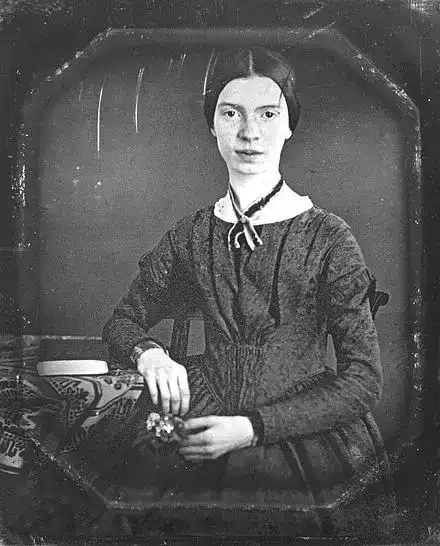
Emily Dickinson
I've heard an Organ talk, sometimes
I've heard an Organ talk, sometimes
183
I've heard an Organ talk, sometimes
In a Cathedral Aisle,
And understood no word it said-
Yet held my breath, the while-
And risen up-and gone away,
A more Berdardine GirlYet-
know not what was done to me
In that old Chapel Aisle.
183
I've heard an Organ talk, sometimes
In a Cathedral Aisle,
And understood no word it said-
Yet held my breath, the while-
And risen up-and gone away,
A more Berdardine GirlYet-
know not what was done to me
In that old Chapel Aisle.
272
Emily Dickinson
I send Two Sunsets
I send Two Sunsets
308
I send Two Sunsets-
Day and I-in competition ran-
I finished Two-and several Stars-
While He-was making One-
His own was ampler-but as I
Was saying to a friendMine-
is the more convenient
To Carry in the Hand-
308
I send Two Sunsets-
Day and I-in competition ran-
I finished Two-and several Stars-
While He-was making One-
His own was ampler-but as I
Was saying to a friendMine-
is the more convenient
To Carry in the Hand-
315
Emily Dickinson
I Died For Beauty
I Died For Beauty
I died for beauty, but was scarce
Adjusted in the tomb,
When one who died for truth was lain
In an adjoining room.
He questioned softly why I failed?
"For beauty," I replied.
"And I for truth - the two are one;
We brethren are," he said.
And so, as kinsmen met a-night,
We talked between the rooms,
Until the moss had reached our lips,
And covered up our names.
I died for beauty, but was scarce
Adjusted in the tomb,
When one who died for truth was lain
In an adjoining room.
He questioned softly why I failed?
"For beauty," I replied.
"And I for truth - the two are one;
We brethren are," he said.
And so, as kinsmen met a-night,
We talked between the rooms,
Until the moss had reached our lips,
And covered up our names.
374
Emily Dickinson
Her-last Poems
Her-"last Poems"
312
Her-"last Poems"Poets-
endedSilver-
perished-with her Tongue-
Not on Record-bubbled other,
Flute-or Woman-
So divine-
Not unto its Summer-Morning
Robin-uttered Half the Tune-
Gushed too free for the Adoring-
From the Anglo-FlorentineLate-
the Praise'
Tis dull-conferring
On the Head too High to CrownDiadem-
or Ducal Showing-
Be its Grave-sufficient signNought-
that We-No Poet's KinsmanSuffocate-
with easy woe-
What, and if, Ourself a Bridegroom-
Put Her down-in Italy?
312
Her-"last Poems"Poets-
endedSilver-
perished-with her Tongue-
Not on Record-bubbled other,
Flute-or Woman-
So divine-
Not unto its Summer-Morning
Robin-uttered Half the Tune-
Gushed too free for the Adoring-
From the Anglo-FlorentineLate-
the Praise'
Tis dull-conferring
On the Head too High to CrownDiadem-
or Ducal Showing-
Be its Grave-sufficient signNought-
that We-No Poet's KinsmanSuffocate-
with easy woe-
What, and if, Ourself a Bridegroom-
Put Her down-in Italy?
378
Emily Dickinson
Drama's Vitallest Expression is the Common Day
Drama's Vitallest Expression is the Common Day
741
Drama's Vitallest Expression is the Common Day
That arise and set about Us-
Other Tragedy
Perish in the RecitationThis-
the best enact
When the Audience is scattered
And the Boxes shut
"Hamlet" to Himself were Hamlet-
Had not Shakespeare wrote-
Though the "Romeo" left no Record
Of his Juliet,
It were infinite enacted
In the Human Heart-
Only Theatre recorded
Owner cannot shut-
741
Drama's Vitallest Expression is the Common Day
That arise and set about Us-
Other Tragedy
Perish in the RecitationThis-
the best enact
When the Audience is scattered
And the Boxes shut
"Hamlet" to Himself were Hamlet-
Had not Shakespeare wrote-
Though the "Romeo" left no Record
Of his Juliet,
It were infinite enacted
In the Human Heart-
Only Theatre recorded
Owner cannot shut-
326
Emily Dickinson
Autumn-overlooked my Knitting
Autumn-overlooked my Knitting
748
Autumn-overlooked my KnittingDyes-
said He-have I-
Could disparage a Flamingo-
Show Me them-said I
Cochineal-I chose-for deeming
It resemble Thee-
And the little Border-Dusker-
For resembling Me-
748
Autumn-overlooked my KnittingDyes-
said He-have I-
Could disparage a Flamingo-
Show Me them-said I
Cochineal-I chose-for deeming
It resemble Thee-
And the little Border-Dusker-
For resembling Me-
389
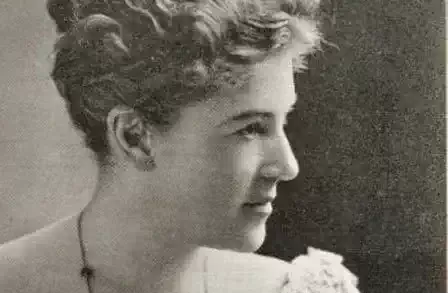
Ella Wheeler Wilcox
The Unattained
The Unattained
A vision beauteous as the morn,
With heavenly eyes and tresses streaming,
Slow glided o'er a field late shorn
Where walked a poet idly dreaming.
He saw her, and joy lit his face.
"Oh, vanish not at human speaking,"
He cried, "thou form of magic grace,
Thou art the poem I am seeking.
"I've sought thee long! I claim thee now---
My thought embodied, living, real."
She shook the tresses from her brow.
"Nay, nay!" she said, "I am ideal.
I am the phantom of desire---
The spirit of all great endeavour,
I am the voice that says, 'Come higher.'
That calls men up and up for ever.
"'Tis not alone the thought supreme
That here upon thy path has risen;
I am the artist's highest dream,
The ray of light he cannot prison.
I am the sweet ecstatic note
Than all glad music gladder, clearer,
That trembles in the singer's throat,
And dies without a human hearer.
"I am the greater, better yield,
That leads and cheers thy farmer neighbour,
For me he bravely tills the field
And whistles gaily at his labour.
Not thou alone, O poet soul,
Dost seek me through an endless morrow,
But to the toiling, hoping whole
I am at once the hope and sorrow.
The spirit of the unattained,
I am to those who seek to name me,
A good desired but never gained.
All shall pursue, but none shall claim me."
A vision beauteous as the morn,
With heavenly eyes and tresses streaming,
Slow glided o'er a field late shorn
Where walked a poet idly dreaming.
He saw her, and joy lit his face.
"Oh, vanish not at human speaking,"
He cried, "thou form of magic grace,
Thou art the poem I am seeking.
"I've sought thee long! I claim thee now---
My thought embodied, living, real."
She shook the tresses from her brow.
"Nay, nay!" she said, "I am ideal.
I am the phantom of desire---
The spirit of all great endeavour,
I am the voice that says, 'Come higher.'
That calls men up and up for ever.
"'Tis not alone the thought supreme
That here upon thy path has risen;
I am the artist's highest dream,
The ray of light he cannot prison.
I am the sweet ecstatic note
Than all glad music gladder, clearer,
That trembles in the singer's throat,
And dies without a human hearer.
"I am the greater, better yield,
That leads and cheers thy farmer neighbour,
For me he bravely tills the field
And whistles gaily at his labour.
Not thou alone, O poet soul,
Dost seek me through an endless morrow,
But to the toiling, hoping whole
I am at once the hope and sorrow.
The spirit of the unattained,
I am to those who seek to name me,
A good desired but never gained.
All shall pursue, but none shall claim me."
378
Ella Wheeler Wilcox
The Muse And The Poet
The Muse And The Poet
The Muse said, Let us sing a little song
Wherein no hint of wrong,
No echo of the great world need, or pain,
Shall mar the strain.
Lock fast the swinging portal of thy heart;
Keep sympathy apart.
Sing of the sunset, of the dawn, the sea;
Of any thing or nothing, so there be
No purpose to thy art.
Yea, let us make, art for Art's sake.
And sing no more unto the hearts of men,
But for the critic's pen.
With songs that are but words, sweet sounding words,
Like joyous jargon of the birds.
Tune now thy lyre, O Poet, and sing on.
Sing of
THE DAWN
The Virgin Night, all languorous with dreams
Of her belovèd Darkness, rose in fear,
Feeling the presence of another near.
Outside her curtained casement shone the gleams
Of burning orbs; and modestly she hid
Her brow and bosom with her dusky hair.
When lo! the bold intruder lurking there
Leaped through the fragile lattice, all unbid,
And half unveiled her. Then the swooning Night
Fell pale and dead, while yet her soul was white
Before that lawless Ravisher, the Light.
The Muse said, Poet, nay; thou hast not caught
My meaning. For there lurks a thought
Back of thy song.
In art, all thought is wrong.
Re-string thy lyre; and let the echoes bound
To nothing but sweet sound.
Strike now the chords
And sing of
WORDS
One day sweet Ladye Language gave to me
A little golden key.
I sat me down beside her jewel box
And turned its locks.
And oh, the wealth that lay there in my sight.
Great solitaires of words, so bright, so bright;
Words that no use can commonize; like God,
And Truth, and Love; and words of sapphire blue;
And amber words; with sunshine dripping through;
And words of that strange hue
A pearl reveals upon a wanton's hand.
Again the Muse:
Thou dost not understand;
A thought within thy song is lingering yet.
Sing but of words; all else forget, forget.
Nor let thy words convey one thought to men.
Try once again.
Down through the dusk and dew there fell a word;
Down through the dew and dusk.
And all the garments of the air it stirred
Smelled sweet as musk;
And all the little waves of air it kissed
Turned gold and amethyst.
There in the dew and dusk a heart it found;
There in the dusk and dew
The sodden silence changed to fragrant sound;
And all the world seemed new.
Upon the path that little word had trod,
There shone the smile of God.
The Muse said, Drop thy lyre.
I tire, I tire.
The Muse said, Let us sing a little song
Wherein no hint of wrong,
No echo of the great world need, or pain,
Shall mar the strain.
Lock fast the swinging portal of thy heart;
Keep sympathy apart.
Sing of the sunset, of the dawn, the sea;
Of any thing or nothing, so there be
No purpose to thy art.
Yea, let us make, art for Art's sake.
And sing no more unto the hearts of men,
But for the critic's pen.
With songs that are but words, sweet sounding words,
Like joyous jargon of the birds.
Tune now thy lyre, O Poet, and sing on.
Sing of
THE DAWN
The Virgin Night, all languorous with dreams
Of her belovèd Darkness, rose in fear,
Feeling the presence of another near.
Outside her curtained casement shone the gleams
Of burning orbs; and modestly she hid
Her brow and bosom with her dusky hair.
When lo! the bold intruder lurking there
Leaped through the fragile lattice, all unbid,
And half unveiled her. Then the swooning Night
Fell pale and dead, while yet her soul was white
Before that lawless Ravisher, the Light.
The Muse said, Poet, nay; thou hast not caught
My meaning. For there lurks a thought
Back of thy song.
In art, all thought is wrong.
Re-string thy lyre; and let the echoes bound
To nothing but sweet sound.
Strike now the chords
And sing of
WORDS
One day sweet Ladye Language gave to me
A little golden key.
I sat me down beside her jewel box
And turned its locks.
And oh, the wealth that lay there in my sight.
Great solitaires of words, so bright, so bright;
Words that no use can commonize; like God,
And Truth, and Love; and words of sapphire blue;
And amber words; with sunshine dripping through;
And words of that strange hue
A pearl reveals upon a wanton's hand.
Again the Muse:
Thou dost not understand;
A thought within thy song is lingering yet.
Sing but of words; all else forget, forget.
Nor let thy words convey one thought to men.
Try once again.
Down through the dusk and dew there fell a word;
Down through the dew and dusk.
And all the garments of the air it stirred
Smelled sweet as musk;
And all the little waves of air it kissed
Turned gold and amethyst.
There in the dew and dusk a heart it found;
There in the dusk and dew
The sodden silence changed to fragrant sound;
And all the world seemed new.
Upon the path that little word had trod,
There shone the smile of God.
The Muse said, Drop thy lyre.
I tire, I tire.
517
Ella Wheeler Wilcox
Noblesse Oblige
Noblesse Oblige
I hold it the duty of one who is gifted
And specially dowered I all men’s sight,
To know no rest till his life is lifted
Fully up to his great gifts’ height.
He must mould the man into rare completeness,
For gems are only in gold refined.
He must fashion his thoughts into perfect sweetness,
And cast out folly and pride from his mind.
For he who drinks from a god’s gold fountain
Of art of music or rhythmic song
Must sift from his soul the chaff of malice,
And weed from his heart the roots of wrong.
Great gifts should be worn, like a crown befitting,
And not like gems in a beggar’s hands!
And the toil must be constant and unremitting
Which lifts up the king to the crown’s demands.
I hold it the duty of one who is gifted
And specially dowered I all men’s sight,
To know no rest till his life is lifted
Fully up to his great gifts’ height.
He must mould the man into rare completeness,
For gems are only in gold refined.
He must fashion his thoughts into perfect sweetness,
And cast out folly and pride from his mind.
For he who drinks from a god’s gold fountain
Of art of music or rhythmic song
Must sift from his soul the chaff of malice,
And weed from his heart the roots of wrong.
Great gifts should be worn, like a crown befitting,
And not like gems in a beggar’s hands!
And the toil must be constant and unremitting
Which lifts up the king to the crown’s demands.
503
Ella Wheeler Wilcox
I Step Across The Mystic Border-Land
I Step Across The Mystic Border-Land
I step across the mystic border-land,
And look upon the wonder-world of Art.
How beautiful, how beautiful its hills!
And all its valleys, how surpassing fair!
The winding paths that lead up to the heights
Are polished by the footsteps of the great.
The mountain-peaks stand very near to God:
The chosen few whose feet have trod thereon
Have talked with Him. and with the angels walked.
Here are no sounds of discord-no profane
Or senseless gossip of unworthy things-
Only the songs of chisels and of pens,
Of busy brushes, and ecstatic strains
Of souls surcharged with music most divine.
Here is no idle sorrow, no poor grief
For any day or object left behind-
For time is counted precious, and herein
Is such complete abandonment of Self
That tears turn into rainbows, and enhance
The beauty of the land where all is fair,
Awed and afraid, I cross the border-land.
Oh, who am I, that I dare enter here
Where the great artists of the world have trod-
The genius-crowned aristocrats of Earth?
Only the singer of a little song;
Yet loving Art with such a mighty love
I hold it greater to have won a place
Just on the fair land's edge, to make my grave,
Than in the outer world of greed and gain
To sit upon a royal throne and reign.
I step across the mystic border-land,
And look upon the wonder-world of Art.
How beautiful, how beautiful its hills!
And all its valleys, how surpassing fair!
The winding paths that lead up to the heights
Are polished by the footsteps of the great.
The mountain-peaks stand very near to God:
The chosen few whose feet have trod thereon
Have talked with Him. and with the angels walked.
Here are no sounds of discord-no profane
Or senseless gossip of unworthy things-
Only the songs of chisels and of pens,
Of busy brushes, and ecstatic strains
Of souls surcharged with music most divine.
Here is no idle sorrow, no poor grief
For any day or object left behind-
For time is counted precious, and herein
Is such complete abandonment of Self
That tears turn into rainbows, and enhance
The beauty of the land where all is fair,
Awed and afraid, I cross the border-land.
Oh, who am I, that I dare enter here
Where the great artists of the world have trod-
The genius-crowned aristocrats of Earth?
Only the singer of a little song;
Yet loving Art with such a mighty love
I hold it greater to have won a place
Just on the fair land's edge, to make my grave,
Than in the outer world of greed and gain
To sit upon a royal throne and reign.
377
Ella Wheeler Wilcox
Clara Morris (Written for a Benefit Given Mrs. Morris)
Clara Morris (Written for a Benefit Given Mrs. Morris)
The Radiant Ruler of Mystic Regions
Where souls of artists are fitted for birth,
Gathered together their lovely legions
And fashioned a woman to shine on earth.
They bathed her in splendor
They made her tender:
They gave her a nature both sweet and wild.
They gave her emotions
Like storm stirred oceans,
And they gave her the heart of a little child.
These Radiant Rulers (who are not human
Nor yet divine like the gods above)
Poured all their gifts in the soul of a woman
That fragile vessel meant only for love.
Still more they taught her,
Still more they brought her-
Till they gave her the world for a harp one day,
And they bade her string it-
They bade her ring it,
While the stars all wondered to hear her play.
She touched the strings in a master fashion,
She uttered the cry of a world's despair.
Its long-hid secret, its pent-up passion,
She gave to the winds in a vibrant air.
For ah! the heart of her,
That was the art of her,
Great with the feeling that makes men kin.
Art unapproachable,
Art all uncoachable,
Fragrance and flame from the spirit within.
The earth turns ever an ear unheeding
To the sorrows of art, as it cries for more:
And she played on the harp till her hands were bleeding
And her brow was bruised by the laurels she wore.
She knew the trend of it,
She knew the end of it.
Men heard the music and men felt the thrill.
Bound to the altar
Of art, could she falter?
Then came a silence-the music was still.
And yet in the echoes we seem to hear it
In waves unbroken it circles the earth:
And we catch in the light of her dauntless spirit
A gleam from the center that gave her birth.
Still is the fame of her
Felt in the name of her.
But low lies the harp that once thrilled to her strain.
No hand has taken it,
No hand can waken it-
For the soul of her art was her secret of pain.
The Radiant Ruler of Mystic Regions
Where souls of artists are fitted for birth,
Gathered together their lovely legions
And fashioned a woman to shine on earth.
They bathed her in splendor
They made her tender:
They gave her a nature both sweet and wild.
They gave her emotions
Like storm stirred oceans,
And they gave her the heart of a little child.
These Radiant Rulers (who are not human
Nor yet divine like the gods above)
Poured all their gifts in the soul of a woman
That fragile vessel meant only for love.
Still more they taught her,
Still more they brought her-
Till they gave her the world for a harp one day,
And they bade her string it-
They bade her ring it,
While the stars all wondered to hear her play.
She touched the strings in a master fashion,
She uttered the cry of a world's despair.
Its long-hid secret, its pent-up passion,
She gave to the winds in a vibrant air.
For ah! the heart of her,
That was the art of her,
Great with the feeling that makes men kin.
Art unapproachable,
Art all uncoachable,
Fragrance and flame from the spirit within.
The earth turns ever an ear unheeding
To the sorrows of art, as it cries for more:
And she played on the harp till her hands were bleeding
And her brow was bruised by the laurels she wore.
She knew the trend of it,
She knew the end of it.
Men heard the music and men felt the thrill.
Bound to the altar
Of art, could she falter?
Then came a silence-the music was still.
And yet in the echoes we seem to hear it
In waves unbroken it circles the earth:
And we catch in the light of her dauntless spirit
A gleam from the center that gave her birth.
Still is the fame of her
Felt in the name of her.
But low lies the harp that once thrilled to her strain.
No hand has taken it,
No hand can waken it-
For the soul of her art was her secret of pain.
442
Ella Wheeler Wilcox
Bohemia
Bohemia
Bohemia, o'er thy unatlassed borders
How many cross, with half-reluctant feet,
And unformed fears of dangers and disorders,
To find delights, more wholesome and more sweet
Than ever yet were known to the "elite."
Herein can dwell no pretence and no seeming;
No stilted pride thrives in this atmosphere,
Which stimulates a tendency to dreaming.
The shores of the ideal world, from here,
Seem sometimes to be tangible and near.
We have no use for formal codes of fashion;
No "Etiquette f Courts" we emulate;
We know it needs sincerity and passion
To carry out the plans of God, or fate;
We do not strive to seem inanimate.
We call no time lost that we give to pleasure;
Life's hurrying river speeds to Death's great sea;
We cast out no vain plummet-line to measure
Imagined depths of that unknown To-Be,
But grasp the Now, and fill it full of glee.
All creeds have room here, and we all together
Devoutly worship at Art's sacred shrine;
But he who dwells once in thy golden weather,
Bohemia--sweet, lovely land of mine--
Can find no joy outside thy border-line.
Bohemia, o'er thy unatlassed borders
How many cross, with half-reluctant feet,
And unformed fears of dangers and disorders,
To find delights, more wholesome and more sweet
Than ever yet were known to the "elite."
Herein can dwell no pretence and no seeming;
No stilted pride thrives in this atmosphere,
Which stimulates a tendency to dreaming.
The shores of the ideal world, from here,
Seem sometimes to be tangible and near.
We have no use for formal codes of fashion;
No "Etiquette f Courts" we emulate;
We know it needs sincerity and passion
To carry out the plans of God, or fate;
We do not strive to seem inanimate.
We call no time lost that we give to pleasure;
Life's hurrying river speeds to Death's great sea;
We cast out no vain plummet-line to measure
Imagined depths of that unknown To-Be,
But grasp the Now, and fill it full of glee.
All creeds have room here, and we all together
Devoutly worship at Art's sacred shrine;
But he who dwells once in thy golden weather,
Bohemia--sweet, lovely land of mine--
Can find no joy outside thy border-line.
342
Ella Wheeler Wilcox
Art and Heart
Art and Heart
Though critics may bow to art, and I am its own true lover,
It is not art, but heart, which wins the wide world over.
Though smooth be the heartless prayer, no ear in Heaven will mind it,
And the finest phrase falls dead if there is no feeling behind it.
Though perfect the player's touch, little, if any, he sways us,
Unless we feel his heart throb through the music he plays us.
Though the poet may spend his life in skilfully rounding a measure,
Unless he writes from a full, warm heart he gives us little pleasure.
So it is not the speech which tells, but the impulse which goes with the saying;
And it is not the words of the prayer, but the yearning back of the praying.
It is not the artist's skill which into our soul comes stealing
With a joy that is almost pain, but it is the player's feeling.
And it is not the poet's song, though sweeter than sweet bells chiming,
Which thrills us through and through, but the heart which beats under the rhyming.
And therefore I say again, though I am art's own true lover,
That it is not art, but heart, which wins the wide world over.
Though critics may bow to art, and I am its own true lover,
It is not art, but heart, which wins the wide world over.
Though smooth be the heartless prayer, no ear in Heaven will mind it,
And the finest phrase falls dead if there is no feeling behind it.
Though perfect the player's touch, little, if any, he sways us,
Unless we feel his heart throb through the music he plays us.
Though the poet may spend his life in skilfully rounding a measure,
Unless he writes from a full, warm heart he gives us little pleasure.
So it is not the speech which tells, but the impulse which goes with the saying;
And it is not the words of the prayer, but the yearning back of the praying.
It is not the artist's skill which into our soul comes stealing
With a joy that is almost pain, but it is the player's feeling.
And it is not the poet's song, though sweeter than sweet bells chiming,
Which thrills us through and through, but the heart which beats under the rhyming.
And therefore I say again, though I am art's own true lover,
That it is not art, but heart, which wins the wide world over.
431
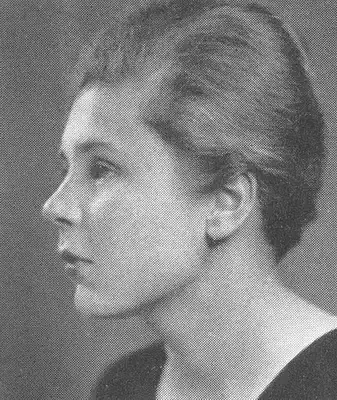
Elizabeth Bishop
The Monument
The Monument
Now can you see the monument? It is of wood
built somewhat like a box. No. Built
like several boxes in descending sizes
one above the other.
Each is turned half-way round so that
its corners point toward the sides
of the one below and the angles alternate.
Then on the topmost cube is set
a sort of fleur-de-lys of weathered wood,
long petals of board, pierced with odd holes,
four-sided, stiff, ecclesiastical.
From it four thin, warped poles spring out,
(slanted like fishing-poles or flag-poles)
and from them jig-saw work hangs down,
four lines of vaguely whittled ornament
over the edges of the boxes
to the ground.
The monument is one-third set against
a sea; two-thirds against a sky.
The view is geared
(that is, the view's perspective)
so low there is no "far away,"
and we are far away within the view.
A sea of narrow, horizontal boards
lies out behind our lonely monument,
its long grains alternating right and left
like floor-boards--spotted, swarming-still,
and motionless. A sky runs parallel,
and it is palings, coarser than the sea's:
splintery sunlight and long-fibred clouds.
"Why does the strange sea make no sound?
Is it because we're far away?
Where are we? Are we in Asia Minor,
or in Mongolia?"
An ancient promontory,
an ancient principality whose artist-prince
might have wanted to build a monument
to mark a tomb or boundary, or make
a melancholy or romantic scene of it...
"But that queer sea looks made of wood,
half-shining, like a driftwood, sea.
And the sky looks wooden, grained with cloud.
It's like a stage-set; it is all so flat!
Those clouds are full of glistening splinters!
What is that?"
It is the monument.
"It's piled-up boxes,
outlined with shoddy fret-work, half-fallen off,
cracked and unpainted. It looks old."
--The strong sunlight, the wind from the sea,
all the conditions of its existence,
may have flaked off the paint, if ever it was painted,
and made it homelier than it was.
"Why did you bring me here to see it?
A temple of crates in cramped and crated scenery,
what can it prove?
I am tired of breathing this eroded air,
this dryness in which the monument is cracking."
It is an artifact
of wood. Wood holds together better
than sea or cloud or and could by itself,
much better than real sea or sand or cloud.
It chose that way to grow and not to move.
The monument's an object, yet those decorations,
carelessly nailed, looking like nothing at all,
give it away as having life, and wishing;
wanting to be a monument, to cherish something.
The crudest scroll-work says "commemorate,"
while once each day the light goes around it
like a prowling animal,
or the rain falls on it, or the wind blows into it.
It may be solid, may be hollow.
The bones of the artist-prince may be inside
or far away on even drier soil.
But roughly but adequately it can shelter
what is within (which after all
cannot have been intended to be seen).
It is the beginning of a painting,
a piece of sculpture, or poem, or monument,
and all of wood. Watch it closely.
Now can you see the monument? It is of wood
built somewhat like a box. No. Built
like several boxes in descending sizes
one above the other.
Each is turned half-way round so that
its corners point toward the sides
of the one below and the angles alternate.
Then on the topmost cube is set
a sort of fleur-de-lys of weathered wood,
long petals of board, pierced with odd holes,
four-sided, stiff, ecclesiastical.
From it four thin, warped poles spring out,
(slanted like fishing-poles or flag-poles)
and from them jig-saw work hangs down,
four lines of vaguely whittled ornament
over the edges of the boxes
to the ground.
The monument is one-third set against
a sea; two-thirds against a sky.
The view is geared
(that is, the view's perspective)
so low there is no "far away,"
and we are far away within the view.
A sea of narrow, horizontal boards
lies out behind our lonely monument,
its long grains alternating right and left
like floor-boards--spotted, swarming-still,
and motionless. A sky runs parallel,
and it is palings, coarser than the sea's:
splintery sunlight and long-fibred clouds.
"Why does the strange sea make no sound?
Is it because we're far away?
Where are we? Are we in Asia Minor,
or in Mongolia?"
An ancient promontory,
an ancient principality whose artist-prince
might have wanted to build a monument
to mark a tomb or boundary, or make
a melancholy or romantic scene of it...
"But that queer sea looks made of wood,
half-shining, like a driftwood, sea.
And the sky looks wooden, grained with cloud.
It's like a stage-set; it is all so flat!
Those clouds are full of glistening splinters!
What is that?"
It is the monument.
"It's piled-up boxes,
outlined with shoddy fret-work, half-fallen off,
cracked and unpainted. It looks old."
--The strong sunlight, the wind from the sea,
all the conditions of its existence,
may have flaked off the paint, if ever it was painted,
and made it homelier than it was.
"Why did you bring me here to see it?
A temple of crates in cramped and crated scenery,
what can it prove?
I am tired of breathing this eroded air,
this dryness in which the monument is cracking."
It is an artifact
of wood. Wood holds together better
than sea or cloud or and could by itself,
much better than real sea or sand or cloud.
It chose that way to grow and not to move.
The monument's an object, yet those decorations,
carelessly nailed, looking like nothing at all,
give it away as having life, and wishing;
wanting to be a monument, to cherish something.
The crudest scroll-work says "commemorate,"
while once each day the light goes around it
like a prowling animal,
or the rain falls on it, or the wind blows into it.
It may be solid, may be hollow.
The bones of the artist-prince may be inside
or far away on even drier soil.
But roughly but adequately it can shelter
what is within (which after all
cannot have been intended to be seen).
It is the beginning of a painting,
a piece of sculpture, or poem, or monument,
and all of wood. Watch it closely.
636
Elizabeth Bishop
Lines Written In The Fannie Farmer Cookbook
Lines Written In The Fannie Farmer Cookbook
[Given to Frank Bidart]
You won't become a gourmet* cook
By studying our Fannie's book--
Her thoughts on Food & Keeping House
Are scarcely those of Lévi-Strauss.
Nevertheless, you'll find, Frank dear,
The basic elements** are here.
And if a problem should arise:
The Soufflé fall before your eyes,
Or strange things happen to the Rice
--You know I love to give advice.
Elizabeth
Christmas, 1971
* Forbidden word
** Forbidden phrase
P.S. Fannie should not be underrated;
She has become sophisticated.
She's picked up many gourmet* tricks
Since the edition of '96.
[Given to Frank Bidart]
You won't become a gourmet* cook
By studying our Fannie's book--
Her thoughts on Food & Keeping House
Are scarcely those of Lévi-Strauss.
Nevertheless, you'll find, Frank dear,
The basic elements** are here.
And if a problem should arise:
The Soufflé fall before your eyes,
Or strange things happen to the Rice
--You know I love to give advice.
Elizabeth
Christmas, 1971
* Forbidden word
** Forbidden phrase
P.S. Fannie should not be underrated;
She has become sophisticated.
She's picked up many gourmet* tricks
Since the edition of '96.
465
Elizabeth Bishop
Large Bad Picture
Large Bad Picture
Remembering the Strait of Belle Isle or
some northerly harbor of Labrador,
before he became a schoolteacher
a great-uncle painted a big picture.
Receding for miles on either side
into a flushed, still sky
are overhanging pale blue cliffs
hundreds of feet high,
their bases fretted by little arches,
the entrances to caves
running in along the level of a bay
masked by perfect waves.
On the middle of that quiet floor
sits a fleet of small black ships,
square-rigged, sails furled, motionless,
their spars like burnt match-sticks.
And high above them, over the tall cliffs'
semi-translucent ranks,
are scribbled hundreds of fine black birds
hanging in n's in banks.
One can hear their crying, crying,
the only sound there is
except for occasional sizhine
as a large aquatic animal breathes.
In the pink light
the small red sun goes rolling, rolling,
round and round and round at the same height
in perpetual sunset, comprehensive, consoling,
while the ships consider it.
Apparently they have reached their destination.
It would be hard to say what brought them there,
commerce or contemplation.
Remembering the Strait of Belle Isle or
some northerly harbor of Labrador,
before he became a schoolteacher
a great-uncle painted a big picture.
Receding for miles on either side
into a flushed, still sky
are overhanging pale blue cliffs
hundreds of feet high,
their bases fretted by little arches,
the entrances to caves
running in along the level of a bay
masked by perfect waves.
On the middle of that quiet floor
sits a fleet of small black ships,
square-rigged, sails furled, motionless,
their spars like burnt match-sticks.
And high above them, over the tall cliffs'
semi-translucent ranks,
are scribbled hundreds of fine black birds
hanging in n's in banks.
One can hear their crying, crying,
the only sound there is
except for occasional sizhine
as a large aquatic animal breathes.
In the pink light
the small red sun goes rolling, rolling,
round and round and round at the same height
in perpetual sunset, comprehensive, consoling,
while the ships consider it.
Apparently they have reached their destination.
It would be hard to say what brought them there,
commerce or contemplation.
657
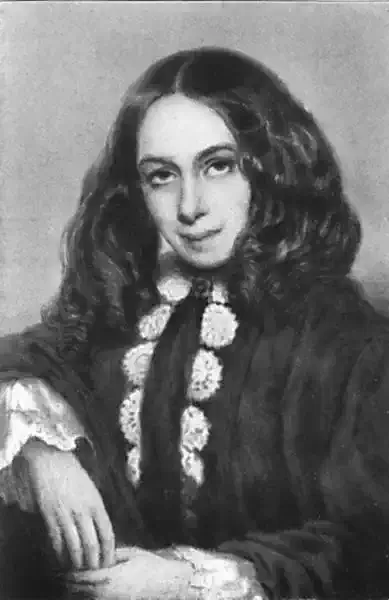
Elizabeth Barrett Browning
To George Sand: A Recognition
To George Sand: A Recognition
TRUE genius, but true woman ! dost deny
The woman's nature with a manly scorn
And break away the gauds and armlets worn
By weaker women in captivity?
Ah, vain denial ! that revolted cry
Is sobbed in by a woman's voice forlorn, _
Thy woman's hair, my sister, all unshorn
Floats back dishevelled strength in agony
Disproving thy man's name: and while before
The world thou burnest in a poet-fire,
We see thy woman-heart beat evermore
Through the large flame. Beat purer, heart, and higher,
Till God unsex thee on the heavenly shore
Where unincarnate spirits purely aspire !
TRUE genius, but true woman ! dost deny
The woman's nature with a manly scorn
And break away the gauds and armlets worn
By weaker women in captivity?
Ah, vain denial ! that revolted cry
Is sobbed in by a woman's voice forlorn, _
Thy woman's hair, my sister, all unshorn
Floats back dishevelled strength in agony
Disproving thy man's name: and while before
The world thou burnest in a poet-fire,
We see thy woman-heart beat evermore
Through the large flame. Beat purer, heart, and higher,
Till God unsex thee on the heavenly shore
Where unincarnate spirits purely aspire !
498
Elizabeth Barrett Browning
The Soul's Expression
The Soul's Expression
WITH stammering lips and insufficient sound
I strive and struggle to deliver right
That music of my nature, day and night
With dream and thought and feeling interwound
And inly answering all the senses round
With octaves of a mystic depth and height
Which step out grandly to the infinite
From the dark edges of the sensual ground.
This song of soul I struggle to outbear
Through portals of the sense, sublime and whole,
And utter all myself into the air:
But if I did it,--as the thunder-roll
Breaks its own cloud, my flesh would perish there,
Before that dread apocalypse of soul.
WITH stammering lips and insufficient sound
I strive and struggle to deliver right
That music of my nature, day and night
With dream and thought and feeling interwound
And inly answering all the senses round
With octaves of a mystic depth and height
Which step out grandly to the infinite
From the dark edges of the sensual ground.
This song of soul I struggle to outbear
Through portals of the sense, sublime and whole,
And utter all myself into the air:
But if I did it,--as the thunder-roll
Breaks its own cloud, my flesh would perish there,
Before that dread apocalypse of soul.
347
Elizabeth Barrett Browning
The Poet And The Bird
The Poet And The Bird
Said a people to a poet---' Go out from among us straightway!
While we are thinking earthly things, thou singest of divine.
There's a little fair brown nightingale, who, sitting in the gateways
Makes fitter music to our ears than any song of thine!'
The poet went out weeping---the nightingale ceased chanting;
'Now, wherefore, O thou nightingale, is all thy sweetness done?'
I cannot sing my earthly things, the heavenly poet wanting,
Whose highest harmony includes the lowest under sun.'
The poet went out weeping,---and died abroad, bereft there--The
bird flew to his grave and died, amid a thousand wails:---
And, when I last came by the place, I swear the music left there
Was only of the poet's song, and not the nightingale's.
Said a people to a poet---' Go out from among us straightway!
While we are thinking earthly things, thou singest of divine.
There's a little fair brown nightingale, who, sitting in the gateways
Makes fitter music to our ears than any song of thine!'
The poet went out weeping---the nightingale ceased chanting;
'Now, wherefore, O thou nightingale, is all thy sweetness done?'
I cannot sing my earthly things, the heavenly poet wanting,
Whose highest harmony includes the lowest under sun.'
The poet went out weeping,---and died abroad, bereft there--The
bird flew to his grave and died, amid a thousand wails:---
And, when I last came by the place, I swear the music left there
Was only of the poet's song, and not the nightingale's.
412
Elizabeth Barrett Browning
Sonnet XVII: My Poet, Thou Canst Touch
Sonnet XVII: My Poet, Thou Canst Touch
My poet, thou canst touch on all the notes
God set between his After and Before,
And strike up and strike off the general roar
Of the rushing worlds a melody that floats
In a serene air purely. Antidotes
Of medicated music, answering for
Mankind's forlornest uses, thou canst pour
From thence into their ears. God's will devotes
Thine to such ends, and mine to wait on thine.
How, Dearest, wilt thou have me for most use?
A hope, to sing by gladly? or a fine
Sad memory, with thy songs to interfuse?
A shade, in which to sing--of palm or pine?
A grave, on which to rest from singing? Choose.
My poet, thou canst touch on all the notes
God set between his After and Before,
And strike up and strike off the general roar
Of the rushing worlds a melody that floats
In a serene air purely. Antidotes
Of medicated music, answering for
Mankind's forlornest uses, thou canst pour
From thence into their ears. God's will devotes
Thine to such ends, and mine to wait on thine.
How, Dearest, wilt thou have me for most use?
A hope, to sing by gladly? or a fine
Sad memory, with thy songs to interfuse?
A shade, in which to sing--of palm or pine?
A grave, on which to rest from singing? Choose.
425
Elizabeth Barrett Browning
Sonnet IV
Sonnet IV
Thou hast thy calling to some palace-floor,
Most gracious singer of high poems ! where
The dancers will break footing, from the care
Of watching up thy pregnant lips for more.
And dost thou lift this house's latch too poor
For hand of thine ? and canst thou think and bear
To let thy music drop here unaware
In folds of golden fulness at my door ?
Look up and see the casement broken in,
The bats and owlets builders in the roof !
My cricket chirps against thy mandolin.
Hush, call no echo up in further proof
Of desolation ! there 's a voice within
That weeps . . . as thou must sing . . . alone, aloof
Thou hast thy calling to some palace-floor,
Most gracious singer of high poems ! where
The dancers will break footing, from the care
Of watching up thy pregnant lips for more.
And dost thou lift this house's latch too poor
For hand of thine ? and canst thou think and bear
To let thy music drop here unaware
In folds of golden fulness at my door ?
Look up and see the casement broken in,
The bats and owlets builders in the roof !
My cricket chirps against thy mandolin.
Hush, call no echo up in further proof
Of desolation ! there 's a voice within
That weeps . . . as thou must sing . . . alone, aloof
442
Elizabeth Barrett Browning
On A Portrait Of Wordsworth
On A Portrait Of Wordsworth
WORDSWORTH upon Helvellyn ! Let the cloud
Ebb audibly along the mountain-wind,
Then break against the rock, and show behind
The lowland valleys floating up to crowd
The sense with beauty. He with forehead bowed
And humble-lidded eyes, as one inclined
Before the sovran thought of his own mind,
And very meek with inspirations proud,
Takes here his rightful place as poet-priest
By the high altar, singing prayer and prayer
To the higher Heavens. A noble vision free
Our Haydon's hand has flung out from the mist:
No portrait this, with Academic air !
This is the poet and his poetry.
WORDSWORTH upon Helvellyn ! Let the cloud
Ebb audibly along the mountain-wind,
Then break against the rock, and show behind
The lowland valleys floating up to crowd
The sense with beauty. He with forehead bowed
And humble-lidded eyes, as one inclined
Before the sovran thought of his own mind,
And very meek with inspirations proud,
Takes here his rightful place as poet-priest
By the high altar, singing prayer and prayer
To the higher Heavens. A noble vision free
Our Haydon's hand has flung out from the mist:
No portrait this, with Academic air !
This is the poet and his poetry.
445
Elizabeth Barrett Browning
Minstrelsy
Minstrelsy
For ever, since my childish looks
Could rest on Nature's pictured books;
For ever, since my childish tongue
Could name the themes our bards have sung;
So long, the sweetness of their singing
Hath been to me a rapture bringing!
Yet ask me not the reason why
I have delight in minstrelsy.
I know that much whereof I sing,
Is shapen but for vanishing;
I know that summer's flower and leaf
And shine and shade are very brief,
And that the heart they brighten, may,
Before them all, be sheathed in clay! --
I do not know the reason why
I have delight in minstrelsy.
A few there are, whose smile and praise
My minstrel hope, would kindly raise:
But, of those few -- Death may impress
The lips of some with silentness;
While some may friendship's faith resign,
And heed no more a song of mine. --
Ask not, ask not the reason why
I have delight in minstrelsy.
The sweetest song that minstrels sing,
Will charm not Joy to tarrying;
The greenest bay that earth can grow,
Will shelter not in burning woe;
A thousand voices will not cheer,
When one is mute that aye is dear! --
Is there, alas! no reason why
I have delight in minstrelsy.
I do not know! The turf is green
Beneath the rain's fast-dropping sheen,
Yet asks not why that deeper hue
Doth all its tender leaves renew; --
And I, like-minded, am content,
While music to my soul is sent,
To question not the reason why
I have delight in minstrelsy.
Years pass -- my life with them shall pass:
And soon, the cricket in the grass
And summer bird, shall louder sing
Than she who owns a minstrel's string.
Oh then may some, the dear and few,
Recall her love, whose truth they knew;
When all forget to question why
She had delight in minstrelsy!
For ever, since my childish looks
Could rest on Nature's pictured books;
For ever, since my childish tongue
Could name the themes our bards have sung;
So long, the sweetness of their singing
Hath been to me a rapture bringing!
Yet ask me not the reason why
I have delight in minstrelsy.
I know that much whereof I sing,
Is shapen but for vanishing;
I know that summer's flower and leaf
And shine and shade are very brief,
And that the heart they brighten, may,
Before them all, be sheathed in clay! --
I do not know the reason why
I have delight in minstrelsy.
A few there are, whose smile and praise
My minstrel hope, would kindly raise:
But, of those few -- Death may impress
The lips of some with silentness;
While some may friendship's faith resign,
And heed no more a song of mine. --
Ask not, ask not the reason why
I have delight in minstrelsy.
The sweetest song that minstrels sing,
Will charm not Joy to tarrying;
The greenest bay that earth can grow,
Will shelter not in burning woe;
A thousand voices will not cheer,
When one is mute that aye is dear! --
Is there, alas! no reason why
I have delight in minstrelsy.
I do not know! The turf is green
Beneath the rain's fast-dropping sheen,
Yet asks not why that deeper hue
Doth all its tender leaves renew; --
And I, like-minded, am content,
While music to my soul is sent,
To question not the reason why
I have delight in minstrelsy.
Years pass -- my life with them shall pass:
And soon, the cricket in the grass
And summer bird, shall louder sing
Than she who owns a minstrel's string.
Oh then may some, the dear and few,
Recall her love, whose truth they knew;
When all forget to question why
She had delight in minstrelsy!
482
E. E. Cummings
Fame Speaks
Fame Speaks
Stand forth,John Keats! On earth thou knew'st me not;
Steadfast through all the storms of passion,thou,
True to thy muse,and virgin to thy vow;
Resigned,if name with ashes were forgot,
So thou one arrow in the gold had'st shot!
I never placed my laurel on thy brow,
But on thy name I come to lay it now,
When thy bones wither in the earthly plot.
Fame is my name. I dwell among the clouds,
Being immortal,and the wreath I bring
Itself is Immortality. The sweets
Of earth I know not,more the pains,but wing
In mine own ether,with the crownéd crowds
Born of the centuries.-Stand forth,John Keats!
Stand forth,John Keats! On earth thou knew'st me not;
Steadfast through all the storms of passion,thou,
True to thy muse,and virgin to thy vow;
Resigned,if name with ashes were forgot,
So thou one arrow in the gold had'st shot!
I never placed my laurel on thy brow,
But on thy name I come to lay it now,
When thy bones wither in the earthly plot.
Fame is my name. I dwell among the clouds,
Being immortal,and the wreath I bring
Itself is Immortality. The sweets
Of earth I know not,more the pains,but wing
In mine own ether,with the crownéd crowds
Born of the centuries.-Stand forth,John Keats!
575