

Poems in this topic
Purpose and Meaning of Life
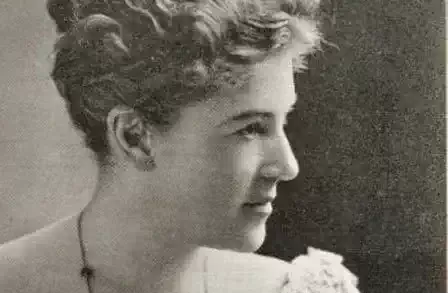
Ella Wheeler Wilcox
Ernestness
Ernestness
The hurry of the times affects us so
In this swift rushing hour, we crowd and press
And thrust each other backward as we go,
And do not pause to lay sufficient stress
Upon that good, strong, true word, Earnestness.
In our impetuous haste, could we but know
Its full, deep meaning, its vast import, oh,
Then might we grasp the secret of success!
In that receding age when men were great,
The bone and sinew of their purpose lay
In this one word. God likes an earnest soul—
Too earnest to be eager. Soon or late
It leaves the spent horde breathless by the way,
And stands serene, triumphant at the goal.
The hurry of the times affects us so
In this swift rushing hour, we crowd and press
And thrust each other backward as we go,
And do not pause to lay sufficient stress
Upon that good, strong, true word, Earnestness.
In our impetuous haste, could we but know
Its full, deep meaning, its vast import, oh,
Then might we grasp the secret of success!
In that receding age when men were great,
The bone and sinew of their purpose lay
In this one word. God likes an earnest soul—
Too earnest to be eager. Soon or late
It leaves the spent horde breathless by the way,
And stands serene, triumphant at the goal.
463
Ella Wheeler Wilcox
Contentment
Contentment
If any line that I ever penned,
Or any word I have spoken,
Has comforted heart of foe or friend In
any way, why my life, I'll say,
Has reaped the reward of labour,
If aught I have said, or written, has made
Gladder the heart o' my neighbour.
If any deed that I ever did
Lightened a sad heart's sorrow,
If I have lifted a drooping lid
Up to the bright to-morrow,
Though the world knows not, nor gives me a thought,
Nor ever can know, nor praise me,
Yet still I shall say, to my heart alway,
That my life and labour repay me.
If in any way I have helped a soul,
Or given a spirit pleasure,
Then my cup of joy, I shall think is full
With an overflowing measure.
Though never an eye, but the one on high
Looks on my kindly action,
Yet, O my heart, we shall think of our part
In the drama, with satisfaction.
If any line that I ever penned,
Or any word I have spoken,
Has comforted heart of foe or friend In
any way, why my life, I'll say,
Has reaped the reward of labour,
If aught I have said, or written, has made
Gladder the heart o' my neighbour.
If any deed that I ever did
Lightened a sad heart's sorrow,
If I have lifted a drooping lid
Up to the bright to-morrow,
Though the world knows not, nor gives me a thought,
Nor ever can know, nor praise me,
Yet still I shall say, to my heart alway,
That my life and labour repay me.
If in any way I have helped a soul,
Or given a spirit pleasure,
Then my cup of joy, I shall think is full
With an overflowing measure.
Though never an eye, but the one on high
Looks on my kindly action,
Yet, O my heart, we shall think of our part
In the drama, with satisfaction.
441
Ella Wheeler Wilcox
Certitude
Certitude
There was a time when I was confident
That God's stupendous mystery of birth
Was mine to know. The wonder of it lent
New ecstasy and glory to the earth.
I heard no voice that uttered it aloud,
Nor was it written for me on a scroll;
Yet, if alone or in the common crowd,
I felt myself a consecrated soul.
My child leaped in its dark and silent room
And cried, 'I am,' though all unheard by men.
So leaps my spirit in the body's gloom
And cries, 'I live! I shall be born again.'
Elate with certitude towards death I go,
Nor doubt, nor argue, since I know, I know!
There was a time when I was confident
That God's stupendous mystery of birth
Was mine to know. The wonder of it lent
New ecstasy and glory to the earth.
I heard no voice that uttered it aloud,
Nor was it written for me on a scroll;
Yet, if alone or in the common crowd,
I felt myself a consecrated soul.
My child leaped in its dark and silent room
And cried, 'I am,' though all unheard by men.
So leaps my spirit in the body's gloom
And cries, 'I live! I shall be born again.'
Elate with certitude towards death I go,
Nor doubt, nor argue, since I know, I know!
298
Ella Wheeler Wilcox
Attainment
Attainment
Use all your hidden forces.
Do not miss the purpose of this life,
and do not wait for circumstance
to mold or change your fate.
In your own self lies destiny.
Let this vast truth cast out all fear,
all prejudice, all hesitation.
Know that you are great -great
with divinity.
Do dominate environment, and enter into bliss.
Live largely, and hate nothing.
Hold no aim that does not chord
with universal good.
Hear what the voices of the silence say.
All joys are yours if you put forth your claim.
Once you let the spiritual laws be understood,
material things must answer and obey.
Use all your hidden forces.
Do not miss the purpose of this life,
and do not wait for circumstance
to mold or change your fate.
In your own self lies destiny.
Let this vast truth cast out all fear,
all prejudice, all hesitation.
Know that you are great -great
with divinity.
Do dominate environment, and enter into bliss.
Live largely, and hate nothing.
Hold no aim that does not chord
with universal good.
Hear what the voices of the silence say.
All joys are yours if you put forth your claim.
Once you let the spiritual laws be understood,
material things must answer and obey.
399
Ella Wheeler Wilcox
As You Go Through Life
As You Go Through Life
Don’t look for the flaws as you go through life;
And even when you find them,
It is wise and kind to be somewhat blind
And look for the virtue behind them.
For the cloudiest night has a hint of light
Somewhere in its shadows hiding;
It is better by far to hunt for a star,
Than the spots on the sun abiding.
The current of life runs ever away
To the bosom of God’s great ocean.
Don’t set your force ‘gainst the river’s course
And think to alter its motion.
Don’t waste a curse on the universe –
Remember it lived before you.
Don’t butt at the storm with your puny form,
But bend and let it go o’er you.
The world will never adjust itself
To suit your whims to the letter.
Some things must go wrong your whole life long,
And the sooner you know it the better.
It is folly to fight with the Infinite,
And go under at last in the wrestle;
The wiser man shapes into God’s plan
As water shapes into a vessel.
Don’t look for the flaws as you go through life;
And even when you find them,
It is wise and kind to be somewhat blind
And look for the virtue behind them.
For the cloudiest night has a hint of light
Somewhere in its shadows hiding;
It is better by far to hunt for a star,
Than the spots on the sun abiding.
The current of life runs ever away
To the bosom of God’s great ocean.
Don’t set your force ‘gainst the river’s course
And think to alter its motion.
Don’t waste a curse on the universe –
Remember it lived before you.
Don’t butt at the storm with your puny form,
But bend and let it go o’er you.
The world will never adjust itself
To suit your whims to the letter.
Some things must go wrong your whole life long,
And the sooner you know it the better.
It is folly to fight with the Infinite,
And go under at last in the wrestle;
The wiser man shapes into God’s plan
As water shapes into a vessel.
444
Ella Wheeler Wilcox
Answered Prayers
Answered Prayers
I prayed for riches, and achieved success;
All that I touched turned into gold. Alas!
My cares were greater and my peace was less,
When that wish came to pass.
I prayed for glory, and I heard my name
Sung by sweet children and by hoary men.
But ah! the hurts – the hurts that come with fame.
I was not happy then.
I prayed for Love, and had my heart’s desire.
Through quivering heart and body, and through brain,
There swept the flame of its devouring fire,
And but the scars remain.
I prayed for a contented mind. At length
Great light upon my darkened spirit burst.
Great peace fell on me also, and great strength –
Oh, had that prayer been first!
I prayed for riches, and achieved success;
All that I touched turned into gold. Alas!
My cares were greater and my peace was less,
When that wish came to pass.
I prayed for glory, and I heard my name
Sung by sweet children and by hoary men.
But ah! the hurts – the hurts that come with fame.
I was not happy then.
I prayed for Love, and had my heart’s desire.
Through quivering heart and body, and through brain,
There swept the flame of its devouring fire,
And but the scars remain.
I prayed for a contented mind. At length
Great light upon my darkened spirit burst.
Great peace fell on me also, and great strength –
Oh, had that prayer been first!
406
Ella Wheeler Wilcox
All Roads That Lead To God Are Good
All Roads That Lead To God Are Good
All roads that lead to God are good.
What matters it, your faith, or mine?
Both centre at the goal divine
Of love’s eternal Brotherhood.
The kindly life in house or street –
The life of prayer and mystic rite –
The student’s search for truth and light –
These paths at one great Junction meet.
Before the oldest book was writ,
Full many a prehistoric soul
Arrived at this unchanging goal,
Through changeless Love, that leads to it.
What matters that one found his Christ
In rising sun, or burning fire?
In faith within him did not tire,
His longing for the Truth sufficed.
Before our modern hell was brought
To edify the modern world,
Full many a hate-filled soul was hurled
In lakes of fire by its own thought.
A thousand creeds have come and gone,
But what is that to you or me?
Creeds are but branches of a tree –
The root of love lives on and on.
Though branch by branch proved withered wood,
The root is warm with precious wine.
Then keep your faith, and leave me mine –
All roads that lead to God are good.
All roads that lead to God are good.
What matters it, your faith, or mine?
Both centre at the goal divine
Of love’s eternal Brotherhood.
The kindly life in house or street –
The life of prayer and mystic rite –
The student’s search for truth and light –
These paths at one great Junction meet.
Before the oldest book was writ,
Full many a prehistoric soul
Arrived at this unchanging goal,
Through changeless Love, that leads to it.
What matters that one found his Christ
In rising sun, or burning fire?
In faith within him did not tire,
His longing for the Truth sufficed.
Before our modern hell was brought
To edify the modern world,
Full many a hate-filled soul was hurled
In lakes of fire by its own thought.
A thousand creeds have come and gone,
But what is that to you or me?
Creeds are but branches of a tree –
The root of love lives on and on.
Though branch by branch proved withered wood,
The root is warm with precious wine.
Then keep your faith, and leave me mine –
All roads that lead to God are good.
406
Ella Wheeler Wilcox
A Grey Mood
A Grey Mood
As we hurry away to the end, my friend,
Of this sad little farce called existence,
We are sure that the future will bring one thing,
And that is the grave in the distance.
And so when our lives run along all wrong,
And nothing seems real or certain,
We can comfort ourselves with the thought (or not)
Of that spectre behind the curtain.
But we haven’t much time to repine or whine,
Or to wound or jostle each other;
And the hour for us each is to-day, I say,
If we mean to assist a brother.
And there is no pleasure that earth gives birth,
But the worry it brings is double;
And all that repays for the strife of life,
Is helping some soul in trouble.
I tell you, if I could go back the track
To my life’s morning hour,
I would not set forth, seeking name or fame,
Or that poor bauble called power.
I would be like the sunlight, and live to give;
I would lend, but I would not borrow;
Nor would I be blind and complain of pain,
Forgetting the meaning of sorrow.
This world is a vaporous jest at best,
Tossed off by the gods in laughter;
And a cruel attempt at wit were it
If nothing better came after.
It is reeking with hearts that ache and break,
Which we ought to comfort and strengthen,
As we hurry away to the end, my friend,
And the shadows behind us lengthen.
As we hurry away to the end, my friend,
Of this sad little farce called existence,
We are sure that the future will bring one thing,
And that is the grave in the distance.
And so when our lives run along all wrong,
And nothing seems real or certain,
We can comfort ourselves with the thought (or not)
Of that spectre behind the curtain.
But we haven’t much time to repine or whine,
Or to wound or jostle each other;
And the hour for us each is to-day, I say,
If we mean to assist a brother.
And there is no pleasure that earth gives birth,
But the worry it brings is double;
And all that repays for the strife of life,
Is helping some soul in trouble.
I tell you, if I could go back the track
To my life’s morning hour,
I would not set forth, seeking name or fame,
Or that poor bauble called power.
I would be like the sunlight, and live to give;
I would lend, but I would not borrow;
Nor would I be blind and complain of pain,
Forgetting the meaning of sorrow.
This world is a vaporous jest at best,
Tossed off by the gods in laughter;
And a cruel attempt at wit were it
If nothing better came after.
It is reeking with hearts that ache and break,
Which we ought to comfort and strengthen,
As we hurry away to the end, my friend,
And the shadows behind us lengthen.
455
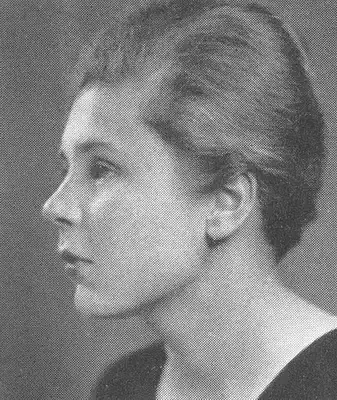
Elizabeth Bishop
Questions of Travel
Questions of Travel
There are too many waterfalls here; the crowded streams
hurry too rapidly down to the sea,
and the pressure of so many clouds on the mountaintops
makes them spill over the sides in soft slow-motion,
turning to waterfalls under our very eyes.
--For if those streaks, those mile-long, shiny, tearstains,
aren't waterfalls yet,
in a quick age or so, as ages go here,
they probably will be.
But if the streams and clouds keep travelling, travelling,
the mountains look like the hulls of capsized ships,
slime-hung and barnacled.
Think of the long trip home.
Should we have stayed at home and thought of here?
Where should we be today?
Is it right to be watching strangers in a play
in this strangest of theatres?
What childishness is it that while there's a breath of life
in our bodies, we are determined to rush
to see the sun the other way around?
The tiniest green hummingbird in the world?
To stare at some inexplicable old stonework,
inexplicable and impenetrable,
at any view,
instantly seen and always, always delightful?
Oh, must we dream our dreams
and have them, too?
And have we room
for one more folded sunset, still quite warm?
But surely it would have been a pity
not to have seen the trees along this road,
really exaggerated in their beauty,
not to have seen them gesturing
like noble pantomimists, robed in pink.
--Not to have had to stop for gas and heard
the sad, two-noted, wooden tune
of disparate wooden clogs
carelessly clacking over
a grease-stained filling-station floor.
(In another country the clogs would all be tested.
Each pair there would have identical pitch.)
--A pity not to have heard
the other, less primitive music of the fat brown bird
who sings above the broken gasoline pump
in a bamboo church of Jesuit baroque:
three towers, five silver crosses.
--Yes, a pity not to have pondered,
blurr'dly and inconclusively,
on what connection can exist for centuries
between the crudest wooden footwear
and, careful and finicky,
the whittled fantasies of wooden footwear
and, careful and finicky,
the whittled fantasies of wooden cages.
--Never to have studied history in
the weak calligraphy of songbirds' cages.
--And never to have had to listen to rain
so much like politicians' speeches:
two hours of unrelenting oratory
and then a sudden golden silence
in which the traveller takes a notebook, writes:
"Is it lack of imagination that makes us come
to imagined places, not just stay at home?
Or could Pascal have been not entirely right
about just sitting quietly in one's room?
Continent, city, country, society:
the choice is never wide and never free.
And here, or there . . . No. Should we have stayed at home,
wherever that may be?"
There are too many waterfalls here; the crowded streams
hurry too rapidly down to the sea,
and the pressure of so many clouds on the mountaintops
makes them spill over the sides in soft slow-motion,
turning to waterfalls under our very eyes.
--For if those streaks, those mile-long, shiny, tearstains,
aren't waterfalls yet,
in a quick age or so, as ages go here,
they probably will be.
But if the streams and clouds keep travelling, travelling,
the mountains look like the hulls of capsized ships,
slime-hung and barnacled.
Think of the long trip home.
Should we have stayed at home and thought of here?
Where should we be today?
Is it right to be watching strangers in a play
in this strangest of theatres?
What childishness is it that while there's a breath of life
in our bodies, we are determined to rush
to see the sun the other way around?
The tiniest green hummingbird in the world?
To stare at some inexplicable old stonework,
inexplicable and impenetrable,
at any view,
instantly seen and always, always delightful?
Oh, must we dream our dreams
and have them, too?
And have we room
for one more folded sunset, still quite warm?
But surely it would have been a pity
not to have seen the trees along this road,
really exaggerated in their beauty,
not to have seen them gesturing
like noble pantomimists, robed in pink.
--Not to have had to stop for gas and heard
the sad, two-noted, wooden tune
of disparate wooden clogs
carelessly clacking over
a grease-stained filling-station floor.
(In another country the clogs would all be tested.
Each pair there would have identical pitch.)
--A pity not to have heard
the other, less primitive music of the fat brown bird
who sings above the broken gasoline pump
in a bamboo church of Jesuit baroque:
three towers, five silver crosses.
--Yes, a pity not to have pondered,
blurr'dly and inconclusively,
on what connection can exist for centuries
between the crudest wooden footwear
and, careful and finicky,
the whittled fantasies of wooden footwear
and, careful and finicky,
the whittled fantasies of wooden cages.
--Never to have studied history in
the weak calligraphy of songbirds' cages.
--And never to have had to listen to rain
so much like politicians' speeches:
two hours of unrelenting oratory
and then a sudden golden silence
in which the traveller takes a notebook, writes:
"Is it lack of imagination that makes us come
to imagined places, not just stay at home?
Or could Pascal have been not entirely right
about just sitting quietly in one's room?
Continent, city, country, society:
the choice is never wide and never free.
And here, or there . . . No. Should we have stayed at home,
wherever that may be?"
652
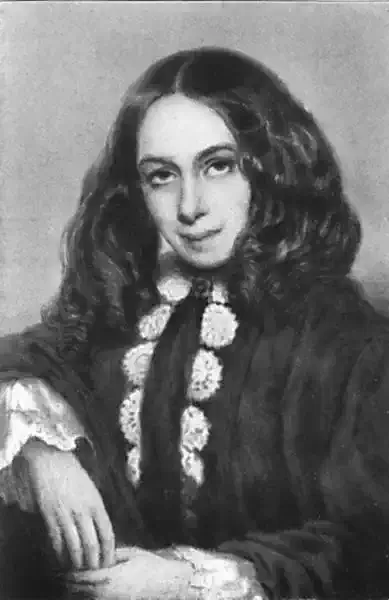
Elizabeth Barrett Browning
Sonnet XXVI: I Lived With Visions
Sonnet XXVI: I Lived With Visions
I lived with visions for my company
Instead of men and women, years ago,
And found them gentle mates, nor thought to know
A sweeter music than they played to me.
But soon their trailing purple was not free
Of this world's dust, their lutes did silent grow,
And I myself grew faint and blind below
Their vanishing eyes. Then thou didst come--to be,
Belovèd, what they seemed. Their shining fronts,
Their songs, their splendors (better, yet the same,
As river water hallowed into fonts),
Met in thee, and from out thee overcame
My soul with satisfaction of all wants:
Because God's gifts put man's best dreams to shame.
I lived with visions for my company
Instead of men and women, years ago,
And found them gentle mates, nor thought to know
A sweeter music than they played to me.
But soon their trailing purple was not free
Of this world's dust, their lutes did silent grow,
And I myself grew faint and blind below
Their vanishing eyes. Then thou didst come--to be,
Belovèd, what they seemed. Their shining fronts,
Their songs, their splendors (better, yet the same,
As river water hallowed into fonts),
Met in thee, and from out thee overcame
My soul with satisfaction of all wants:
Because God's gifts put man's best dreams to shame.
375
Elizabeth Barrett Browning
Sonnet XVII: My Poet, Thou Canst Touch
Sonnet XVII: My Poet, Thou Canst Touch
My poet, thou canst touch on all the notes
God set between his After and Before,
And strike up and strike off the general roar
Of the rushing worlds a melody that floats
In a serene air purely. Antidotes
Of medicated music, answering for
Mankind's forlornest uses, thou canst pour
From thence into their ears. God's will devotes
Thine to such ends, and mine to wait on thine.
How, Dearest, wilt thou have me for most use?
A hope, to sing by gladly? or a fine
Sad memory, with thy songs to interfuse?
A shade, in which to sing--of palm or pine?
A grave, on which to rest from singing? Choose.
My poet, thou canst touch on all the notes
God set between his After and Before,
And strike up and strike off the general roar
Of the rushing worlds a melody that floats
In a serene air purely. Antidotes
Of medicated music, answering for
Mankind's forlornest uses, thou canst pour
From thence into their ears. God's will devotes
Thine to such ends, and mine to wait on thine.
How, Dearest, wilt thou have me for most use?
A hope, to sing by gladly? or a fine
Sad memory, with thy songs to interfuse?
A shade, in which to sing--of palm or pine?
A grave, on which to rest from singing? Choose.
425
Elizabeth Barrett Browning
Sonnet 26 - I lived with visions for my company
Sonnet 26 - I lived with visions for my company
XXVI
I lived with visions for my company
Instead of men and women, years ago,
And found them gentle mates, nor thought to know
A sweeter music than they played to me.
But soon their trailing purple was not free
Of this world's dust, their lutes did silent grow,
And I myself grew faint and blind below
Their vanishing eyes. Then THOU didst come-to be,
Beloved, what they seemed. Their shining fronts,
Their songs, their splendors (better, yet the same,
As river-water hallowed into fonts),
Met in thee, and from out thee overcame
My soul with satisfaction of all wants:
Because God's gifts put man's best dreams to shame.
XXVI
I lived with visions for my company
Instead of men and women, years ago,
And found them gentle mates, nor thought to know
A sweeter music than they played to me.
But soon their trailing purple was not free
Of this world's dust, their lutes did silent grow,
And I myself grew faint and blind below
Their vanishing eyes. Then THOU didst come-to be,
Beloved, what they seemed. Their shining fronts,
Their songs, their splendors (better, yet the same,
As river-water hallowed into fonts),
Met in thee, and from out thee overcame
My soul with satisfaction of all wants:
Because God's gifts put man's best dreams to shame.
419

Edward Lear
Imitation of The Olden Poets
Imitation of The Olden Poets
Time is a taper waning fast!
Use it, man, well whilst it doth last:
Lest burning downwards it consume away,
Before thou hast commenced the labour of the day.
Time is a pardon of a goodly soil!
Plenty shall crown thine honest toil:
But if uncultivated, rankest weeds
Shall choke the efforts of the rising seeds.
Time is a leasehold of uncertain date!
Granted to thee by everlasting fate.
Neglect not thou, ere thy short term expire,
To save thy soul from ever-burning fire.
Time is a taper waning fast!
Use it, man, well whilst it doth last:
Lest burning downwards it consume away,
Before thou hast commenced the labour of the day.
Time is a pardon of a goodly soil!
Plenty shall crown thine honest toil:
But if uncultivated, rankest weeds
Shall choke the efforts of the rising seeds.
Time is a leasehold of uncertain date!
Granted to thee by everlasting fate.
Neglect not thou, ere thy short term expire,
To save thy soul from ever-burning fire.
255
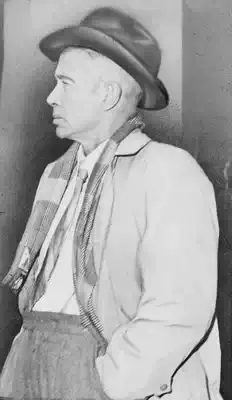
E. E. Cummings
in time of daffodils(who know
in time of daffodils(who know
in time of daffodils(who know
the goal of living is to grow)
forgetting why,remember how
in time of lilacs who proclaim
the aim of waking is to dream,
remember so(forgetting seem)
in time of roses(who amaze
our now and here with paradise)
forgetting if,remember yes
in time of all sweet things beyond
whatever mind may comprehend,
remember seek(forgetting find)
and in a mystery to be
(when time from time shall set us free)
forgetting me,remember me
in time of daffodils(who know
the goal of living is to grow)
forgetting why,remember how
in time of lilacs who proclaim
the aim of waking is to dream,
remember so(forgetting seem)
in time of roses(who amaze
our now and here with paradise)
forgetting if,remember yes
in time of all sweet things beyond
whatever mind may comprehend,
remember seek(forgetting find)
and in a mystery to be
(when time from time shall set us free)
forgetting me,remember me
460
Edna St. Vincent Millay
The Singing-Woman From The Wood's Edge
The Singing-Woman From The Wood's Edge
What should I be but a prophet and a liar,
Whose mother was a leprechaun, whose father was a friar?
Teethed on a crucifix and cradled under water,
What should I be but the fiend's god-daughter?
And who should be my playmates but the adder and the frog,
That was got beneath a furze-bush and born in a bog?
And what should be my singing, that was christened at an altar,
But Aves and Credos and Psalms out of the Psalter?
You will see such webs on the wet grass, maybe,
As a pixie-mother weaves for her baby,
You will find such flame at the wave's weedy ebb
As flashes in the meshes of a mer-mother's web,
But there comes to birth no common spawn
From the love a a priest for a leprechaun,
And you never have seen and you never will see
Such things as the things that swaddled me!
After all's said and after all's done,
What should I be but a harlot and a nun?
In through the bushes, on any foggy day,
My Da would come a-swishing of the drops away,
With a prayer for my death and a groan for my birth,
A-mumbling of his beads for all that he was worth.
And there'd sit my Ma, with her knees beneath her chin,
A-looking in his face and a-drinking of it in,
And a-marking in the moss some funny little saying
That would mean just the opposite of all that he was praying!
He taught me the holy-talk of Vesper and of Matin,
He heard me my Greek and he heard me my Latin,
He blessed me and crossed me to keep my soul from evil,
And we watched him out of sight, and we conjured up the devil!
Oh, the things I haven't seen and the things I haven't known,
What with hedges and ditches till after I was grown,
And yanked both way by my mother and my father,
With a "Which would you better?" and a " Which would you
rather?"
With him for a sire and her for a dam,
What should I be but just what I am?
What should I be but a prophet and a liar,
Whose mother was a leprechaun, whose father was a friar?
Teethed on a crucifix and cradled under water,
What should I be but the fiend's god-daughter?
And who should be my playmates but the adder and the frog,
That was got beneath a furze-bush and born in a bog?
And what should be my singing, that was christened at an altar,
But Aves and Credos and Psalms out of the Psalter?
You will see such webs on the wet grass, maybe,
As a pixie-mother weaves for her baby,
You will find such flame at the wave's weedy ebb
As flashes in the meshes of a mer-mother's web,
But there comes to birth no common spawn
From the love a a priest for a leprechaun,
And you never have seen and you never will see
Such things as the things that swaddled me!
After all's said and after all's done,
What should I be but a harlot and a nun?
In through the bushes, on any foggy day,
My Da would come a-swishing of the drops away,
With a prayer for my death and a groan for my birth,
A-mumbling of his beads for all that he was worth.
And there'd sit my Ma, with her knees beneath her chin,
A-looking in his face and a-drinking of it in,
And a-marking in the moss some funny little saying
That would mean just the opposite of all that he was praying!
He taught me the holy-talk of Vesper and of Matin,
He heard me my Greek and he heard me my Latin,
He blessed me and crossed me to keep my soul from evil,
And we watched him out of sight, and we conjured up the devil!
Oh, the things I haven't seen and the things I haven't known,
What with hedges and ditches till after I was grown,
And yanked both way by my mother and my father,
With a "Which would you better?" and a " Which would you
rather?"
With him for a sire and her for a dam,
What should I be but just what I am?
358
Edna St. Vincent Millay
Spring
Spring
To what purpose, April, do you return again?
Beauty is not enough.
You can no longer quiet me with the redness
Of little leaves opening stickily.
I know what I know.
The sun is hot on my neck as I observe
The spikes of the crocus.
The smell of the earth is good.
It is apparent that there is no death.
But what does that signify?
Not only under ground are the brains of men
Eaten by maggots.
Life in itself
Is nothing,
An empty cup, a flight of uncarpeted stairs.
It is not enough that yearly, down this hill,
April
Comes like an idiot, babbling and strewing flowers.
To what purpose, April, do you return again?
Beauty is not enough.
You can no longer quiet me with the redness
Of little leaves opening stickily.
I know what I know.
The sun is hot on my neck as I observe
The spikes of the crocus.
The smell of the earth is good.
It is apparent that there is no death.
But what does that signify?
Not only under ground are the brains of men
Eaten by maggots.
Life in itself
Is nothing,
An empty cup, a flight of uncarpeted stairs.
It is not enough that yearly, down this hill,
April
Comes like an idiot, babbling and strewing flowers.
418
Edna St. Vincent Millay
Renascence
Renascence
All I could see from where I stood
Was three long mountains and a wood;
I turned and looked another way,
And saw three islands in a bay.
So with my eyes I traced the line
Of the horizon, thin and fine,
Straight around till I was come
Back to where I'd started from;
And all I saw from where I stood
Was three long mountains and a wood.
Over these things I could not see;
These were the things that bounded me;
And I could touch them with my hand,
Almost, I thought, from where I stand.
And all at once things seemed so small
My breath came short, and scarce at all.
But, sure, the sky is big, I said;
Miles and miles above my head;
So here upon my back I'll lie
And look my fill into the sky.
And so I looked, and, after all,
The sky was not so very tall.
The sky, I said, must somewhere stop,
And -- sure enough! -- I see the top!
The sky, I thought, is not so grand;
I 'most could touch it with my hand!
And, reaching up my hand to try,
I screamed to feel it touch the sky.
I screamed, and -- lo! -- Infinity
Came down and settled over me;
And, pressing of the Undefined
The definition on my mind,
Held up before my eyes a glass
Through which my shrinking sight did pass
Until it seemed I must behold
Immensity made manifold;
Whispered to me a word whose sound
Deafened the air for worlds around,
And brought unmuffled to my ears
The gossiping of friendly spheres,
The creaking of the tented sky,
The ticking of Eternity.
I saw and heard, and knew at last
The How and Why of all things, past,
And present, and forevermore.
The universe, cleft to the core,
Lay open to my probing sense
That, sick'ning, I would fain pluck thence
But could not, -- nay! But needs must suck
At the great wound, and could not pluck
My lips away till I had drawn
All venom out. -- Ah, fearful pawn!
For my omniscience paid I toll
In infinite remorse of soul.
All sin was of my sinning, all
Atoning mine, and mine the gall
Of all regret. Mine was the weight
Of every brooded wrong, the hate
That stood behind each envious thrust,
Mine every greed, mine every lust.
And all the while for every grief,
Each suffering, I craved relief
With individual desire, --
Craved all in vain! And felt fierce fire
About a thousand people crawl;
Perished with each, -- then mourned for all!
A man was starving in Capri;
He moved his eyes and looked at me;
I felt his gaze, I heard his moan,
And knew his hunger as my own.
I saw at sea a great fog-bank
Between two ships that struck and sank;
A thousand screams the heavens smote;
And every scream tore through my throat.
No hurt I did not feel, no death
That was not mine; mine each last breath
That, crying, met an answering cry
From the compassion that was I.
All suffering mine, and mine its rod;
Mine, pity like the pity of God.
Ah, awful weight! Infinity
Pressed down upon the finite Me!
My anguished spirit, like a bird,
Beating against my lips I heard;
Yet lay the weight so close about
There was no room for it without.
And so beneath the Weight lay I
And suffered death, but could not die.
Long had I lain thus, craving death,
When quietly the earth beneath
Gave way, and inch by inch, so great
At last had grown the crushing weight,
Into the earth I sank till I
Full six feet under ground did lie,
And sank no more, -- there is no weight
Can follow here, however great.
From off my breast I felt it roll,
And as it went my tortured soul
Burst forth and fled in such a gust
That all about me swirled the dust.
Deep in the earth I rested now;
Cool is its hand upon the brow
And soft its breast beneath the head
Of one who is so gladly dead.
And all at once, and over all,
The pitying rain began to fall;
I lay and heard each pattering hoof
Upon my lowly, thatched roof,
And seemed to love the sound far more
Than ever I had done before.
For rain it hath a friendly sound
To one who's six feet underground;
And scarce the friendly voice or face:
A grave is such a quiet place.
The rain, I said, is kind to come
And speak to me in my new home.
I would I were alive again
To kiss the fingers of the rain,
To drink into my eyes the shine
Of every slanting silver line,
To catch the freshened, fragrant breeze
From drenched and dripping apple-trees.
For soon the shower will be done,
And then the broad face of the sun
Will laugh above the rain-soaked earth
Until the world with answering mirth
Shakes joyously, and each round drop
Rolls, twinkling, from its grass-blade top.
How can I bear it; buried here,
While overhead the sky grows clear
And blue again after the storm?
O, multi-colored, multiform,
Beloved beauty over me,
That I shall never, never see
Again! Spring-silver, autumn-gold,
That I shall never more behold!
Sleeping your myriad magics through,
Close-sepulchred away from you!
O God, I cried, give me new birth,
And put me back upon the earth!
Upset each cloud's gigantic gourd
And let the heavy rain, down-poured
In one big torrent, set me free,
Washing my grave away from me!
I ceased; and, through the breathless hush
That answered me, the far-off rush
Of herald wings came whispering
Like music down the vibrant string
Of my ascending prayer, and -- crash!
Before the wild wind's whistling lash
The startled storm-clouds reared on high
And plunged in terror down the sky,
And the big rain in one black wave
Fell from the sky and struck my grave.
I know not how such things can be
I only know there came to me
A fragrance such as never clings
To aught save happy living things;
A sound as of some joyous elf
Singing sweet songs to please himself,
And, through and over everything,
A sense of glad awakening.
The grass, a-tiptoe at my ear,
Whispering to me I could hear;
I felt the rain's cool finger-tips
Brushed tenderly across my lips,
Laid gently on my sealed sight,
And all at once the heavy night
Fell from my eyes and I could see, --
A drenched and dripping apple-tree,
A last long line of silver rain,
A sky grown clear and blue again.
And as I looked a quickening gust
Of wind blew up to me and thrust
Into my face a miracle
Of orchard-breath, and with the smell, --
I know not how such things can be! --
I breathed my soul back into me.
Ah! Up then from the ground sprang I
And hailed the earth with such a cry
As is not heard save from a man
Who has been dead, and lives again.
About the trees my arms I wound;
Like one gone mad I hugged the ground;
I raised my quivering arms on high;
I laughed and laughed into the sky,
Till at my throat a strangling sob
Caught fiercely, and a great heart-throb
Sent instant tears into my eyes;
O God, I cried, no dark disguise
Can e'er hereafter hide from me
Thy radiant identity!
Thou canst not move across the grass
But my quick eyes will see Thee pass,
Nor speak, however silently,
But my hushed voice will answer Thee.
I know the path that tells Thy way
Through the cool eve of every day;
God, I can push the grass apart
And lay my finger on Thy heart!
The world stands out on either side
No wider than the heart is wide;
Above the world is stretched the sky, --
No higher than the soul is high.
The heart can push the sea and land
Farther away on either hand;
The soul can split the sky in two,
And let the face of God shine through.
But East and West will pinch the heart
That cannot keep them pushed apart;
And he whose soul is flat -- the sky
Will cave in on him by and by.
All I could see from where I stood
Was three long mountains and a wood;
I turned and looked another way,
And saw three islands in a bay.
So with my eyes I traced the line
Of the horizon, thin and fine,
Straight around till I was come
Back to where I'd started from;
And all I saw from where I stood
Was three long mountains and a wood.
Over these things I could not see;
These were the things that bounded me;
And I could touch them with my hand,
Almost, I thought, from where I stand.
And all at once things seemed so small
My breath came short, and scarce at all.
But, sure, the sky is big, I said;
Miles and miles above my head;
So here upon my back I'll lie
And look my fill into the sky.
And so I looked, and, after all,
The sky was not so very tall.
The sky, I said, must somewhere stop,
And -- sure enough! -- I see the top!
The sky, I thought, is not so grand;
I 'most could touch it with my hand!
And, reaching up my hand to try,
I screamed to feel it touch the sky.
I screamed, and -- lo! -- Infinity
Came down and settled over me;
And, pressing of the Undefined
The definition on my mind,
Held up before my eyes a glass
Through which my shrinking sight did pass
Until it seemed I must behold
Immensity made manifold;
Whispered to me a word whose sound
Deafened the air for worlds around,
And brought unmuffled to my ears
The gossiping of friendly spheres,
The creaking of the tented sky,
The ticking of Eternity.
I saw and heard, and knew at last
The How and Why of all things, past,
And present, and forevermore.
The universe, cleft to the core,
Lay open to my probing sense
That, sick'ning, I would fain pluck thence
But could not, -- nay! But needs must suck
At the great wound, and could not pluck
My lips away till I had drawn
All venom out. -- Ah, fearful pawn!
For my omniscience paid I toll
In infinite remorse of soul.
All sin was of my sinning, all
Atoning mine, and mine the gall
Of all regret. Mine was the weight
Of every brooded wrong, the hate
That stood behind each envious thrust,
Mine every greed, mine every lust.
And all the while for every grief,
Each suffering, I craved relief
With individual desire, --
Craved all in vain! And felt fierce fire
About a thousand people crawl;
Perished with each, -- then mourned for all!
A man was starving in Capri;
He moved his eyes and looked at me;
I felt his gaze, I heard his moan,
And knew his hunger as my own.
I saw at sea a great fog-bank
Between two ships that struck and sank;
A thousand screams the heavens smote;
And every scream tore through my throat.
No hurt I did not feel, no death
That was not mine; mine each last breath
That, crying, met an answering cry
From the compassion that was I.
All suffering mine, and mine its rod;
Mine, pity like the pity of God.
Ah, awful weight! Infinity
Pressed down upon the finite Me!
My anguished spirit, like a bird,
Beating against my lips I heard;
Yet lay the weight so close about
There was no room for it without.
And so beneath the Weight lay I
And suffered death, but could not die.
Long had I lain thus, craving death,
When quietly the earth beneath
Gave way, and inch by inch, so great
At last had grown the crushing weight,
Into the earth I sank till I
Full six feet under ground did lie,
And sank no more, -- there is no weight
Can follow here, however great.
From off my breast I felt it roll,
And as it went my tortured soul
Burst forth and fled in such a gust
That all about me swirled the dust.
Deep in the earth I rested now;
Cool is its hand upon the brow
And soft its breast beneath the head
Of one who is so gladly dead.
And all at once, and over all,
The pitying rain began to fall;
I lay and heard each pattering hoof
Upon my lowly, thatched roof,
And seemed to love the sound far more
Than ever I had done before.
For rain it hath a friendly sound
To one who's six feet underground;
And scarce the friendly voice or face:
A grave is such a quiet place.
The rain, I said, is kind to come
And speak to me in my new home.
I would I were alive again
To kiss the fingers of the rain,
To drink into my eyes the shine
Of every slanting silver line,
To catch the freshened, fragrant breeze
From drenched and dripping apple-trees.
For soon the shower will be done,
And then the broad face of the sun
Will laugh above the rain-soaked earth
Until the world with answering mirth
Shakes joyously, and each round drop
Rolls, twinkling, from its grass-blade top.
How can I bear it; buried here,
While overhead the sky grows clear
And blue again after the storm?
O, multi-colored, multiform,
Beloved beauty over me,
That I shall never, never see
Again! Spring-silver, autumn-gold,
That I shall never more behold!
Sleeping your myriad magics through,
Close-sepulchred away from you!
O God, I cried, give me new birth,
And put me back upon the earth!
Upset each cloud's gigantic gourd
And let the heavy rain, down-poured
In one big torrent, set me free,
Washing my grave away from me!
I ceased; and, through the breathless hush
That answered me, the far-off rush
Of herald wings came whispering
Like music down the vibrant string
Of my ascending prayer, and -- crash!
Before the wild wind's whistling lash
The startled storm-clouds reared on high
And plunged in terror down the sky,
And the big rain in one black wave
Fell from the sky and struck my grave.
I know not how such things can be
I only know there came to me
A fragrance such as never clings
To aught save happy living things;
A sound as of some joyous elf
Singing sweet songs to please himself,
And, through and over everything,
A sense of glad awakening.
The grass, a-tiptoe at my ear,
Whispering to me I could hear;
I felt the rain's cool finger-tips
Brushed tenderly across my lips,
Laid gently on my sealed sight,
And all at once the heavy night
Fell from my eyes and I could see, --
A drenched and dripping apple-tree,
A last long line of silver rain,
A sky grown clear and blue again.
And as I looked a quickening gust
Of wind blew up to me and thrust
Into my face a miracle
Of orchard-breath, and with the smell, --
I know not how such things can be! --
I breathed my soul back into me.
Ah! Up then from the ground sprang I
And hailed the earth with such a cry
As is not heard save from a man
Who has been dead, and lives again.
About the trees my arms I wound;
Like one gone mad I hugged the ground;
I raised my quivering arms on high;
I laughed and laughed into the sky,
Till at my throat a strangling sob
Caught fiercely, and a great heart-throb
Sent instant tears into my eyes;
O God, I cried, no dark disguise
Can e'er hereafter hide from me
Thy radiant identity!
Thou canst not move across the grass
But my quick eyes will see Thee pass,
Nor speak, however silently,
But my hushed voice will answer Thee.
I know the path that tells Thy way
Through the cool eve of every day;
God, I can push the grass apart
And lay my finger on Thy heart!
The world stands out on either side
No wider than the heart is wide;
Above the world is stretched the sky, --
No higher than the soul is high.
The heart can push the sea and land
Farther away on either hand;
The soul can split the sky in two,
And let the face of God shine through.
But East and West will pinch the heart
That cannot keep them pushed apart;
And he whose soul is flat -- the sky
Will cave in on him by and by.
390
Edgar Albert Guest
Selfishness
Selfishness
Search history, my boy, and see
What petty selfishness has done.
Find if you can one victory
That little minds have ever won.
There is no record there to read
Of men who fought for self alone,
No instance of a single deed
Splendor they may proudly own.
Through all life's story you will find
The miser—with his hoarded gold—
A hermit, dreary and unkind,
An outcast from the human fold.
Men hold him up to view with scorn,
A creature by his wealth enslaved,
A spirit craven and forlorn,
Doomed by the money he has saved.
No man was ever truly great
Who sought to serve himself alone,
Who put himself above the state,
Above the friends about him thrown.
No man was ever truly glad
Who risked his joy on hoarded pelf,
And gave of nothing that he had
Through fear of needing it himself.
For selfishness is wintry cold,
And bitter are its joys at last,
The very charms it tries to hold,
With woes are quickly overcast.
And only he shall gladly live,
And bravely die when God shall call,
Who gathers but that he may give,
And with his fellows shares his all.
Search history, my boy, and see
What petty selfishness has done.
Find if you can one victory
That little minds have ever won.
There is no record there to read
Of men who fought for self alone,
No instance of a single deed
Splendor they may proudly own.
Through all life's story you will find
The miser—with his hoarded gold—
A hermit, dreary and unkind,
An outcast from the human fold.
Men hold him up to view with scorn,
A creature by his wealth enslaved,
A spirit craven and forlorn,
Doomed by the money he has saved.
No man was ever truly great
Who sought to serve himself alone,
Who put himself above the state,
Above the friends about him thrown.
No man was ever truly glad
Who risked his joy on hoarded pelf,
And gave of nothing that he had
Through fear of needing it himself.
For selfishness is wintry cold,
And bitter are its joys at last,
The very charms it tries to hold,
With woes are quickly overcast.
And only he shall gladly live,
And bravely die when God shall call,
Who gathers but that he may give,
And with his fellows shares his all.
863
Edgar Albert Guest
On Quitting
On Quitting
How much grit do you think you've got?
Can you quit a thing that you like a lot?
You may talk of pluck; it's an easy word,
And where'er you go it is often heard;
But can you tell to a jot or guess
Just how much courage you now possess?
You may stand to trouble and keep your grin,
But have you tackled self-discipline?
Have you ever issued commands to you
To quit the things that you like to do,
And then, when tempted and sorely swayed,
Those rigid orders have you obeyed?
Don't boast of your grit till you've tried it out,
Nor prate to men of your courage stout,
For it's easy enough to retain a grin
In the face of a fight there's a chance to win,
But the sort of grit that is good to own
Is the stuff you need when you're all alone.
How much grit do you think you've got?
Can you turn from joys that you like a lot?
Have you ever tested yourself to know
How far with yourself your will can go?
If you want to know if you have grit,
Just pick out a joy that you like, and quit.
It's bully sport and it's open fight;
It will keep you busy both day and night;
For the toughest kind of a game you'll find
Is to make your body obey your mind.
And you never will know what is meant by grit
Unless there's something you've tried to quit.
How much grit do you think you've got?
Can you quit a thing that you like a lot?
You may talk of pluck; it's an easy word,
And where'er you go it is often heard;
But can you tell to a jot or guess
Just how much courage you now possess?
You may stand to trouble and keep your grin,
But have you tackled self-discipline?
Have you ever issued commands to you
To quit the things that you like to do,
And then, when tempted and sorely swayed,
Those rigid orders have you obeyed?
Don't boast of your grit till you've tried it out,
Nor prate to men of your courage stout,
For it's easy enough to retain a grin
In the face of a fight there's a chance to win,
But the sort of grit that is good to own
Is the stuff you need when you're all alone.
How much grit do you think you've got?
Can you turn from joys that you like a lot?
Have you ever tested yourself to know
How far with yourself your will can go?
If you want to know if you have grit,
Just pick out a joy that you like, and quit.
It's bully sport and it's open fight;
It will keep you busy both day and night;
For the toughest kind of a game you'll find
Is to make your body obey your mind.
And you never will know what is meant by grit
Unless there's something you've tried to quit.
1,129
Edgar Albert Guest
Life's Slacker
Life's Slacker
The saddest sort of death to die
Would be to quit the game called life
And know, beneath the gentle sky,
You'd lived a slacker in the strife.
That nothing men on earth would find
To mark the spot that you had filled;
That you must go and leave behind
No patch of soil your hands had tilled.
I know no greater shame than this:
To feel that yours were empty years;
That after death no man would miss
Your presence in this vale of tears;
That you had breathed the fragrant air
And sat by kindly fires that burn,
And in earth's riches had a share
But gave no labor in return.
Yet some men die this way, nor care:
They enter and they leave life's door
And at the end, their record's bare—
The world's no better than before.
A few false tears are shed, and then,
In busy service, they're forgot.
We have no time to mourn for men
Who lived on earth but served it not.
A man in perfect peace to die
Must leave some mark of toil behind,
Some building towering to the sky,
Some symbol that his heart was kind,
Some roadway where strange feet may tread
That out of gratitude he made;
He cannot bravely look ahead
Unless his debt to life is paid.
The saddest sort of death to die
Would be to quit the game called life
And know, beneath the gentle sky,
You'd lived a slacker in the strife.
That nothing men on earth would find
To mark the spot that you had filled;
That you must go and leave behind
No patch of soil your hands had tilled.
I know no greater shame than this:
To feel that yours were empty years;
That after death no man would miss
Your presence in this vale of tears;
That you had breathed the fragrant air
And sat by kindly fires that burn,
And in earth's riches had a share
But gave no labor in return.
Yet some men die this way, nor care:
They enter and they leave life's door
And at the end, their record's bare—
The world's no better than before.
A few false tears are shed, and then,
In busy service, they're forgot.
We have no time to mourn for men
Who lived on earth but served it not.
A man in perfect peace to die
Must leave some mark of toil behind,
Some building towering to the sky,
Some symbol that his heart was kind,
Some roadway where strange feet may tread
That out of gratitude he made;
He cannot bravely look ahead
Unless his debt to life is paid.
684
Edgar Albert Guest
He Who Serves
He Who Serves
He has not served who gathers gold,
Nor has he served, whose life is told
In selfish battles he has won,
Or deeds of skill that he has done;
But he has served who now and then
Has helped along his fellow men.
The world needs many men today;
Red-blooded men along life's way,
With cheerful smiles and helping hands,
And with the faith that understands
The beauty of the simple deed
Which serves another's hour of need.
Strong men to stand beside the weak,
Kind men to hear what others speak;
True men to keep our country's laws
And guard its honor and its cause;
Men who will bravely play life's game
Nor ask rewards of gold and fame.
Teach me to do the best I can
To help and cheer our fellow man;
Teach me to lose my selfish need
And glory in the larger deed
Which smoothes the road, and lights the day
For all who chance to come my way.
He has not served who gathers gold,
Nor has he served, whose life is told
In selfish battles he has won,
Or deeds of skill that he has done;
But he has served who now and then
Has helped along his fellow men.
The world needs many men today;
Red-blooded men along life's way,
With cheerful smiles and helping hands,
And with the faith that understands
The beauty of the simple deed
Which serves another's hour of need.
Strong men to stand beside the weak,
Kind men to hear what others speak;
True men to keep our country's laws
And guard its honor and its cause;
Men who will bravely play life's game
Nor ask rewards of gold and fame.
Teach me to do the best I can
To help and cheer our fellow man;
Teach me to lose my selfish need
And glory in the larger deed
Which smoothes the road, and lights the day
For all who chance to come my way.
701
Edgar Albert Guest
Ideals
Ideals
Better than land or gold or trade
Are a high ideal and a purpose true;
Better than all of the wealth we've made
Is the work for others that now we do.
For Rome grew rich and she turned to song
And danced to music and drank her wine,
But she sapped the strength of her fibres strong
And a gilded shroud was her splendor fine.
The Rome of old with its wealth and wine
Was the handiwork of a sturdy race;
They builded well and they made it fine
And they dreamed of it as their children's place.
They thought the joys they had won to give,
And which seemed so certain and fixed and sure,
To the end of time in the world would live
And the Rome they'd fashioned would long endure.
They passed to their children the hoarded gold,
Their marble halls and their fertile fields!
But not the spirit of Rome of old,
Nor the Roman courage that never yields.
They left them the wealth that their hands had won,
But they failed to leave them a purpose true.
They left them thinking life's work all done,
And Rome went down and was lost to view.
We must guard ourselves lest we follow Rome.
We must leave our children the finer things.
We must teach them love of the spot called home
And the lasting joy that a purpose brings.
For vain are our Flag and our battles won,
And vain are our lands and our stores of gold,
If our children feel that life's work is done.
We must give them a high ideal to hold.
Better than land or gold or trade
Are a high ideal and a purpose true;
Better than all of the wealth we've made
Is the work for others that now we do.
For Rome grew rich and she turned to song
And danced to music and drank her wine,
But she sapped the strength of her fibres strong
And a gilded shroud was her splendor fine.
The Rome of old with its wealth and wine
Was the handiwork of a sturdy race;
They builded well and they made it fine
And they dreamed of it as their children's place.
They thought the joys they had won to give,
And which seemed so certain and fixed and sure,
To the end of time in the world would live
And the Rome they'd fashioned would long endure.
They passed to their children the hoarded gold,
Their marble halls and their fertile fields!
But not the spirit of Rome of old,
Nor the Roman courage that never yields.
They left them the wealth that their hands had won,
But they failed to leave them a purpose true.
They left them thinking life's work all done,
And Rome went down and was lost to view.
We must guard ourselves lest we follow Rome.
We must leave our children the finer things.
We must teach them love of the spot called home
And the lasting joy that a purpose brings.
For vain are our Flag and our battles won,
And vain are our lands and our stores of gold,
If our children feel that life's work is done.
We must give them a high ideal to hold.
732
Edgar Albert Guest
Compensation
Compensation
I'd like to think when life is done
That I had filled a needed post.
That here and there I'd paid my fare
With more than idle talk and boast;
That I had taken gifts divine.
The breath of life and manhood fine,
And tried to use them now and then
In service for my fellow men.
I'd hate to think when life is through
That I had lived my round of years
A useless kind, that leaves behind
No record in this vale of tears;
That I had wasted all my days
By treading only selfish ways,
And that this world would be the same
If it had never known my name.
I'd like to think that here and there,
When I am gone, there shall remain
A happier spot that might have not
Existed had I toiled for gain;
That someone's cheery voice and smile
Shall prove that I had been worth while;
That I had paid with something fine
My debt to God for life divine.
I'd like to think when life is done
That I had filled a needed post.
That here and there I'd paid my fare
With more than idle talk and boast;
That I had taken gifts divine.
The breath of life and manhood fine,
And tried to use them now and then
In service for my fellow men.
I'd hate to think when life is through
That I had lived my round of years
A useless kind, that leaves behind
No record in this vale of tears;
That I had wasted all my days
By treading only selfish ways,
And that this world would be the same
If it had never known my name.
I'd like to think that here and there,
When I am gone, there shall remain
A happier spot that might have not
Existed had I toiled for gain;
That someone's cheery voice and smile
Shall prove that I had been worth while;
That I had paid with something fine
My debt to God for life divine.
676
Dylan Thomas
I, In My Intricate Image
I, In My Intricate Image
I
I, in my intricate image, stride on two levels,
Forged in man's minerals, the brassy orator
Laying my ghost in metal,
The scales of this twin world tread on the double,
My half ghost in armour hold hard in death's corridor,
To my man-iron sidle.
Beginning with doom in the bulb, the spring unravels,
Bright as her spinning-wheels, the colic season
Worked on a world of petals;
She threads off the sap and needles, blood and bubble
Casts to the pine roots, raising man like a mountain
Out of the naked entrail.
Beginning with doom in the ghost, and the springing marvels,
Image of images, my metal phantom
Forcing forth through the harebell,
My man of leaves and the bronze root, mortal, unmortal,
I, in my fusion of rose and male motion,
Create this twin miracle.
This is the fortune of manhood: the natural peril,
A steeplejack tower, bonerailed and masterless,
No death more natural;
Thus the shadowless man or ox, and the pictured devil,
In seizure of silence commit the dead nuisance.
The natural parallel.
My images stalk the trees and the slant sap's tunnel,
No tread more perilous, the green steps and spire
Mount on man's footfall,
I with the wooden insect in the tree of nettles,
In the glass bed of grapes with snail and flower,
Hearing the weather fall.
Intricate manhood of ending, the invalid rivals,
Voyaging clockwise off the symboled harbour,
Finding the water final,
On the consumptives' terrace taking their two farewells,
Sail on the level, the departing adventure,
To the sea-blown arrival.
II
They climb the country pinnacle,
Twelve winds encounter by the white host at pasture,
Corner the mounted meadows in the hill corral;
They see the squirrel stumble,
The haring snail go giddily round the flower,
A quarrel of weathers and trees in the windy spiral.
As they dive, the dust settles,
The cadaverous gravels, falls thick and steadily,
The highroad of water where the seabear and mackerel
Turn the long sea arterial
Turning a petrol face blind to the enemy
Turning the riderless dead by the channel wall.
(Death instrumental,
Splitting the long eye open, and the spiral turnkey,
Your corkscrew grave centred in navel and nipple,
The neck of the nostril,
Under the mask and the ether, they making bloody
The tray of knives, the antiseptic funeral;
Bring out the black patrol,
Your monstrous officers and the decaying army,
The sexton sentinel, garrisoned under thistles,
A cock-on-a-dunghill
Crowing to Lazarus the morning is vanity,
Dust be your saviour under the conjured soil.)
As they drown, the chime travels,
Sweetly the diver's bell in the steeple of spindrift
Rings out the Dead Sea scale;
And, clapped in water till the triton dangles,
Strung by the flaxen whale-weed, from the hangman's raft,
Hear they the salt glass breakers and the tongues of burial.
(Turn the sea-spindle lateral,
The grooved land rotating, that the stylus of lightning
Dazzle this face of voices on the moon-turned table,
Let the wax disk babble
Shames and the damp dishonours, the relic scraping.
These are your years' recorders. The circular world stands still.)
III
They suffer the undead water where the turtle nibbles,
Come unto sea-stuck towers, at the fibre scaling,
The flight of the carnal skull
And the cell-stepped thimble;
Suffer, my topsy-turvies, that a double angel
Sprout from the stony lockers like a tree on Aran.
Be by your one ghost pierced, his pointed ferrule,
Brass and the bodiless image, on a stick of folly
Star-set at Jacob's angle,
Smoke hill and hophead's valley,
And the five-fathomed Hamlet on his father's coral
Thrusting the tom-thumb vision up the iron mile.
Suffer the slash of vision by the fin-green stubble,
Be by the ships' sea broken at the manstring anchored
The stoved bones' voyage downward
In the shipwreck of muscle;
Give over, lovers, locking, and the seawax struggle,
Love like a mist or fire through the bed of eels.
And in the pincers of the boiling circle,
The sea and instrument, nicked in the locks of time,
My great blood's iron single
In the pouring town,
I, in a wind on fire, from green Adam's cradle,
No man more magical, clawed out the crocodile.
Man was the scales, the death birds on enamel,
Tail, Nile, and snout, a saddler of the rushes,
Time in the hourless houses
Shaking the sea-hatched skull,
And, as for oils and ointments on the flying grail,
All-hollowed man wept for his white apparel.
Man was Cadaver's masker, the harnessing mantle,
Windily master of man was the rotten fathom,
My ghost in his metal neptune
Forged in man's mineral.
This was the god of beginning in the intricate seawhirl,
And my images roared and rose on heaven's hill.
I
I, in my intricate image, stride on two levels,
Forged in man's minerals, the brassy orator
Laying my ghost in metal,
The scales of this twin world tread on the double,
My half ghost in armour hold hard in death's corridor,
To my man-iron sidle.
Beginning with doom in the bulb, the spring unravels,
Bright as her spinning-wheels, the colic season
Worked on a world of petals;
She threads off the sap and needles, blood and bubble
Casts to the pine roots, raising man like a mountain
Out of the naked entrail.
Beginning with doom in the ghost, and the springing marvels,
Image of images, my metal phantom
Forcing forth through the harebell,
My man of leaves and the bronze root, mortal, unmortal,
I, in my fusion of rose and male motion,
Create this twin miracle.
This is the fortune of manhood: the natural peril,
A steeplejack tower, bonerailed and masterless,
No death more natural;
Thus the shadowless man or ox, and the pictured devil,
In seizure of silence commit the dead nuisance.
The natural parallel.
My images stalk the trees and the slant sap's tunnel,
No tread more perilous, the green steps and spire
Mount on man's footfall,
I with the wooden insect in the tree of nettles,
In the glass bed of grapes with snail and flower,
Hearing the weather fall.
Intricate manhood of ending, the invalid rivals,
Voyaging clockwise off the symboled harbour,
Finding the water final,
On the consumptives' terrace taking their two farewells,
Sail on the level, the departing adventure,
To the sea-blown arrival.
II
They climb the country pinnacle,
Twelve winds encounter by the white host at pasture,
Corner the mounted meadows in the hill corral;
They see the squirrel stumble,
The haring snail go giddily round the flower,
A quarrel of weathers and trees in the windy spiral.
As they dive, the dust settles,
The cadaverous gravels, falls thick and steadily,
The highroad of water where the seabear and mackerel
Turn the long sea arterial
Turning a petrol face blind to the enemy
Turning the riderless dead by the channel wall.
(Death instrumental,
Splitting the long eye open, and the spiral turnkey,
Your corkscrew grave centred in navel and nipple,
The neck of the nostril,
Under the mask and the ether, they making bloody
The tray of knives, the antiseptic funeral;
Bring out the black patrol,
Your monstrous officers and the decaying army,
The sexton sentinel, garrisoned under thistles,
A cock-on-a-dunghill
Crowing to Lazarus the morning is vanity,
Dust be your saviour under the conjured soil.)
As they drown, the chime travels,
Sweetly the diver's bell in the steeple of spindrift
Rings out the Dead Sea scale;
And, clapped in water till the triton dangles,
Strung by the flaxen whale-weed, from the hangman's raft,
Hear they the salt glass breakers and the tongues of burial.
(Turn the sea-spindle lateral,
The grooved land rotating, that the stylus of lightning
Dazzle this face of voices on the moon-turned table,
Let the wax disk babble
Shames and the damp dishonours, the relic scraping.
These are your years' recorders. The circular world stands still.)
III
They suffer the undead water where the turtle nibbles,
Come unto sea-stuck towers, at the fibre scaling,
The flight of the carnal skull
And the cell-stepped thimble;
Suffer, my topsy-turvies, that a double angel
Sprout from the stony lockers like a tree on Aran.
Be by your one ghost pierced, his pointed ferrule,
Brass and the bodiless image, on a stick of folly
Star-set at Jacob's angle,
Smoke hill and hophead's valley,
And the five-fathomed Hamlet on his father's coral
Thrusting the tom-thumb vision up the iron mile.
Suffer the slash of vision by the fin-green stubble,
Be by the ships' sea broken at the manstring anchored
The stoved bones' voyage downward
In the shipwreck of muscle;
Give over, lovers, locking, and the seawax struggle,
Love like a mist or fire through the bed of eels.
And in the pincers of the boiling circle,
The sea and instrument, nicked in the locks of time,
My great blood's iron single
In the pouring town,
I, in a wind on fire, from green Adam's cradle,
No man more magical, clawed out the crocodile.
Man was the scales, the death birds on enamel,
Tail, Nile, and snout, a saddler of the rushes,
Time in the hourless houses
Shaking the sea-hatched skull,
And, as for oils and ointments on the flying grail,
All-hollowed man wept for his white apparel.
Man was Cadaver's masker, the harnessing mantle,
Windily master of man was the rotten fathom,
My ghost in his metal neptune
Forged in man's mineral.
This was the god of beginning in the intricate seawhirl,
And my images roared and rose on heaven's hill.
259