
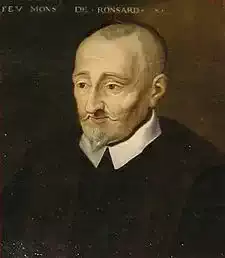
Pierre de Ronsard
 FR
FR
Pierre de Ronsard was a French Renaissance poet, considered one of the greatest lyricists in the French language. His work is marked by profound classical erudition, the exploration of themes such as love, the passage of time, and ephemeral beauty, and a formal rigor that established him as a master of poetry. He is a central figure of the Pléiade, a group of poets who sought to elevate the French language to a literary level comparable to Latin and Greek, through the imitation and adaptation of classical and Italian models.
n. 1524-09-11, La Possonnière Castle · m. 1585-12-27, La Riche
Bio
Identification and basic context
Pierre de Ronsard, named Count of Ronsard, was a French poet, widely considered the greatest lyric poet in France in the 16th century and one of the greatest in the French language. Born in 1524 or 1525, he died in 1585. He was the son of a nobleman and a member of the court, which allowed him access to an education and an influential career.Childhood and education
Born into a noble and influential family, Ronsard had a childhood marked by access to privileges. He received a meticulous education, which included learning Latin and Greek, and had contact with classical literature from an early age. A health problem that left him partially deaf, and which prevented him from pursuing a military career, directed his studies and his interest towards literature and the arts.Literary career
Ronsard's literary career began in his youth, with the publication of his early works that quickly brought him recognition. He was a central figure of the poetic group known as "La Pléiade," which aimed to ennoble the French language through the imitation and adaptation of classical and Italian models. Ronsard dedicated himself intensely to poetry, exploring various genres and forms, and maintained a constant output throughout his life, culminating in monumental works.Work, style, and literary characteristics
Work, style, and literary characteristics Ronsard's major works include "Odes" (1550), "Les Amours de Cassandre" (1552), "Les Sonnets pour Hélène" (1578), and "Poèmes" (1560). His recurring themes are love, the ephemerality of life and beauty ("carpe diem"), nature, time, and death. Formally, Ronsard mastered the sonnet and other fixed poetic forms, but also experimented with free verse. His language is rich in imagery, musicality, and mythological references, with a tone that varies from lyrical to elegiac, and even satirical. He is associated with the Renaissance movement and humanist lyricism.Work, style, and literary characteristics
Cultural and historical context Ronsard lived during a period of intense transformations in France, including the Wars of Religion between Catholics and Protestants. He maintained close relationships with the court and important figures of the time, such as King Charles IX, for whom he wrote poems. His position as a laureate poet conferred prestige upon him, but also exposed him to the political and religious tensions of his time. The European Renaissance, with its rediscovery of the classics and the flourishing of arts and humanities, was the backdrop to his work.Work, style, and literary characteristics
Personal life Ronsard's relationships were marked by his devotion to the court and his platonic loves, such as the one that inspired "Les Amours de Cassandre." His dedication to poetry was almost exclusive, although he received minor orders and a royal pension. His fragile health, especially his deafness, marked him deeply, but did not prevent him from leading an active intellectual life.Work, style, and literary characteristics
Recognition and reception During his lifetime, Ronsard was widely recognized as the "prince of French poets" and received honors and distinctions from the court. His work was admired by contemporaries and, despite a period of declining popularity after his death, was rediscovered and re-evaluated, consolidating his place in the French and European literary canon.Work, style, and literary characteristics
Influences and legacy Ronsard was influenced by Latin poets such as Horace and Virgil, and by Italian Petrarchism. He, in turn, influenced generations of French poets, especially during the periods of Classicism and Romanticism, and his legacy lies in the consolidation of the French poetic language and formal mastery. His work continues to be studied and admired for its beauty and depth.Work, style, and literary characteristics
Interpretation and critical analysis Ronsard's work is often analyzed from the perspective of the Renaissance ideal, courtly love, and reflection on the human condition in the face of time. His poetry explores the duality between idealized beauty and fleeting reality, universal themes that resonate with readers across the centuries.Work, style, and literary characteristics
Curiosities and lesser-known aspects A curious aspect is his partial deafness, which affected him from a young age and shaped part of his sensory and artistic experience. Despite his privileged position, Ronsard also showed a certain melancholy and reflection on the fragility of life, contrasting with the grandeur of his work.Work, style, and literary characteristics
Death and memory Pierre de Ronsard died in 1585, surrounded by honors. His memory was preserved through the continuous publication of his works and the recognition of his fundamental role in the history of French literature. He is remembered as one of the pillars of classical poetry in the French language.Poems
0No poems found
Quotes
7Comments (0)
No comments yet. Be the first to comment.