
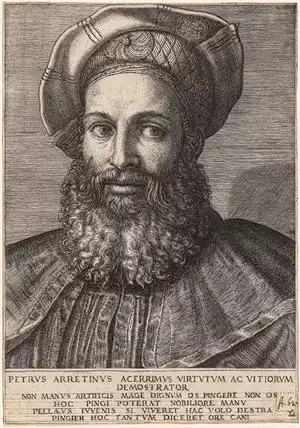
Pietro Aretino
 IT
IT
Pietro Aretino was a prominent figure of the Italian Renaissance, known for his wit, satirical writing, and his ability to navigate the intricate power circles of the time. Dubbed the "scourge of princes" due to his scathing criticisms and blackmail, Aretino built a unique literary career based on manipulating his reputation and producing texts that mixed poetry, prose, and correspondence. His work, although sometimes controversial, reflects a deep understanding of Renaissance society, its grandeur and its miseries. Aretino distinguished himself not only as a poet and writer but also as a master of self-promotion, using his pen to obtain patronage and influence public opinion.
n. 1492-04-20, Arezzo · m. 1556-10-21, Veneza
Bio
Identification and Basic Context
Pietro Aretino (1492-1556) was an Italian writer, playwright, and poet of the Renaissance, born in Arezzo. He gained notoriety and was feared for his sharp pen, being known as the "scourge of princes" and the "arch-satirist." His work spans erotic poetry, sonnets, letters, and comedies, often marked by a satirical, irreverent, and sometimes obscene tone.Childhood and Education
Details about Aretino's childhood are scarce, but it is known that he had a rudimentary education. He moved to Perugia at a young age, where he worked as a painter and learned to read and write, showing an early sharp intellect and a flair for writing. His education was largely self-taught, absorbing knowledge through reading and observing the world around him.Literary Career
Aretino began his literary career in Rome, where he quickly distinguished himself by his audacity and his talent for satire. He worked as a secretary to Agostino Chigi, an influential banker, and began producing poems and panegyrics that introduced him to artistic and noble circles. His fame spread rapidly, and he learned to use his writing to gain favors and notoriety. Later, he settled in Venice, a vibrant cultural center, where he continued his literary production and his activity as a "journalist" and "correspondent," maintaining a vast network of contacts across Europe. His work evolved from encomiastic poems to more aggressive satirical writings and letters that became models of style and cunning.Work, Style, and Literary Characteristics
Aretino's main works include the "Sonetti Lussuriosi" (Lustful Sonnets), which brought him infamy, the "Ragionamenti" (Discourses), a prose work in dialogue of erotic and satirical content, and his vast "Lettere" (Letters), which are a treasure trove of information about Renaissance life and society, as well as notable examples of Italian prose. The dominant themes in his work are love (often in an erotic and cynical way), social and political criticism, hypocrisy, ambition, and human nature. His style is characterized by liveliness, audacity, abundant use of colloquial and popular vocabulary, and incisive rhetoric. His poetic form varies, but the prose of his letters is remarkable for its fluidity and expressiveness. Aretino did not belong to a specific literary movement, but his work engages with Renaissance humanism while anticipating elements of satirical and journalistic literature. His innovation lies in how he used writing as a tool of power and self-promotion, and in the rawness with which he depicted society.Cultural and Historical Context
Pietro Aretino lived during the height of the Italian Renaissance, a period of great cultural, artistic, and political effervescence, but also of conflicts and instability. He skillfully navigated between papal courts, powerful families (like the Medici and Gonzaga), and renowned artists such as Leonardo da Vinci and Titian. His literary "generation" is marked by the exploration of the vernacular and the search for new forms of expression. Aretino was known for his ambiguous political positions, adapting to his patrons, but his writing frequently criticized the corruption and moral decay of the time. Renaissance society, with its complex networks of patronage, intrigue, and power, was the stage and source of inspiration for his work.Personal Life
Aretino's life was as colorful and controversial as his work. He had numerous love affairs and was the father of several children. His friendships included prominent figures such as Titian, who painted his portraits, and Pope Leo X, who initially sponsored him. However, his reputation as a blackmailer and his bold writing also created many enemies. He lived in Rome, Venice, and Mantua, always seeking patrons to support his expensive lifestyle. He was known for his vanity and his sharp intellect.Recognition and Reception
During his lifetime, Aretino enjoyed considerable but ambiguous fame. He was admired for his literary genius and wit but also feared and criticized for his harshness and moral conduct. He was crowned poet by Pope Clement VII, an official recognition of his talent. After his death, his work continued to be studied and read, especially his letters, which became a model of prose. His reputation as a master of satire and Italian prose endures to this day.Influences and Legacy
Aretino was influenced by classical literature and emerging Italian prose. In turn, he influenced many later writers with his direct style, thematic boldness, and mastery of the letter and satire. His legacy lies in how he demonstrated the power of writing in the public sphere and his contribution to the development of modern Italian prose. His figure is a fascinating example of how an author can shape their own image and use literature as an instrument of power and survival.Interpretation and Critical Analysis
Aretino's work has been the subject of critical debate due to its sometimes shocking content and questionable morality. However, modern critical analysis tends to recognize his importance as a keen observer of Renaissance society and a pioneer in the exploration of satire and vernacular prose. His ability to blend the high and the low, the sacred and the profane, makes him a complex and fascinating figure.Curiosities and Lesser-Known Aspects
Aretino was a master of self-promotion, even sending his own effigy to various European rulers. He had a particular talent for blackmail, often threatening to publish scandals if he did not receive bribes or patronage. His correspondence was so vast and influential that it functioned as a "news service" of the time.Death and Memory
Pietro Aretino died in Venice in 1556. The exact circumstances of his death are uncertain, but it is speculated that it was due to natural causes, possibly aggravated by his lifestyle. His memory endures as that of one of the most original and controversial writers of the Italian Renaissance, a master of satire and prose.Poems
0No poems found
Quotes
20Comments (0)
No comments yet. Be the first to comment.