
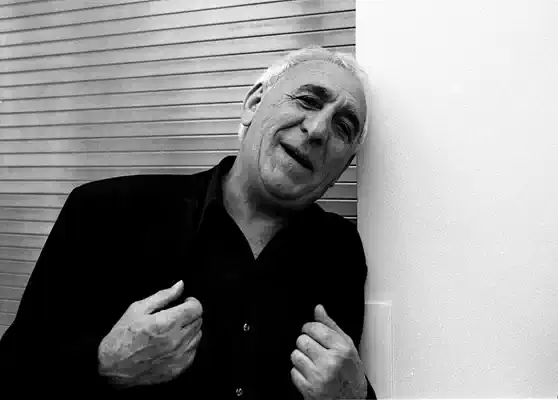
Raymond Federman
1928–2009
· lived 81 years
 FR
FR
FR
Raymond Federman was a French-born American novelist, poet, literary critic, and professor, known for his experimental writing and exploration of the boundaries of language and narrative. His work is marked by a deep interest in memory, identity, and the human condition, often with an autobiographical tone and a fragmented approach.
n. 1928-05-15, Montrouge · m. 2009-10-06, San Diego
22
Views
Bio
Identification and basic context
Raymond Federman, born Raymond Fœdermann, was a prominent French-born American novelist, poet, literary critic, and professor. He became known for his avant-garde writing and his exploration of the possibilities of language and narrative. His nationality was American, although he was born in France. The primary language of his writing was English.Childhood and education
Born in France, Federman lived through World War II and the Nazi occupation, experiences that profoundly marked his childhood and youth, shaping his sense of identity and his perspective on survival and memory. His academic education in the United States, where he emigrated, was fundamental to his development as a writer and academic.Literary career
Federman's literary career was characterized by a strong inclination towards formal and thematic experimentation. He began his career as an academic, but quickly dedicated himself to creative writing, exploring unconventional narrative forms. His work evolved over time, maintaining a common thread of questioning the nature of reality, language, and autobiography. He published poetry, fiction, and literary criticism, and was an active contributor to various academic and literary publications.Work, style, and literary characteristics
Federman's main works include novels such as "Double Negative", "Take It or Leave It", "The Voice in the Closet", and "Critique of Pure Redundancy". His dominant themes revolve around fragmented memory, identity in crisis, language as a constructor of reality, and the very nature of writing and reading. Federman is known for his use of free verse and poetic prose, with a style marked by repetition, wordplay, metafiction, and a non-linear and fragmented narrative structure. His poetic voice is often confessional and exploratory, reflecting an incessant search for meaning in a chaotic world. His language is dense, imagistic, and challenging, with a rich vocabulary and creative use of rhetorical devices.Work, style, and literary characteristics
Cultural and historical context Federman lived in a period of intense cultural and literary transformations, especially in the United States, where he became part of the experimental and postmodern writing landscape. His work engages with the tensions of the Cold War, post-war identity issues, and post-structuralism. He was a contemporary of other writers who explored the limits of language and narrative.Work, style, and literary characteristics
Personal life His personal experiences, particularly those lived during the war, had a profound impact on his writing, informing his themes of memory, trauma, and survival. His academic career as a professor of French and Comparative Literature in the United States also shaped his perspective on literary theory and writing practice.Work, style, and literary characteristics
Recognition and reception Federman was recognized for his contribution to experimental and postmodern literature. Although his work, due to its challenging nature, did not reach a mass audience, it was widely respected in academic circles and among writers who value formal and thematic innovation. He received several honors and distinctions throughout his career.Work, style, and literary characteristics
Influences and legacy Federman was influenced by authors such as Samuel Beckett and Alain Robbe-Grillet, pioneers of the Nouveau Roman and experimental writing. His legacy lies in his audacious exploration of the possibilities of fiction, in the way he questioned the authority of narrative, and in his insistence on language as a field of play and discovery. He influenced generations of writers who ventured into experimental and metafictional writing.Work, style, and literary characteristics
Interpretation and critical analysis Federman's work is often analyzed from the perspective of metafiction, post-structuralist theory, and studies on memory and trauma. His narratives challenge the reader to confront the subjective nature of reality and the relationship between language, identity, and existence. Critical debates often focus on his fragmented approach and his exploration of redundancy and silence in writing.Work, style, and literary characteristics
Curiosities and lesser-known aspects A curiosity about Federman is his insistence on questioning the very notion of author and authorship, often subverting autobiographical conventions. His dedication to exploring the limits of language and narrative can be seen as a reflection of his own search for meaning in a world that seemed inherently chaotic to him.Work, style, and literary characteristics
Death and memory Raymond Federman passed away, but his work continues to be studied and celebrated, ensuring his memory through his literary and academic contributions. Posthumous publications and reissues of his works continue to keep his legacy alive.Poems
0No poems found
Comments (0)
Log in
to post a comment.
No comments yet. Be the first to comment.