
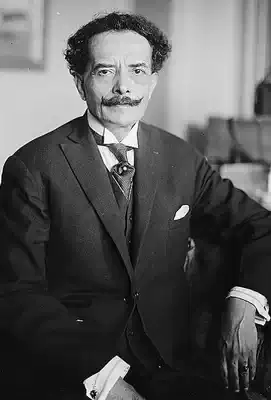
Ricardo Jaimes Freyre
 --
--
Ricardo Jaimes Freyre was a prominent Bolivian poet, essayist, and diplomat, a key figure in Hispano-American literary Modernism. His poetic work, marked by musicality, subjectivity, and a deep exploration of themes such as love, melancholy, and nature, is fully integrated into the aesthetic currents of the late 19th and early 20th centuries. As an essayist, he addressed literary criticism and social issues of his time, advocating for a renewed vision of literature and culture. His diplomatic work allowed him to disseminate Bolivian culture abroad, consolidating his figure as an intellectual with continental reach.
n. 1868-05-12, Tacna · m. 1933-04-24, Buenos Aires
Bio
Identification and basic context
Ricardo Jaimes Freyre was a Bolivian poet, essayist, literary critic, and diplomat, considered one of the most important figures of Hispano-American Modernism. He was born in Tacna, Viceroyalty of Peru (present-day Peru), on May 23, 1868, and died in Buenos Aires, Argentina, on June 17, 1933. Although born on Peruvian soil, his ancestry and life were strongly linked to Bolivia, a country he represented diplomatically. He wrote primarily in Spanish. He lived in a period of profound social and political changes in Latin America, marked by the consolidation of republics and the search for national identity.Childhood and education
As a young man, Jaimes Freyre moved to Bolivia, where he completed his education. He studied at the Liceo de La Paz and later at the Universidad Mayor de San Francisco Xavier de Chuquisaca, where he graduated as a lawyer. His intellectual formation was influenced by European literary currents, especially French Parnassianism and Symbolism, and by the liberal and positivist ideas that predominated at the time.Literary career
Jaimes Freyre's literary career began in his youth, publishing poems and articles in newspapers and magazines in Bolivia and Argentina. He moved to Buenos Aires in 1893, where he developed much of his career. There, he associated with important figures in the literary and political world, and became a reference point for Modernism. He was director of the National Library of Buenos Aires and served as a diplomat, representing Bolivia in various countries. He published important poetry collections such as "Lirismo" (1896) and "Castalia" (1901), as well as critical essays.Work, style, and literary characteristics
Jaimes Freyre's poetry is characterized by its pursuit of formal beauty, the musicality of verse, and the exploration of themes such as love, melancholy, solitude, nature, and mythology. His style is elegant, refined, and often introspective, with clear influences from Symbolism and Parnassianism. He masterfully used classical metrical forms and free verse. His essayistic work, present in "Doctrinas literarias" (1908), addresses modernist aesthetics and literary criticism, advocating for the renovation of language and form in Hispano-American literature.Cultural and historical context
Jaimes Freyre was a key exponent of Hispano-American Modernism, a movement that sought aesthetic and linguistic renewal in the Spanish language literature, drawing inspiration from European models while simultaneously seeking a unique voice for America. He lived in a period of great cultural and political effervescence on the continent, and his work reflects the search for identity and modernity. His diplomatic work allowed him to serve as a bridge between Bolivia and other countries, especially Argentina, where he became a respected figure.Personal life
Jaimes Freyre had a life dedicated to literature and diplomacy. His move to Buenos Aires allowed him to integrate into one of the most important cultural centers of Hispanic America. He maintained a close relationship with other modernist writers, and his figure was respected for both his literary work and his professional endeavors. He dedicated a significant part of his life to cultural management and the dissemination of literature.Recognition and reception
Jaimes Freyre's recognition as a modernist poet was significant in his time, especially in the literary circles of Buenos Aires. His poetic work, although sometimes overshadowed by authors like Rubén Darío, is considered fundamental to understanding the evolution of Modernism. His critical essays were also valued for their sharpness and depth.Influences and legacy
He was influenced by poets such as Paul Verlaine, Stéphane Mallarmé, and Théophile Gautier, as well as by the work of Rubén Darío. In turn, his poetry influenced subsequent generations of Bolivian and Latin American poets who sought aesthetic renewal. His legacy lies in his contribution to the consolidation of Modernism and in the quality of his lyrical work.Interpretation and critical analysis
Jaimes Freyre's work has been analyzed from various perspectives, highlighting his formal mastery, his lyricism, and his contribution to the standardization of literary language. He is recognized for his ability to fuse classical tradition with the innovations of literary modernity.Childhood and education
Although less known than other modernists, Jaimes Freyre was a prolific essayist and critic, whose intellectual work complemented his poetic output. His dedication to diplomacy demonstrates his commitment to Bolivia's cultural projection.Death and memory
Ricardo Jaimes Freyre died in Buenos Aires in 1933. His work continues to be studied and valued as an important part of Bolivian literary heritage and Hispano-American Modernism.Poems
0No poems found
Videos
50
Comments (0)
No comments yet. Be the first to comment.