
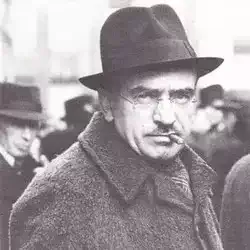
Richard Minne
 BE
BE
Richard Minne was a Belgian poet and translator, known for his work that frequently explored existentialist themes and for his deep connection to the Flemish language and culture. His poetic compositions are notable for their introspection and reflection on the human condition, addressing the transience of time and the search for meaning in a constantly changing world. Throughout his career, Minne also dedicated himself to translation, making works by other authors accessible to the Flemish public, which demonstrates his commitment to cultural dissemination. His poetry, though sometimes melancholic, is marked by formal beauty and depth of thought that have secured him a prominent place in Belgian literature.
n. 1891-11-30, Bruges · m. 1965-06-01, Bruges
Bio
Identification and Basic Context
Richard Minne was a Dutch-language Belgian poet, translator, and essayist. He was born on September 11, 1897, in Ghent, Belgium, and died on October 15, 1985, in Bruges, also in Belgium. Pseudonyms or heteronyms are not widely documented for Minne. His family background came from the middle class in Ghent, an important cultural and economic center in Flanders. He was of Belgian nationality and wrote in Dutch (Flemish). He lived through much of the 20th century, a period marked by two World Wars, the rise and fall of ideologies, and profound social and cultural transformations in Europe.Childhood and Education
Minne's childhood took place in a Flanders undergoing cultural and linguistic affirmation. His formal education took place in Ghent, where he likely came into contact with the rich Flemish literary tradition. Early influences on his work certainly include Symbolist poetry and the existentialist philosophical currents that were gaining strength in Europe. Literary movements such as Impressionism and Symbolism may have played a role in his formation, as well as a propensity for philosophical reflection on existence.Literary Career
Richard Minne began his literary activity as a poet, with a body of work that evolved over time, maintaining a line of introspection and existential reflection. His poetic output spanned several decades, reflecting his concerns with the passage of time, mortality, and the search for meaning. He collaborated in various Flemish literary publications, contributing to the region's cultural vitality. In addition to his poetic work, Minne dedicated himself intensely to translating poetry and prose from other languages into Dutch, including French and German authors.Work, Style, and Literary Characteristics
Richard Minne's best-known work includes poetry collections such as "De Heilige Stad" (The Holy City) and "De Eeuwige Terugkeer" (The Eternal Return), although precise production dates for each individual work require consultation of specific studies. The dominant themes in his poetry are the ephemerality of life, death, time, solitude, the search for transcendence, and reflection on the human condition. Minne explored various poetic forms, but he is often associated with restrained lyricism and careful language, with an introspective rhythm. His style is characterized by philosophical depth, contemplative melancholy, and a certain formal austerity, avoiding ornamental excesses. The poetic voice is often confessional and universal, reflecting the anxieties and questions of the modern individual. The language is precise, sometimes dense, with a strong imagistic and evocative charge. Minne did not seek to introduce radical formal innovations, but rather to deepen the expression of complex feelings and thoughts within a literary tradition that valued clarity and depth. He was associated with Flemish modernism but always maintained a stylistic individuality marked by his existential outlook.Work, Style, and Literary Characteristics
Cultural and Historical Context Richard Minne lived in a period of intense cultural and political activity in Belgium and Europe. His work reflects the uncertainties and dramas of the 20th century, including two World Wars, which undoubtedly had an impact on his worldview and his understanding of humanity. He belonged to a generation of Flemish writers who sought to assert the cultural identity of their region. His philosophical stance leaned towards existentialism, exploring the fragility of human existence and the absence of definitive answers.Work, Style, and Literary Characteristics
Personal Life Details about Richard Minne's personal life are less prominent in his public literary biography, but it is known that he maintained an intense dedication to his poetic work and his translation activities. His emotional and familial relationships certainly shaped his worldview, but specific details that directly influenced his work are not widely disclosed. His life appears to have been primarily dedicated to his intellectual and literary work.Work, Style, and Literary Characteristics
Recognition and Reception Richard Minne is recognized as an important poet in 20th-century Flemish literature. His work received distinctions and recognition throughout his career and after his death. Although he may not have achieved the international fame of other European poets, his legacy within Dutch-language literature is consolidated. His poetry continues to be studied and appreciated for its depth and lyrical quality.Work, Style, and Literary Characteristics
Influences and Legacy Influences on Richard Minne include Symbolist poets and existentialist thinkers. His work, in turn, influenced later generations of Flemish poets through his introspective approach and his careful language. Minne is an important name in the Flemish literary canon, and his poetry has been the subject of academic studies. The international dissemination of his work is limited, but his importance to Dutch-language literature is undeniable.Work, Style, and Literary Characteristics
Interpretation and Critical Analysis Richard Minne's work has been interpreted in light of existentialist philosophical currents, exploring themes such as finitude, the anguish of existence, and the search for meaning. His reflections on time and mortality offer a rich field for critical analysis, confronting human fragility with the permanence of the universe. Possible readings of his poetry range from a melancholic perspective to a resilient search for meaning.Work, Style, and Literary Characteristics
Curiosities and Lesser-Known Aspects Some lesser-known aspects of Richard Minne's personality may be linked to his almost monastic dedication to writing and translation. His life seems to have been marked by profound seriousness and a constant intellectual pursuit. Details about specific writing habits or creative rituals are not widely disclosed, but his work suggests a thoughtful and introspective creative process.Work, Style, and Literary Characteristics
Death and Memory Richard Minne passed away in 1985, leaving a significant legacy in Flemish poetry. Posthumous publications may have included compilations of his work or unpublished material, contributing to the perpetuation of his memory and to a more in-depth study of his literary journey. His name is remembered as one of the most important Dutch-language poets of the 20th century.Poems
0No poems found
Comments (0)
No comments yet. Be the first to comment.