
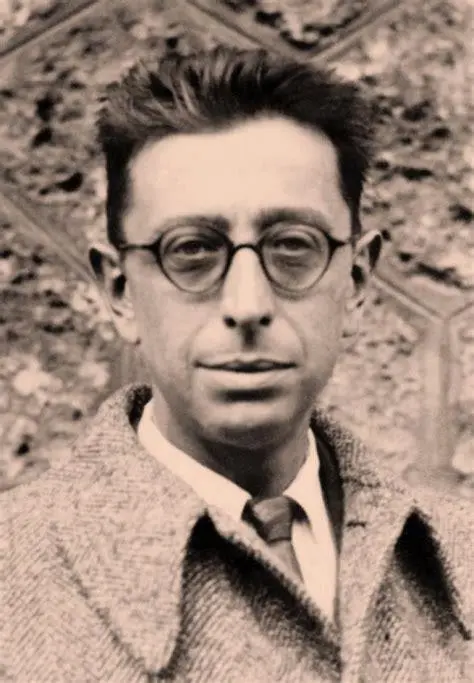
Robert Desnos
 FR
FR
Robert Desnos was a French surrealist poet, a central figure of the movement, known for his exploration of the unconscious, dreams, and psychic automatism in writing. His poetry is marked by formal freedom, prodigious imagination, and a frequently dreamlike and visionary tone. Desnos also distinguished himself through his active participation in the French Resistance during World War II, which cost him his life. He is remembered as one of the great French poets of the 20th century, whose work continues to fascinate with its originality and depth.
n. 1900-07-04, 11.º arrondissement de Paris · m. 1945-06-08, Theresienstadt
Bio
Identification and Basic Context
Robert Desnos was a French poet, journalist, and resistance fighter, born on July 11, 1900, in Paris and died on June 8, 1945, in Theresienstadt. He was the son of Jean-Georges Desnos and Marie-Adèle Desnos. Known for his surrealist work, Desnos was one of the most important poets of the movement, exploring the limits of language and consciousness. He was a French citizen.Childhood and Education
Desnos attended Lycée Charlemagne in Paris. After completing his studies, he worked in various professions, including that of a pharmacist. From an early age, he showed a talent for writing and a deep intellectual curiosity, being strongly influenced by the literary and philosophical currents of his time.Literary Career
His literary career began with the publication of poems in newspapers and magazines. Desnos joined the surrealist movement in 1922, becoming a central figure and one of its most ardent defenders. He was famous for his ability in a trance state, during which he produced automatic texts of great originality. His poetic work evolved over time, always maintaining a strong connection with surrealism, but developing a personal and innovative style. He collaborated intensely with the magazine "La Révolution surréaliste".Work, Style, and Literary Characteristics
Among his most important works are "Sirius" (1920-1930, published posthumously), "Corps et Biens" (1930), "La Liberté ou l'Amour!" (1927), and "Fortunes" (1945). His poetry explores themes of love, dreams, the unconscious, freedom, and metamorphosis. Desnos's style is characterized by formal freedom, vibrant rhythm, an abundance of surprising images, and the exploration of the absurd and the marvelous. He masterfully used free verse, creating a transgressive and innovative language. His poetic voice is often visionary, confessional, and charged with a strong erotic and mystical charge. Desnos was one of the pioneers in the poetic exploration of psychic automatism, influencing many surrealist poets.Cultural and Historical Context
Robert Desnos lived during a turbulent period in European history, marked by two World Wars. He was an active participant in the surrealist movement, which emerged after World War I as a response to the rationality that, in its view, had led to catastrophe. The rise of Nazism and the occupation of France had a profound impact on his life. Desnos was a friend and contemporary of André Breton, Louis Aragon, and Paul Éluard, with whom he shared surrealist ideals. His political stance, initially aligned with the left and later with the anti-fascist resistance, marked his life and work.Personal Life
Desnos had significant relationships with women who were also important figures in the surrealist milieu, such as Simone Breton and later Youki Desnos, his wife. His life was marked by a passion for poetry, freedom, and the fight against oppression. During World War II, he joined the French Resistance, using his writing talent in clandestine missions. His courage and idealism were striking characteristics of his personality.Recognition and Reception
During his lifetime, Desnos was a respected poet in surrealist circles, but his broader recognition, especially academic, would come posthumously. His work was rediscovered and valued in the decades following his death, and he is today considered one of the great poets of surrealism and 20th-century French literature. His ability to transfigure reality through dreams and the unconscious secured him a unique place in the history of poetry.Influences and Legacy
Desnos was influenced by poets such as Arthur Rimbaud and Lautréamont, and by Freudian psychoanalysis. In turn, he influenced countless surrealist and later poets with his radical exploration of language and the unconscious. His legacy lies in his poetic audacity, his ability to merge the real and the unreal, and his testament to courage and resistance. His work continues to be studied and admired for its originality and visionary power.Interpretation and Critical Analysis
Desnos's work has been the subject of critical analysis focused on his exploration of the unconscious, eroticism, and freedom. His experiments with hypnotic sleep and automatic writing are central to interpretations of his poetry, seen as a bridge between the inner and outer worlds. His work raises questions about the nature of reality, identity, and desire.Curiosities and Lesser-Known Aspects
One of Desnos's most well-known facets is his ability to enter a trance state and produce remarkable automatic texts. This skill led some to see him as a surrealist "medium." During the war, he used pseudonyms and contact networks for his Resistance activities. His death in a concentration camp is one of the most tragic and emblematic episodes of Nazi repression against intellectuals.Death and Memory
Robert Desnos died of typhus in the Theresienstadt concentration camp, a few months after its liberation. His death represented an immeasurable loss to literature and the surrealist movement. The posthumous publication of much of his work, such as "Sirius," allowed his genius to be fully recognized and his memory as a poet and resistance fighter to be perpetuated.Poems
0No poems found
Quotes
1No poems found
Comments (0)
No comments yet. Be the first to comment.