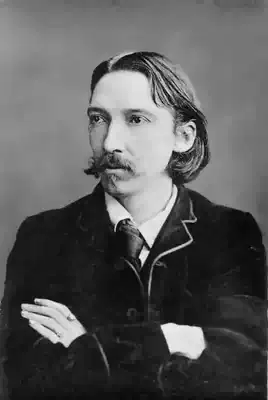
Robert Louis Stevenson

Robert Louis Stevenson

1850–1894 · lived 44 years GB GB

Robert Louis Stevenson was a Scottish poet, novelist, and travel writer, best known for "Treasure Island" and "Strange Case of Dr Jekyll and Mr Hyde." His work often explores themes of duality, adventure, and the supernatural, blending romanticism with a keen psychological insight. Stevenson's vivid prose and compelling narratives have secured his place as a significant figure in English literature.

n. 1850-11-13, Edimburgo · m. 1894-12-03, Vailima

41,571 Views

You Looked So Tempting In The Pew

You Looked So Tempting In The Pew
YOU looked so tempting in the pew,
You looked so sly and calm -
My trembling fingers played with yours
As both looked out the Psalm.
Your heart beat hard against my arm,
My foot to yours was set,
Your loosened ringlet burned my cheek
Whenever they two met.
O little, little we hearkened, dear,
And little, little cared,
Although the parson sermonised,
The congregation stared.
Read full poem
Bio

Identification and basic context

Robert Louis Balfour Stevenson was a prolific Scottish writer. He is celebrated for his novels, novellas, poems, and travel writings. His most famous works include "Treasure Island," "Strange Case of Dr Jekyll and Mr Hyde," and "Kidnapped." Stevenson's writing often delves into the complexities of human nature, the allure of adventure, and the darker aspects of the psyche. His contributions span various genres, leaving a lasting impact on literature.

Childhood and education

Born into a family of prominent civil engineers, Stevenson's early life was marked by a frail constitution and frequent illnesses, including respiratory problems. Despite his physical challenges, he received a rigorous education. He attended the University of Edinburgh, initially studying engineering and then law, though his passion for writing led him to pursue literature. His childhood was filled with stories and a vivid imagination, which would later fuel his creative endeavors. He was exposed to a wide range of literature and intellectual discussions within his family and social circles.

Literary trajectory

Stevenson's literary career began to gain momentum in the 1870s. His early works included essays and travelogues, such as "An Inland Voyage" and "Travels with a Donkey in the Cévennes." He gained significant recognition with the publication of "Treasure Island" in 1883, followed by "Strange Case of Dr Jekyll and Mr Hyde" in 1886. His output was prolific, encompassing novels, short stories, poetry, and essays. His work evolved over time, moving from travel writing and essays to powerful fictional narratives that explored moral and psychological themes. He also contributed to various periodicals and collaborated on plays.

Works, style, and literary characteristics

Stevenson's major works include "Treasure Island" (1883), "Strange Case of Dr Jekyll and Mr Hyde" (1886), "Kidnapped" (1886), and "The Master of Ballantrae" (1889). His dominant themes often revolve around adventure, morality, the duality of human nature, the supernatural, and the exotic. His style is characterized by clarity, vivid imagery, and a strong narrative drive. He masterfully employed storytelling techniques, creating memorable characters and compelling plots. His poetic works, such as "A Child's Garden of Verses," showcase a different, more lyrical and imaginative side. He was adept at creating suspense and exploring psychological depths within his characters. His language is precise and evocative, contributing to the immersive quality of his stories. While often associated with adventure fiction, his works also carry profound philosophical and moral undertones.

Cultural and historical context

Stevenson lived during the Victorian era, a period of significant social, industrial, and intellectual change in Britain. His work often reflects the era's fascination with exploration, empire, and the contrasting forces of progress and tradition. He was part of a literary scene that included contemporaries like George Meredith and Andrew Lang. His adventurous spirit and extensive travels also positioned him as a chronicler of different cultures and landscapes, engaging with the burgeoning interest in anthropology and geography of his time. His exploration of the darker side of human nature and societal hypocrisy can be seen as a commentary on the complexities of Victorian society.

Personal life

Stevenson's personal life was marked by his ongoing struggles with ill health, which significantly influenced his writing and his choice of residence. He married Fanny Vandegrift Osbourne, an American woman he met in France. Their relationship was a source of support and inspiration for him. His travels, often undertaken in search of a healthier climate, led him to live in various parts of the world, including the United States, Samoa, and the South Pacific. These experiences deeply enriched his understanding of different cultures and provided settings for his later works. He maintained friendships with other writers and artists, though his health often limited his social engagements.

Recognition and reception

During his lifetime, Stevenson achieved considerable fame and critical acclaim, particularly for his adventure novels. He was recognized as a significant literary voice of his generation. Posthumously, his reputation continued to grow, cementing his status as a classic author. His works have been widely translated and have remained consistently in print, appealing to both young and adult readers. While some critics have focused on his adventure elements, others have delved into the deeper psychological and philosophical aspects of his writing.

Influences and legacy

Stevenson was influenced by a range of authors, including Sir Walter Scott, Charles Dickens, and Edgar Allan Poe. His own work, in turn, has had a profound influence on countless writers, particularly in the genres of adventure, gothic, and children's literature. His innovative narrative techniques and explorations of character have left an indelible mark on storytelling. "Treasure Island" remains a cornerstone of adventure fiction, and "Dr Jekyll and Mr Hyde" has become a cultural touchstone for exploring themes of duality. His legacy endures through his enduring popularity and his continued presence in educational curricula and popular culture.

Interpretation and critical analysis

Stevenson's works are often analyzed for their exploration of moral dilemmas, the conflict between civilization and savagery, and the nature of identity. The duality presented in "Dr Jekyll and Mr Hyde" has been interpreted in various ways, from psychoanalytic perspectives to broader social commentary on repression and freedom. Critics often examine his use of symbolism, his engagement with themes of the uncanny, and his ability to create gripping narratives that also provoke thought. His exploration of the exotic and the 'other' in works like "The Beach of Falesá" also invites critical discussion regarding colonialism and cultural representation.

Curiosities and lesser-known aspects

Stevenson was known for his distinctive appearance, often wearing a velvet jacket and a jaunty hat. He had a lifelong fascination with the macabre and the supernatural, which informed much of his fiction. His intense desire to write and create, despite his chronic ill health, is a testament to his determination. He was also a keen observer of human nature and social customs, which he captured vividly in his writings. His nomadic lifestyle, dictated by his health, allowed him to experience a wide array of environments and cultures, shaping his unique perspective.

Death and memory

Robert Louis Stevenson died of a cerebral hemorrhage in 1894. He was buried on Mount Vaea in Samoa, overlooking the Pacific Ocean. His tomb is marked by an inscription of his own poem, "Requiem." His death was mourned by many, and his legacy has been preserved through his enduring literary works, which continue to be read, studied, and adapted worldwide.

Poems

108

The Summer Sun Shone Round Me

The Summer Sun Shone Round Me
THE summer sun shone round me,
The folded valley lay
In a stream of sun and odour,
That sultry summer day.
The tall trees stood in the sunlight
As still as still could be,
But the deep grass sighed and rustled
And bowed and beckoned me.
The deep grass moved and whispered
And bowed and brushed my face.
It whispered in the sunshine:
"The winter comes apace."
358

The Swing

The Swing
How do you like to go up in a swing,
Up in the air so blue?
Oh, I do think it the pleasantest thing
Ever a child can do!
Up in the air and over the wall,
Till I can see so wide,
River and trees and cattle and all
Over the countryside--
Till I look down on the garden green,
Down on the roof so brown--
Up in the air I go flying again,
Up in the air and down!
339

The Piper

The Piper
AGAIN I hear you piping, for I know the tune so well, -
You rouse the heart to wander and be free,
Tho' where you learned your music, not the God of song can tell,
For you pipe the open highway and the sea.
O piper, lightly footing, lightly piping on your way,
Tho' your music thrills and pierces far and near,
I tell you you had better pipe to someone else to-day,
For you cannot pipe my fancy from my dear.
You sound the note of travel through the hamlet and the town;
You would lure the holy angels from on high;
And not a man can hear you, but he throws the hammer down
And is off to see the countries ere he die.
But now no more I wander, now unchanging here I stay;
By my love, you find me safely sitting here:
And pipe you ne'er so sweetly, till you pipe the hills away,
You can never pipe my fancy from my dear.
369

The Moon

The Moon
The moon has a face like the clock in the hall;
She shines on thieves on the garden wall,
On streets and fields and harbour quays,
And birdies asleep in the forks of the trees.
The squalling cat and the squeaking mouse,
The howling dog by the door of the house,
The bat that lies in bed at noon,
All love to be out by the light of the moon.
But all of the things that belong to the day
Cuddle to sleep to be out of her way;
And flowers and children close their eyes
Till up in the morning the sun shall arise.
657

The Land of Counterpane

The Land of Counterpane
When I was sick and lay a-bed,
I had two pillows at my head,
And all my toys beside me lay,
To keep me happy all the day.
And sometimes for an hour or so
I watched my leaden soldiers go,
With different uniforms and drills,
Among the bed-clothes, through the hills;
And sometimes sent my ships in fleets
All up and down among the sheets;
Or brought my trees and houses out,
And planted cities all about.
I was the giant great and still
That sits upon the pillow-hill,
And sees before him, dale and plain,
The pleasant land of counterpane.
348

The Land of Story-Books

The Land of Story-Books
At evening when the lamp is lit,
Around the fire my parents sit;
They sit at home and talk and sing,
And do not play at anything.
Now, with my little gun, I crawl
All in the dark along the wall,
And follow round the forest track
Away behind the sofa back.
There, in the night, where none can spy,
All in my hunter's camp I lie,
And play at books that I have read
Till it is time to go to bed.
These are the hills, these are the woods,
These are my starry solitudes;
And there the river by whose brink
The roaring lions come to drink.
I see the others far away
As if in firelit camp they lay,
And I, like to an Indian scout,
Around their party prowled about.
So when my nurse comes in for me,
Home I return across the sea,
And go to bed with backward looks
At my dear land of Story-books.
395

The Hayloft

The Hayloft
Through all the pleasant meadow-side
The grass grew shoulder-high,
Till the shining scythes went far and wide
And cut it down to dry.
Those green and sweetly smelling crops
They led the waggons home;
And they piled them here in mountain tops
For mountaineers to roam.
Here is Mount Clear, Mount Rusty-Nail,
Mount Eagle and Mount High;--
The mice that in these mountains dwell,
No happier are than I!
Oh, what a joy to clamber there,
Oh, what a place for play,
With the sweet, the dim, the dusty air,
The happy hills of hay!
313

The Flowers

The Flowers
All the names I know from nurse:
Gardener's garters, Shepherd's purse,
Bachelor's buttons, Lady's smock,
And the Lady Hollyhock.
Fairy places, fairy things,
Fairy woods where the wild bee wings,
Tiny trees for tiny dames--
These must all be fairy names!
Tiny woods below whose boughs
Shady fairies weave a house;
Tiny tree-tops, rose or thyme,
Where the braver fairies climb!
Fair are grown-up people's trees,
But the fairest woods are these;
Where, if I were not so tall,
I should live for good and all.
293

The Clock's Clear Voice Into The Clearer Air

The Clock's Clear Voice Into The Clearer Air
THE cock's clear voice into the clearer air
Where westward far I roam,
Mounts with a thrill of hope,
Falls with a sigh of home.
A rural sentry, he from farm and field
The coming morn descries,
And, mankind's bugler, wakes
The camp of enterprise.
He sings the morn upon the westward hills
Strange and remote and wild;
He sings it in the land
Where once I was a child.
He brings to me dear voices of the past,
The old land and the years:
My father calls for me,
My weeping spirit hears.
Fife, fife, into the golden air, O bird,
And sing the morning in;
For the old days are past
And new days begin.
381

The Dumb Soldier

The Dumb Soldier
When the grass was closely mown,
Walking on the lawn alone,
In the turf a hole I found
And hid a soldier underground.
Spring and daisies came apace;
Grasses hid my hiding-place;
Grasses run like a green sea
O'er the lawn up to my knee.
Under grass alone he lies,
Looking up with leaden eyes,
Scarlet coat and pointed gun,
To the stars and to the sun.
When the grass is ripe like grain,
When the scythe is stoned again,
When the lawn is shaven clear,
Then my hole shall reappear.
I shall find him, never fear,
I shall find my grenadier;
But, for all that's gone and come,
I shall find my soldier dumb.
He has lived, a little thing,
In the grassy woods of spring;
Done, if he could tell me true,
Just as I should like to do.
He has seen the starry hours
And the springing of the flowers;
And the fairy things that pass
In the forests of the grass.
In the silence he has heard
Talking bee and ladybird,
And the butterfly has flown
O'er him as he lay alone.
Not a word will he disclose,
Not a word of all he knows.
I must lay him on the shelf,
And make up the tale myself.
327

Quotes

40

Videos

50

Comments (0)

Share
Log in to post a comment.

No comments yet. Be the first to comment.