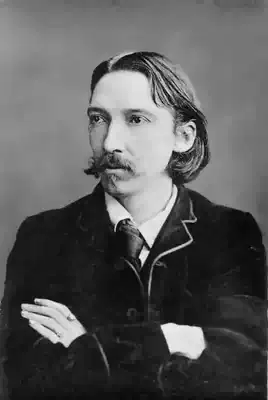
Robert Louis Stevenson

Robert Louis Stevenson

1850–1894 · lived 44 years GB GB

Robert Louis Stevenson was a Scottish poet, novelist, and travel writer, best known for "Treasure Island" and "Strange Case of Dr Jekyll and Mr Hyde." His work often explores themes of duality, adventure, and the supernatural, blending romanticism with a keen psychological insight. Stevenson's vivid prose and compelling narratives have secured his place as a significant figure in English literature.

n. 1850-11-13, Edimburgo · m. 1894-12-03, Vailima

41,576 Views

You Looked So Tempting In The Pew

You Looked So Tempting In The Pew
YOU looked so tempting in the pew,
You looked so sly and calm -
My trembling fingers played with yours
As both looked out the Psalm.
Your heart beat hard against my arm,
My foot to yours was set,
Your loosened ringlet burned my cheek
Whenever they two met.
O little, little we hearkened, dear,
And little, little cared,
Although the parson sermonised,
The congregation stared.
Read full poem
Bio

Identification and basic context

Robert Louis Balfour Stevenson was a prolific Scottish writer. He is celebrated for his novels, novellas, poems, and travel writings. His most famous works include "Treasure Island," "Strange Case of Dr Jekyll and Mr Hyde," and "Kidnapped." Stevenson's writing often delves into the complexities of human nature, the allure of adventure, and the darker aspects of the psyche. His contributions span various genres, leaving a lasting impact on literature.

Childhood and education

Born into a family of prominent civil engineers, Stevenson's early life was marked by a frail constitution and frequent illnesses, including respiratory problems. Despite his physical challenges, he received a rigorous education. He attended the University of Edinburgh, initially studying engineering and then law, though his passion for writing led him to pursue literature. His childhood was filled with stories and a vivid imagination, which would later fuel his creative endeavors. He was exposed to a wide range of literature and intellectual discussions within his family and social circles.

Literary trajectory

Stevenson's literary career began to gain momentum in the 1870s. His early works included essays and travelogues, such as "An Inland Voyage" and "Travels with a Donkey in the Cévennes." He gained significant recognition with the publication of "Treasure Island" in 1883, followed by "Strange Case of Dr Jekyll and Mr Hyde" in 1886. His output was prolific, encompassing novels, short stories, poetry, and essays. His work evolved over time, moving from travel writing and essays to powerful fictional narratives that explored moral and psychological themes. He also contributed to various periodicals and collaborated on plays.

Works, style, and literary characteristics

Stevenson's major works include "Treasure Island" (1883), "Strange Case of Dr Jekyll and Mr Hyde" (1886), "Kidnapped" (1886), and "The Master of Ballantrae" (1889). His dominant themes often revolve around adventure, morality, the duality of human nature, the supernatural, and the exotic. His style is characterized by clarity, vivid imagery, and a strong narrative drive. He masterfully employed storytelling techniques, creating memorable characters and compelling plots. His poetic works, such as "A Child's Garden of Verses," showcase a different, more lyrical and imaginative side. He was adept at creating suspense and exploring psychological depths within his characters. His language is precise and evocative, contributing to the immersive quality of his stories. While often associated with adventure fiction, his works also carry profound philosophical and moral undertones.

Cultural and historical context

Stevenson lived during the Victorian era, a period of significant social, industrial, and intellectual change in Britain. His work often reflects the era's fascination with exploration, empire, and the contrasting forces of progress and tradition. He was part of a literary scene that included contemporaries like George Meredith and Andrew Lang. His adventurous spirit and extensive travels also positioned him as a chronicler of different cultures and landscapes, engaging with the burgeoning interest in anthropology and geography of his time. His exploration of the darker side of human nature and societal hypocrisy can be seen as a commentary on the complexities of Victorian society.

Personal life

Stevenson's personal life was marked by his ongoing struggles with ill health, which significantly influenced his writing and his choice of residence. He married Fanny Vandegrift Osbourne, an American woman he met in France. Their relationship was a source of support and inspiration for him. His travels, often undertaken in search of a healthier climate, led him to live in various parts of the world, including the United States, Samoa, and the South Pacific. These experiences deeply enriched his understanding of different cultures and provided settings for his later works. He maintained friendships with other writers and artists, though his health often limited his social engagements.

Recognition and reception

During his lifetime, Stevenson achieved considerable fame and critical acclaim, particularly for his adventure novels. He was recognized as a significant literary voice of his generation. Posthumously, his reputation continued to grow, cementing his status as a classic author. His works have been widely translated and have remained consistently in print, appealing to both young and adult readers. While some critics have focused on his adventure elements, others have delved into the deeper psychological and philosophical aspects of his writing.

Influences and legacy

Stevenson was influenced by a range of authors, including Sir Walter Scott, Charles Dickens, and Edgar Allan Poe. His own work, in turn, has had a profound influence on countless writers, particularly in the genres of adventure, gothic, and children's literature. His innovative narrative techniques and explorations of character have left an indelible mark on storytelling. "Treasure Island" remains a cornerstone of adventure fiction, and "Dr Jekyll and Mr Hyde" has become a cultural touchstone for exploring themes of duality. His legacy endures through his enduring popularity and his continued presence in educational curricula and popular culture.

Interpretation and critical analysis

Stevenson's works are often analyzed for their exploration of moral dilemmas, the conflict between civilization and savagery, and the nature of identity. The duality presented in "Dr Jekyll and Mr Hyde" has been interpreted in various ways, from psychoanalytic perspectives to broader social commentary on repression and freedom. Critics often examine his use of symbolism, his engagement with themes of the uncanny, and his ability to create gripping narratives that also provoke thought. His exploration of the exotic and the 'other' in works like "The Beach of Falesá" also invites critical discussion regarding colonialism and cultural representation.

Curiosities and lesser-known aspects

Stevenson was known for his distinctive appearance, often wearing a velvet jacket and a jaunty hat. He had a lifelong fascination with the macabre and the supernatural, which informed much of his fiction. His intense desire to write and create, despite his chronic ill health, is a testament to his determination. He was also a keen observer of human nature and social customs, which he captured vividly in his writings. His nomadic lifestyle, dictated by his health, allowed him to experience a wide array of environments and cultures, shaping his unique perspective.

Death and memory

Robert Louis Stevenson died of a cerebral hemorrhage in 1894. He was buried on Mount Vaea in Samoa, overlooking the Pacific Ocean. His tomb is marked by an inscription of his own poem, "Requiem." His death was mourned by many, and his legacy has been preserved through his enduring literary works, which continue to be read, studied, and adapted worldwide.

Poems

108

Lo! In Thine Honest Eyes I Read

Lo! In Thine Honest Eyes I Read
LO! in thine honest eyes I read
The auspicious beacon that shall lead,
After long sailing in deep seas,
To quiet havens in June ease.
Thy voice sings like an inland bird
First by the seaworn sailor heard;
And like road sheltered from life's sea
Thine honest heart is unto me.
276

Let Love Go, If Go She Will

Let Love Go, If Go She Will
LET love go, if go she will.
Seek not, O fool, her wanton flight to stay.
Of all she gives and takes away
The best remains behind her still.
The best remains behind; in vain
Joy she may give and take again,
Joy she may take and leave us pain,
If yet she leave behind
The constant mind
To meet all fortunes nobly, to endure
All things with a good heart, and still be pure,
Still to be foremost in the foremost cause,
And still be worthy of the love that was.
Love coming is omnipotent indeed,
But not Love going. Let her go. The seed
Springs in the favouring Summer air, and grows,
And waxes strong; and when the Summer goes,
Remains, a perfect tree.
Joy she may give and take again,
Joy she may take and leave us pain.
O Love, and what care we?
For one thing thou hast given, O Love, one thing
Is ours that nothing can remove;
And as the King discrowned is still a King,
The unhappy lover still preserves his love.
301

Know You The River NEar To Grez

Know You The River NEar To Grez
KNOW you the river near to Grez,
A river deep and clear?
Among the lilies all the way,
That ancient river runs to-day
From snowy weir to weir.
Old as the Rhine of great renown,
She hurries clear and fast,
She runs amain by field and town
From south to north, from up to down,
To present on from past.
The love I hold was borne by her;
And now, though far away,
My lonely spirit hears the stir
Of water round the starling spur
Beside the bridge at Grez.
So may that love forever hold
In life an equal pace;
So may that love grow never old,
But, clear and pure and fountain-cold,
Go on from grace to grace.
366

It Blows A Snowing Gale

It Blows A Snowing Gale
IT blows a snowing gale in the winter of the year;
The boats are on the sea and the crews are on the pier.
The needle of the vane, it is veering to and fro,
A flash of sun is on the veering of the vane.
Autumn leaves and rain,
The passion of the gale.
270

Katherine

Katherine
We see you as we see a face
That trembles in a forest place
Upon the mirror of a pool
Forever quiet, clear and cool;
And in the wayward glass, appears
To hover between smiles and tears,
Elfin and human, airy and true,
And backed by the reflected blue.
307

In the Highlands

In the Highlands
IN the highlands, in the country places,
Where the old plain men have rosy faces,
And the young fair maidens
Quiet eyes;
Where essential silence cheers and blesses,
And for ever in the hill-recesses
Her more lovely music
Broods and dies--
O to mount again where erst I haunted;
Where the old red hills are bird-enchanted,
And the low green meadows
Bright with sward;
And when even dies, the million-tinted,
And the night has come, and planets glinted,
Lo, the valley hollow
Lamp-bestarr'd!
O to dream, O to awake and wander
There, and with delight to take and render,
Through the trance of silence,
Quiet breath!
Lo! for there, among the flowers and grasses,
Only the mightier movement sounds and passes;
Only winds and rivers,
Life and death.
343

In Port

In Port
Last, to the chamber where I lie
My fearful footsteps patter nigh,
And come out from the cold and gloom
Into my warm and cheerful room.
There, safe arrived, we turn about
To keep the coming shadows out,
And close the happy door at last
On all the perils that we past.
Then, when mamma goes by to bed,
She shall come in with tip-toe tread,
And see me lying warm and fast
And in the land of Nod at last.
323

If This Were Faith

If This Were Faith
God, if this were enough,
That I see things bare to the buff
And up to the buttocks in mire;
That I ask nor hope nor hire,
Nut in the husk,
Nor dawn beyond the dusk,
Nor life beyond death:
God, if this were faith!
Having felt thy wind in my face
Spit sorrow and disgrace,
Having seen thine evil doom
In Golgotha and Khartoum,
And the brutes, the work of thine hands,
Fill with injustice lands
And stain with blood the sea:
If still in my veins the glee
Of the black night and the sun
And the lost battle, run:
If, an adept,
The iniquitous lists I still accept
With joy, and joy to endure and be withstood,
And still to battle and perish for a dream of good:
God, if that were enough!
If to feel, in the ink of the slough,
And the sink of the mire,
Veins of glory and fire
Run through and transpierce and transpire,
And a secret purpose of glory in every part,
And the answering glory of battle fill my heart;
To thrill with the joy of girded men
To go on for ever and fail and go on again,
And be mauled to the earth and arise,
And contend for the shade of a word and a thing
not seen with the eyes:
With the half of a broken hope for a pillow at night
That somehow the right is the right
And the smooth shall bloom from the rough:
Lord, if that were enough!
413

In Lupum

In Lupum
BEYOND the gates thou gav'st a field to till;
I have a larger on my window-sill.
A farm, d'ye say? Is this a farm to you,
Where for all woods I spay one tuft of rue,
And that so rusty, and so small a thing,
One shrill cicada hides it with a wing;
Where one cucumber covers all the plain;
And where one serpent rings himself in vain
To enter wholly; and a single snail
Eats all and exit fasting to the pool?
Here shall my gardener be the dusty mole.
My only ploughman the . . . mole.
Here shall I wait in vain till figs be set,
And till the spring disclose the violet.
Through all my wilds a tameless mouse careers,
And in that narrow boundary appears,
Huge as the stalking lion of Algiers,
Huge as the fabled boar of Calydon.
And all my hay is at one swoop impresst
By one low-flying swallow for her nest,
Strip god Priapus of each attribute
Here finds he scarce a pedestal to foot.
The gathered harvest scarcely brims a spoon;
And all my vintage drips in a cocoon.
Generous are you, but I more generous still:
Take back your farm and stand me half a gill!
401

I Love To Be Warm By The Red Fireside

I Love To Be Warm By The Red Fireside
I LOVE to be warm by the red fireside,
I love to be wet with rain:
I love to be welcome at lamplit doors,
And leave the doors again.
235

Quotes

40

Videos

50

Comments (0)

Share
Log in to post a comment.

No comments yet. Be the first to comment.