
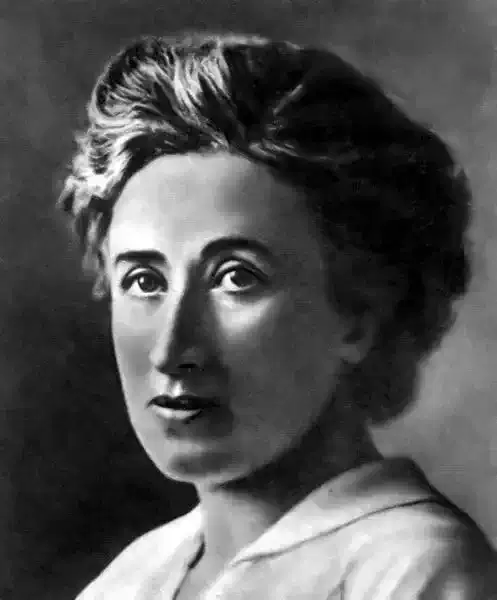
Rosa Luxemburgo
1871–1919
· lived 47 years
 PL
PL
PL
Rosa Luxemburg was a Polish and German Marxist theorist, philosopher, economist, anti-war activist, and revolutionary socialist. A prominent figure in the international socialist movement, she was known for her criticism of capitalism, imperialism, and war, advocating for proletarian revolution and workers' democracy. Although primarily recognized for her political and theoretical work, Luxemburg also produced writings with a strong literary and reflective quality on freedom and the human condition.
n. 1871-03-05, Zamość · m. 1919-01-15, Berlim
39
Views
Bio
Identification and Basic Context
Rosa Luxemburg, birth name Rozalia Luksenburg, was born on March 5, 1871, in Zamość, Poland (then part of the Russian Empire), and was murdered in Berlin, Germany, on January 15, 1919. Of Jewish origin, she was a German citizen of Polish birth and wrote primarily in German.Childhood and Education
Rosa Luxemburg was born into a middle-class Jewish family in Zamość. From an early age, she displayed a sharp intellect and a strong interest in social and political issues. Due to her involvement in clandestine political activities, she was forced to flee Poland and went into exile in Switzerland, where she studied at the University of Zurich, one of the few universities that admitted women at the time. She obtained her doctorate in Political and Economic Sciences in 1897 with a thesis on the industrial development of Poland.Literary Career
Although Rosa Luxemburg is primarily known as a Marxist theorist and political activist, her written work possesses a remarkable literary quality. Her correspondence, articles, and theoretical texts are marked by passionate language, a vigorous style, and a deep capacity for analysis and expression. Her "Junius Pamphlet," written in prison, is an example of political prose that transcends mere analysis to become a powerful call to action and hope.Work, Style, and Literary Characteristics
Rosa Luxemburg's work covers a wide range of themes, including criticism of capitalism and imperialism, analysis of capital accumulation, advocacy for the general strike as a revolutionary tool, and defense of workers' democracy. Among her most important works are "Social Reform or Revolution?" (1899), "The Accumulation of Capital" (1913), and "The Crisis of Social Democracy" (1916), also known as the "Junius Pamphlet." Her style is characterized by clarity, logical argumentation, and passionate, combative rhetoric. Her voice is that of an uncompromising revolutionary, but also of a thinker with a deep humanist concern for the freedom and dignity of workers.Cultural and Historical Context
Rosa Luxemburg lived in a period of intense social and political transformations in Europe, marked by the growth of the labor movement, imperialism, and tensions that would culminate in World War I. She was a central figure in the left wing of the Second International, clashing with other socialist currents, particularly the Bolsheviks, on strategic and theoretical issues. Her stance against the war and her advocacy for a world revolution were significant.Personal Life
Rosa Luxemburg's life was entirely dedicated to the revolutionary cause. She lived most of her life in exile and spent several periods in prison due to her political activities. Her personal relationships were often marked by intensity and the demands of her activism. Despite the difficulties, she maintained a rich and revealing correspondence with friends and comrades, which reveals her vibrant personality and deep humanism.Recognition and Reception
Rosa Luxemburg is internationally recognized as one of the most important theorists and activists of the socialist movement. Her work continues to be studied and debated in academic and activist circles, serving as an indispensable reference for understanding Marxism and the social struggles of the 20th century. Her figure is celebrated as a symbol of the struggle for freedom and against oppression.Influences and Legacy
Rosa Luxemburg was influenced by Karl Marx and Friedrich Engels, but she also developed her own original theories, particularly on capital accumulation and the role of the general strike. Her legacy lies in her radical critique of capitalism and imperialism, her uncompromising defense of democracy and freedom within the labor movement, and her vision of an authentic socialist revolution. She influenced generations of socialists, communists, and activists worldwide.Interpretation and Critical Analysis
Rosa Luxemburg's work is the subject of ongoing study and debate. Her critiques of Bolshevism and her advocacy for a revolution "from below" are central themes in the critical analysis of her work. Her emphasis on the spontaneity of the masses and the relationship between economic and political struggle are frequently highlighted aspects.Curiosities and Lesser-Known Aspects
Beyond her political activity, Rosa Luxemburg had a great appreciation for nature and the arts, as reflected in her correspondence. Her unwavering courage and determination, even in the face of persecution and imprisonment, are notable aspects of her personality.Death and Memory
Rosa Luxemburg was brutally murdered, along with Karl Liebknecht, by far-right militias in Berlin in January 1919, following the suppression of the Spartacist Uprising. Her death marked the end of an era for the revolutionary movement in Germany. Her memory is kept alive by numerous social and political movements that draw inspiration from her ideas and her struggle for social justice and freedom.Poems
0No poems found
Quotes
3Comments (0)
Log in
to post a comment.
No comments yet. Be the first to comment.