
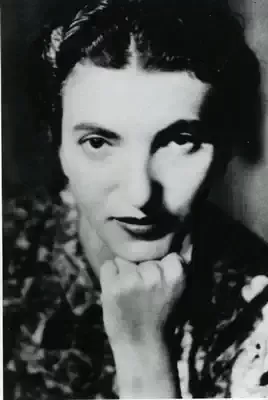
Rose Ausländer
 DE
DE
Rose Ausländer was a poet of Romanian origin who wrote most of her work in German. Her poetry is deeply marked by experiences of exile, loss, and resilience, reflecting her journey through turbulent times and a constant sense of displacement. Her work is characterized by concise yet emotionally charged language and powerful imagery, exploring themes such as memory, identity, hope, and the search for a home. Rose Ausländer sought, through poetry, to find refuge and meaning in a frequently hostile and unstable world, leaving a poetic legacy of great strength and sensitivity.
n. 1901-05-11, Chernivtsi · m. 1988-01-03, Düsseldorf
Bio
Identification and basic context
Rose Ausländer (born Else Kramer) was a German-speaking poet, born in Czernowitz, Bukovina, which then belonged to the Austro-Hungarian Empire and later to Romania. Her life was marked by a prolonged period of exile and the constant search for a home, which is deeply reflected in her work.Childhood and education
Rose Ausländer was born into a German-speaking Jewish family. Her childhood in Czernowitz, a cosmopolitan city with a strong German, Jewish, and Romanian cultural presence, shaped her worldview and sensitivity. She studied philosophy and literature in Vienna and Bucharest, but her education was interrupted and significantly influenced by subsequent historical events, including the rise of Nazism and World War II.Literary career
The beginning of her literary activity dates back to her youth, but international recognition of her work came later in life. Her first publications appeared in literary magazines. Her poetry evolved over time, going through different phases marked by her life experiences, her profound reflection on the human condition, and her relationship with the German language, which she chose as her means of expression, despite it not being her original mother tongue. Her later work is considered her most mature and impactful.Work, style, and literary characteristics
Rose Ausländer's main works include "Wir sind die Letzten" (We are the last, 1957), "Die Abendesschale" (The dinner bowl, 1974), "Schatten und Licht" (Shadows and light, 1976), "Der Weg du selbst" (The path is you, 1979), and "Insel der Freiheit" (Island of freedom, 1981). Dominant themes in her poetry are memory, exile, loss, identity, the search for a home, hope, nature, and transcendence. Her style is characterized by conciseness, imagistic power, and musicality. She frequently uses free verse, with unadorned yet intensely expressive language. The poetic voice is often confessional and marked by melancholy, but also by resilience and hope. She introduced a unique perspective on the experience of exile and fragmented identity.Work, style, and literary characteristics
Cultural and historical context Rose Ausländer lived through a large part of the 20th century, a period of immense historical upheavals, including World War I and World War II, the Holocaust, and the Cold War. Born in a region that changed hands and borders several times, her life was a direct reflection of these instabilities. As a German-speaking Jew, she experienced Nazi persecution and the trauma of the Holocaust, which led her to a long period of exile. She belongs to a generation of writers who explored the depths of the human condition in times of crisis.Work, style, and literary characteristics
Personal life Rose Ausländer had a personal life marked by significant losses, including the death of family members during the Holocaust. She spent many years in exile, living in various countries, including the United States, before returning to Germany. Her experience of displacement and her struggle for survival profoundly shaped her perspective and her writing. She was a fervent advocate for peace and understanding among peoples.Work, style, and literary characteristics
Recognition and reception Although her work was recognized during her lifetime, the great recognition and international dissemination of her work occurred after her death. She received several literary awards, including the Droste-Hülshoff Prize in 1967 and the Georg Büchner Prize in 1980. Her poetry is today studied and admired for its depth and its contribution to the German-language literature.Work, style, and literary characteristics
Influences and legacy Rose Ausländer was influenced by poets such as Rainer Maria Rilke and Else Lasker-Schüler. Her legacy lies in her ability to transform pain and suffering into poetry of rare beauty and strength, addressing the experience of exile and identity in a universal way. She influenced later generations of poets, especially those dealing with themes of memory, identity, and trauma.Work, style, and literary characteristics
Interpretation and critical analysis Rose Ausländer's work is often analyzed from the perspective of the Holocaust experience, exile, and Jewish identity. Her reflections on transience, the search for a place in the world, and the resilience of the human spirit offer profound philosophical and existential insights.Work, style, and literary characteristics
Curiosities and lesser-known aspects A curious aspect of her life is her choice of the German language as her main means of poetic expression, even though she lived in a multicultural region and faced persecution from the regime that used that same language. Her poems often arose from moments of deep contemplation and introspection, even in difficult circumstances.Work, style, and literary characteristics
Death and memory Rose Ausländer passed away in Düsseldorf, Germany. Her works continue to be published and studied, keeping her memory alive through the beauty and depth of her poetry.Poems
0No poems found
Comments (0)
No comments yet. Be the first to comment.