Poems List

Libido

Libido
How should I know? The enormous wheels of will
Drove me cold-eyed on tired and sleepless feet.
Night was void arms and you a phantom still,
And day your far light swaying down the street.
As never fool for love, I starved for you;
My throat was dry and my eyes hot to see.
Your mouth so lying was most heaven in view,
And your remembered smell most agony.
Love wakens love! I felt your hot wrist shiver
And suddenly the mad victory I planned
Flashed real, in your burning bending head. . . .
My conqueror's blood was cool as a deep river
In shadow; and my heart beneath your hand
Quieter than a dead man on a bed.
177

Jolly Company, The

Jolly Company, The
The stars, a jolly company,
I envied, straying late and lonely;
And cried upon their revelry:
"O white companionship! You only
In love, in faith unbroken dwell,
Friends radiant and inseparable!"
Light-heart and glad they seemed to me
And merry comrades (EVEN SO
GOD OUT OF HEAVEN MAY LAUGH TO SEE
THE HAPPY CROWDS; AND NEVER KNOW
THAT IN HIS LONE OBSCURE DISTRESS
EACH WALKETH IN A WILDERNESS).
But I, remembering, pitied well
And loved them, who, with lonely light,
In empty infinite spaces dwell,
Disconsolate. For, all the night,
I heard the thin gnat-voices cry,
Star to faint star, across the sky.
217

IV. The Dead

IV. The Dead
These hearts were woven of human joys and cares,
Washed marvellously with sorrow, swift to mirth.
The years had given them kindness. Dawn was theirs,
And sunset, and the colours of the earth.
These had seen movement, and heard music; known
Slumber and waking; loved; gone proudly friended;
Felt the quick stir of wonder; sat alone;
Touched flowers and furs and cheeks. All this is ended.
There are waters blown by changing winds to laughter
And lit by the rich skies, all day. And after,
Frost, with a gesture, stays the waves that dance
And wandering loveliness. He leaves a white
Unbroken glory, a gathered radiance,
A width, a shining peace, under the night.
239

III. The Dead

III. The Dead
Blow out, you bugles, over the rich Dead!
There's none of these so lonely and poor of old,
But, dying, has made us rarer gifts than gold.
These laid the world away; poured out the red
Sweet wine of youth; gave up the years to be
Of work and joy, and that unhoped serene,
That men call age; and those who would have been,
Their sons, they gave, their immortality.
Blow, bugles, blow! They brought us, for our dearth,
Holiness, lacked so long, and Love, and Pain.
Honour has come back, as a king, to earth,
And paid his subjects with a royal wage;
And Nobleness walks in our ways again;
And we have come into our heritage.
214

Hill, The

Hill, The
Breathless, we flung us on the windy hill,
Laughed in the sun, and kissed the lovely grass.
You said, "Through glory and ecstasy we pass;
Wind, sun, and earth remain, the birds sing still,
When we are old, are old. . . ." "And when we die
All's over that is ours; and life burns on
Through other lovers, other lips," said I,
-- "Heart of my heart, our heaven is now, is won!"
"We are Earth's best, that learnt her lesson here.
Life is our cry. We have kept the faith!" we said;
"We shall go down with unreluctant tread
Rose-crowned into the darkness!" . . . Proud we were,
And laughed, that had such brave true things to say.
-- And then you suddenly cried, and turned away.
184

I. Peace

I. Peace
Now, God be thanked Who has matched us with His hour,
And caught our youth, and wakened us from sleeping,
With hand made sure, clear eye, and sharpened power,
To turn, as swimmers into cleanness leaping,
Glad from a world grown old and cold and weary,
Leave the sick hearts that honour could not move,
And half-men, and their dirty songs and dreary,
And all the little emptiness of love!
Oh! we, who have known shame, we have found release there,
Where there's no ill, no grief, but sleep has mending,
Naught broken save this body, lost but breath;
Nothing to shake the laughing heart's long peace there
But only agony, and that has ending;
And the worst friend and enemy is but Death.

183

He Wonders Whether To Praise Or To Blame Her

He Wonders Whether To Praise Or To Blame Her
I have peace to weigh your worth, now all is over,
But if to praise or blame you, cannot say.
For, who decries the loved, decries the lover;
Yet what man lauds the thing he's thrown away?
Be you, in truth, this dull, slight, cloudy naught,
The more fool I, so great a fool to adore;
But if you're that high goddess once I thought,
The more your godhead is, I lose the more.
Dear fool, pity the fool who thought you clever!
Dear wisdom, do not mock the fool that missed you!
Most fair, -- the blind has lost your face for ever!
Most foul, -- how could I see you while I kissed you?
So . . . the poor love of fools and blind I've proved you,
For, foul or lovely, 'twas a fool that loved you.
191

Hauntings

Hauntings
In the grey tumult of these after years
Oft silence falls; the incessant wranglers part;
And less-than-echoes of remembered tears
Hush all the loud confusion of the heart;
And a shade, through the toss'd ranks of mirth and crying
Hungers, and pains, and each dull passionate mood, --
Quite lost, and all but all forgot, undying,
Comes back the ecstasy of your quietude.
So a poor ghost, beside his misty streams,
Is haunted by strange doubts, evasive dreams,
Hints of a pre-Lethean life, of men,
Stars, rocks, and flesh, things unintelligible,
And light on waving grass, he knows not when,
And feet that ran, but where, he cannot tell.
181

Goddess In The Wood, The

Goddess In The Wood, The
In a flowered dell the Lady Venus stood,
Amazed with sorrow. Down the morning one
Far golden horn in the gold of trees and sun
Rang out; and held; and died. . . . She thought the wood
Grew quieter. Wing, and leaf, and pool of light
Forgot to dance. Dumb lay the unfalling stream;
Life one eternal instant rose in dream
Clear out of time, poised on a golden height. . . .
Till a swift terror broke the abrupt hour.
The gold waves purled amidst the green above her;
And a bird sang. With one sharp-taken breath,
By sunlit branches and unshaken flower,
The immortal limbs flashed to the human lover,
And the immortal eyes to look on death.
189

Flight

Flight
Voices out of the shade that cried,
And long noon in the hot calm places,
And children's play by the wayside,
And country eyes, and quiet faces --
All these were round my steady paces.
Those that I could have loved went by me;
Cool gardened homes slept in the sun;
I heard the whisper of water nigh me,
Saw hands that beckoned, shone, were gone
In the green and gold. And I went on.
For if my echoing footfall slept,
Soon a far whispering there'd be
Of a little lonely wind that crept
From tree to tree, and distantly
Followed me, followed me. . . .
But the blue vaporous end of day
Brought peace, and pursuit baffled quite,
Where between pine-woods dipped the way.
I turned, slipped in and out of sight.
I trod as quiet as the night.
The pine-boles kept perpetual hush;
And in the boughs wind never swirled.
I found a flowering lowly bush,
And bowed, slid in, and sighed and curled,
Hidden at rest from all the world.
Safe! I was safe, and glad, I knew!
Yet -- with cold heart and cold wet brows
I lay. And the dark fell. . . . There grew
Meward a sound of shaken boughs;
And ceased, above my intricate house;
And silence, silence, silence found me. . . .
I felt the unfaltering movement creep
Among the leaves. They shed around me
Calm clouds of scent, that I did weep;
And stroked my face. I fell asleep.
186

Comments (0)

Log in to post a comment.

NoComments

Identification and basic context

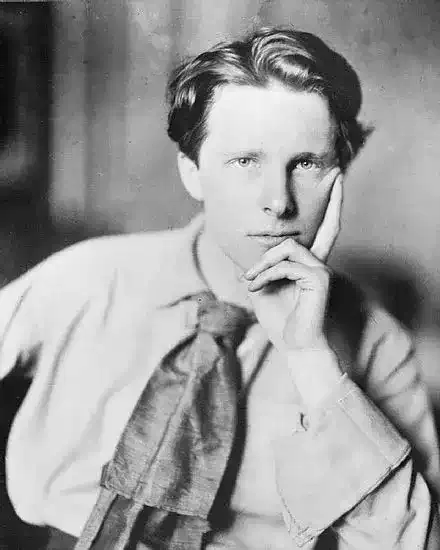
Rupert Chawner Brooke was an English poet, often considered to be the most distinguished poet of the Georgian era.

Childhood and education

Born into a well-to-do family, Brooke received a comprehensive education, first at Rugby School and then at King's College, Cambridge, where he was a member of the Apostles. His early life was marked by intellectual pursuits and friendships with prominent literary figures.

Literary trajectory

Brooke's poetic career, though short, gained significant traction during World War I. His sonnets, particularly "1914," captured the public imagination with their patriotic fervor and romanticized view of war. He was associated with the Georgian poets, a group that favored traditional forms and themes.

Works, style, and literary characteristics

Brooke is best known for his war sonnets, including "The Soldier." His style is lyrical, elegant, and often employs traditional forms like the sonnet. His poetry frequently explores themes of love, beauty, England, and the perceived glory of dying for one's country. His language is accessible and his imagery often draws from nature.

Cultural and historical context

Brooke lived during a period of significant social and political change, culminating in World War I. His work resonated with the prevailing patriotic sentiment in Britain at the beginning of the conflict. He was part of a literary circle that included figures like Virginia Woolf and D.H. Lawrence.

Personal life

Brooke had complex personal relationships, including romantic involvements that influenced his poetry. He was known for his striking good looks and charismatic personality. His experiences traveling and living abroad also informed his worldview.

Recognition and reception

Brooke achieved immense posthumous fame, largely due to his heroic image and his famous war poems. He became a symbol of lost youth and patriotic sacrifice, though later critical assessments have sometimes debated the sincerity and depth of his war poetry.

Influences and legacy

Brooke was influenced by classical poets and contemporary writers. His legacy is tied to his idealized vision of warfare and his status as a war poet. He inspired a generation with his patriotic verses, even as his artistic merit has been subject to later re-evaluation.

Interpretation and critical analysis

Brooke's poetry is often interpreted as embodying a youthful, idealistic patriotism. Critics have debated whether his work represents genuine belief or a romanticized, almost naive, response to the realities of war. His lyrical qualities are generally admired, but his thematic depth has been questioned.

Curiosities and lesser-known aspects

Brooke's personal life was the subject of much fascination, with details of his relationships and friendships often discussed. His involvement in unconventional lifestyles and his charismatic presence contributed to his legendary status.

Death and memory

Rupert Brooke died of an infected mosquito bite on April 23, 1915, while en route to Gallipoli. He was buried on the Greek island of Skyros, and his death was widely mourned, solidifying his image as a fallen hero of World War I. His poems were published posthumously, further cementing his fame.