
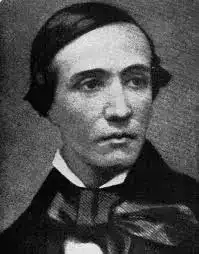
Sousândrade
 BR
BR
Luís Xavier de Jesus Sousândrade was a Brazilian poet and journalist, notable for his work which stands out for its originality, strong influence of French poetry, and social and political themes. His poetry is marked by intense lyricism, exploration of themes such as love, homeland, and the human condition, as well as a critical view of the society of his time. Considered a precursor of modernism in Brazil, Sousândrade introduced formal and thematic innovations in his work, breaking with the literary conventions of his time. His life, marked by travels and political and social engagement, was reflected in poetry that sought to express the anxieties and aspirations of his time, with a rich and innovative language that makes him a unique figure in Brazilian literature.
n. 1833-07-09, Guimarães · m. 1902-04-21, São Luís
Bio
Identification and basic context
Luís Xavier de Jesus Sousândrade was a Brazilian poet and journalist. He was born in Alcântara, Maranhão, on July 4, 1833, and died in Rio de Janeiro on July 12, 1902. He mainly used his own name in his publications. Coming from a wealthy family, he had access to a privileged education and a conducive cultural environment. His nationality was Brazilian, and his writing language was Portuguese. He lived in a period of great transformations in Brazil, with the transition from the Empire to the Republic, and in a context of growing European influence.Childhood and education
Sousândrade had a childhood and youth marked by formal education and contact with European culture. He studied in schools in Rio de Janeiro and, later, in Coimbra, Portugal, where he pursued Medicine. His intellectual training was broad, absorbing influences from the literature, philosophy, and sciences of the time. He traveled extensively through Europe, which broadened his worldview and cultural repertoire.Literary career
Sousândrade's literary career began with the publication of his first poems in newspapers and magazines. His most important poetic work, 'O Guesa', was published in parts, with the first part in 1878 and the second in 1886. He also worked as a journalist, writing in various periodicals, and as a translator. His literary production, although not voluminous, is considered highly original and a harbinger of modernism in Brazil, with its formal and thematic rupture.Work, style, and literary characteristics
Sousândrade's most emblematic work is the epic poem 'O Guesa', which narrates the saga of an indigenous warrior and addresses themes such as national identity, the history of Brazil, and the human condition. Other important works include the novel 'O Coro dos Contrabandistas' and the poetry book 'Paris – Rio de Janeiro'. His style is characterized by formal experimentation, the use of free verse, and bold, innovative language. He incorporated elements of orality and popular culture, while demonstrating a deep familiarity with French poetry, especially with the Parnassians and Symbolists. His central themes include love, homeland, freedom, social justice, and criticism of the hypocrisy of bourgeois society. The poetic voice of Sousândrade is often intense, passionate, and engaged, reflecting his political and social convictions. His language is rich in imagery, metaphors, and neologisms, which gives his poetry a unique sonority and expressive density.Work, style, and literary characteristics
Cultural and historical context Sousândrade lived in a period of intense changes in Brazil, culminating in the Abolition of Slavery and the Proclamation of the Republic. He actively participated in the intellectual debate of his time, defending progressive ideas and criticizing existing social structures. His work dialogues with the context of the Second Reign and the transition to the Republic, reflecting the tensions and aspirations for the country's modernization. He was in contact with various literary and intellectual circles, both in Brazil and Europe.Work, style, and literary characteristics
Personal life Sousândrade had an intense personal life marked by travels and significant affective relationships, which were often reflected in his poetry. He was also involved in political and social issues, which led to some conflicts. His profession as a journalist and his work in public bodies complemented his life.Work, style, and literary characteristics
Recognition and reception Sousândrade's recognition as one of the precursors of Brazilian modernism occurred mainly posthumously. During his life, his innovative work was not always understood and appreciated by conservative criticism. However, his importance for the renewal of Brazilian poetry is now widely recognized, and he is considered a fundamental author for understanding the transition from Romanticism to Modernism.Work, style, and literary characteristics
Influences and legacy Sousândrade was influenced by French poets such as Victor Hugo, Baudelaire, and Verlaine, as well as by the tradition of Brazilian poetry. He, in turn, influenced later generations of poets, especially the modernists, with his formal and thematic boldness. His legacy is that of an innovative poet who anticipated many of the achievements of 20th-century poetry in Brazil, opening new paths for poetic expression.Work, style, and literary characteristics
Interpretation and critical analysis Sousândrade's work is rich in interpretations, being frequently analyzed from the perspective of national identity, social criticism, and the search for an autonomous poetic language. 'O Guesa' is seen as a modern epic that reinterprets the history of Brazil from a critical and humanistic perspective. The complexity of his language and the depth of his themes generate constant academic debates.Work, style, and literary characteristics
Curiosities and lesser-known aspects A curiosity about Sousândrade is his strong connection with the city of Alcântara, his birthplace, which served as inspiration for many of his writings. He was also known for his strong temperament and uncompromising convictions.Work, style, and literary characteristics
Death and memory Luís Xavier de Jesus Sousândrade died in Rio de Janeiro in 1902 from tuberculosis. His death, although not widely reported at the time, marked the end of a life dedicated to art and thought. Posthumous publications and the recovery of his work by critics and scholars have ensured his perpetuity in Brazilian literary memory.Poems
0No poems found
Comments (0)
No comments yet. Be the first to comment.