
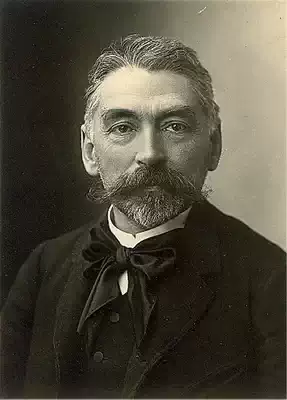
Stéphane Mallarmé
1842–1898
· lived 56 years
 FR
FR
FR
Stéphane Mallarmé was a French poet and critic, a central figure of literary symbolism. His work is known for its complexity, musicality, and for the pursuit of a poetic language that transcended everyday reality, aiming to create an absolute "book." His influence extends throughout modern poetry, impacting movements like surrealism and concrete poetry.
n. 1842-03-18, Paris · m. 1898-09-09, Fontainebleau
596
Views
Bio
Identification and Basic Context
Stéphane Mallarmé (full name: Étienne Mallarmé) was born in France. He was a French poet and literary critic, considered one of the most important figures of symbolism. His work is marked by linguistic experimentation and the pursuit of a pure and autonomous poetic expression, profoundly influencing modern poetry.Childhood and Education
Mallarmé was born into a family of civil servants. His childhood was marked by the early loss of his mother. He received a regular academic education, but it was through self-taught reading and contact with the Parisian literary circle that he developed his poetic style and thought.Literary Career
The beginning of his literary activity occurred in his youth, with the publication of his first poems and critiques. Throughout his career, he evolved towards an increasingly hermetic and musical poetry, seeking to unravel the mysteries of existence through language. He collaborated in various literary magazines, being a respected critic.Work, Style, and Literary Characteristics
His most famous works include "L'Après-midi d'un faune" (The Afternoon of a Faun) and "Un coup de dés jamais n'abolira le hasard" (A Throw of Dice Will Never Abolish Chance). The central themes of his poetry explore the nature of language, the relationship between the real and the ideal, solitude, and the mystery of creation. His style is characterized by symbolic density, musicality, the use of complex metaphors, and formal experimentation, including free verse and the graphic arrangement of verses. Mallarmé sought to create a "pure poetry," separate from mere communication or direct personal expression, directly influencing symbolism and paving the way for modernism.Cultural and Historical Context
Mallarmé lived in a period of great social and cultural transformations in France, including the development of symbolism as a reaction to realism and Parnassianism. He was a central figure in Parisian literary salons, where he received and debated with artists and writers of various generations, such as Verlaine, Rimbaud, and Verlaine.Personal Life
He was an English teacher, which provided him with financial stability to dedicate himself to poetry. He married and had children. His personal life, though marked by a certain intellectual reclusion, was also a space for intense reflection on art and the human condition.Recognition and Reception
Although he did not achieve massive popularity during his lifetime, his recognition within literary circles was immense. His work was seen as the culmination of symbolism and as a starting point for new poetic explorations, being studied and admired by later generations of poets and critics.Influences and Legacy
Mallarmé was influenced by poets such as Baudelaire and Edgar Allan Poe. His legacy is immense, having influenced poets such as Paul Valéry, Rainer Maria Rilke, T.S. Eliot, and the Surrealists. He is considered one of the fathers of modern poetry, with his emphasis on the autonomy of poetic language and the exploration of its potential.Interpretation and Critical Analysis
Mallarmé's work is the subject of constant critical debate due to its complexity and hermeticism. Interpretations range from philosophical readings on language and being to formal analyses of his metrical and graphic innovations.Curiosities and Lesser-Known Aspects
Mallarmé was known for his "mardis" (Tuesdays), gatherings at his home where literature and art were debated. His pursuit of poetic perfection led him to repeatedly revise and rewrite his poems.Death and Memory
He died in France. His work continued to be published and to be the object of study and admiration, consolidating his place as one of the greatest poets in the French language.Poems
0No poems found
Quotes
8Comments (0)
Log in
to post a comment.
No comments yet. Be the first to comment.