
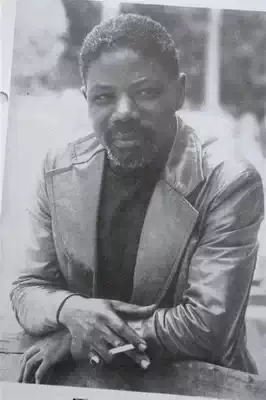
Tchicaya U Tam'si
1931–1988
· lived 56 years
 CG
CG
CG
Constantin Mutombo Mukenge, better known as Tchicaya U Tam'si, was a Congolese poet, novelist, and playwright. His work, written in French, is marked by a profound exploration of African identity, the post-colonial condition, spirituality, and the complexities of the relationship between man and the cosmos. Tchicaya U Tam'si is considered one of the greatest African poets of French expression, whose voice resonates with strength and originality.
n. 1931-08-25, Kouilou · m. 1988-04-22, Bazancourt
31
Views
Bio
Identification and basic context
Constantin Mutombo Mukenge, literary pseudonym Tchicaya U Tam'si, was born in Makakou, French Congo (present-day Republic of the Congo), on November 17, 1931. He was a poet, novelist, and playwright. He died in Antony, France, on April 25, 1988. His work is written in French and is intrinsically linked to his Congolese identity and African experience.Childhood and education
Of noble family origin in his ethnicity, Tchicaya U Tam'si received a formal education in the Congo and, subsequently, in France, where he studied Law and Political Science. These studies contributed to his critical view of society and politics. Readings of Symbolist and Surrealist poets, as well as the rich African oral tradition, were significant influences in his youth.Literary career
Tchicaya U Tam'si began his literary career in the 1950s, publishing his first work, the novel "Le Zébu et le Mort", in 1955. Poetry quickly became the genre in which he excelled most. His work evolved into an increasingly profound exploration of issues of identity, spirituality, and the relationship between the African continent and the West. He published in various literary magazines and actively participated in Francophone intellectual circles.Work, style, and literary characteristics
Among his most important poetic works are "Cahier de Brûlé" (1960), "Le Probleme des Objets" (1963), "L'Arc Musical" (1970), and "Comme une ombre toutes mes dents" (1980). His poetry addresses themes such as ancestry, critique of colonialism, the search for an authentic African identity, sexuality, death, and the relationship with the divine. Tchicaya U Tam'si's style is characterized by imagistic density, musicality, and the fusion of elements from African culture (myths, rituals, language) with Western poetic tradition. He frequently uses free verse, but with a strong rhythm and striking sonority. His poetic voice is simultaneously personal, ancestral, and universal, challenging traditional categories. He is associated with the Négritude movement, but transcends its boundaries with a unique and innovative approach.Cultural and historical context
He lived during a period of intense decolonization in Africa and cultural effervescence in African and Francophone intellectual circles. His work reflects the tensions and dilemmas of African identity in the contemporary world, criticizing the colonial legacy and seeking the affirmation of unique cultural values. He was friends with other African writers and maintained dialogue with intellectuals of the time.Personal life
His life was marked by a strong connection to his African roots, but also by an immersion in the European intellectual world. He was married and had children. His experience as an African in Europe profoundly influenced his worldview and his writing.Recognition and reception
Tchicaya U Tam'si is widely recognized as one of the foremost African poets of French expression. His work has received awards and distinctions, being studied in universities and admired for its originality and depth.Influences and legacy
He was influenced by poets such as Rimbaud and Baudelaire, but developed a unique voice that integrated African influences. His work has influenced later generations of African and diaspora poets, consolidating his place in the African and world literary canon. His poems have been translated into several languages.Interpretation and critical analysis
Tchicaya U Tam'si's work is rich in symbolism and allows for diverse readings, exploring existential, philosophical, and political questions. His analyses often focus on the duality between the West and Africa, the modern and the ancestral.Curiosities and lesser-known aspects
His given name, Mutombo Mukenge, means "stone messenger" in Tshiluba, which many see as a premonition of his literary vocation. His pseudonym "U Tam'si" is a reference to an ancestor.Death and memory
Tchicaya U Tam'si passed away prematurely, leaving a valuable poetic legacy. His work continues to be celebrated and studied, ensuring his memory and relevance to African and universal literature.Poems
0No poems found
Comments (0)
Log in
to post a comment.
No comments yet. Be the first to comment.