
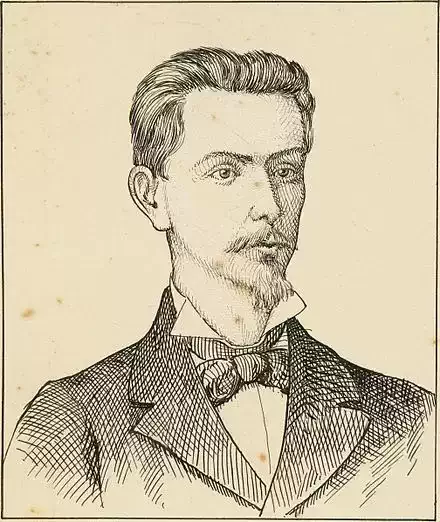
Teófilo Dias
1854–1889
· lived 34 years
 BR
BR
BR
Teófilo Dias was a 19th-century Brazilian poet, known for his participation in the Parnassian movement. His poetry is marked by the pursuit of formal perfection, objectivity, and themes inspired by classical and historical subjects. His work reflects the Parnassian ideal of "art for art's sake," with great attention to meter, rhyme, and erudite vocabulary, seeking beauty in form and meticulous description, which established him as an important representative of this literary school in Brazil.
n. 1854-11-08, Caxias · m. 1889-03-29, São Paulo
33
Views
Bio
Identification and basic context
Teófilo de Almeida Dias was a Brazilian poet, born in Minas Gerais in 1852 and died in Rio de Janeiro in 1877. He used only his full name for literary identification. He was Brazilian and wrote in Portuguese.Childhood and education
Born into a traditional Minas Gerais family, Teófilo Dias had access to a good education. He studied Law in Rio de Janeiro, where he came into contact with the intellectual circles of the time, which brought him closer to new literary currents.Literary career
Teófilo Dias emerged as one of the most promising representatives of Parnassianism in Brazil. He began his poetic production at a young age, demonstrating a great command of classical forms from early on. His work, although relatively short due to his premature death, left a significant mark on Brazilian poetry.Work, style, and literary characteristics
Teófilo Dias's work is predominantly found in his only collection published during his lifetime, "Primitivas" (1871), and in scattered poems. His central themes include classical mythology, history, idealized nature, and reflections on art. His style is markedly Parnassian, with great formal rigor: use of sonnets, precise meter, rich rhymes, and an erudite and careful vocabulary. His poetry values objectivity, detailed description, and the pursuit of beauty in form, aligning with the principle of "art for art's sake."Cultural and historical context
Teófilo Dias lived in a period of transition for Brazil, with the Second Reign underway and discussions about the abolition of slavery gaining strength. In the literary scene, Romanticism was giving way to Realism and Parnassianism. He belongs to the latter movement, which sought aesthetic renewal in opposition to the sentimental excesses of Romanticism.Personal life
Little is known about Teófilo Dias's personal life beyond his academic and literary trajectory. His life was marked by youth and premature death, which limits knowledge about affective relationships or deep personal conflicts.Recognition and reception
In his time, Teófilo Dias was recognized as a promising talent of Parnassianism, admired for his technical mastery and the purity of his poetic forms. Despite his short career, his work continued to be valued by critics and scholars for his aesthetic contribution to the movement.Influences and legacy
Teófilo Dias was influenced by French Parnassian poets, such as Théophile Gautier and Leconte de Lisle. His legacy lies in the consolidation of Parnassianism in Brazil, with his poetry serving as an example for the pursuit of formal perfection and thematic objectivity. Although his name may not be as popular as that of other poets, his importance within the Parnassian canon is undeniable.Interpretation and critical analysis
Critical analysis of Teófilo Dias's work focuses on his adherence to Parnassian precepts, highlighting his formal excellence and classical themes. Some critics point to the coldness or emotional distance in his poetry, an inherent characteristic of the movement's aesthetic proposal.Curiosities and lesser-known aspects
A curious aspect is the precocity with which Teófilo Dias published "Primitivas," a book that already demonstrated technical and stylistic maturity for such a young poet. His premature death deprived Brazilian literature of a promising continuator of Parnassianism.Death and memory
Teófilo Dias died in 1877, at the age of 25, in Rio de Janeiro, victim of tuberculosis. His premature death interrupted a literary career that promised great development. The memory of Teófilo Dias is maintained through the study of his work, considered an important milestone of Brazilian Parnassianism.Poems
0No poems found
Comments (0)
Log in
to post a comment.
No comments yet. Be the first to comment.